
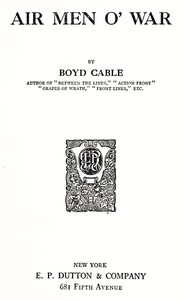
Air Men o' War by Boyd Cable
Published in 1918, while World War I was still raging, Boyd Cable’s Air Men o' War is a collection of short stories that captures the birth of aerial combat. Cable wrote these tales based on real accounts from pilots, aiming to bring the war in the air home to the public. The book doesn’t follow one character, but instead gives us snapshots of different pilots and crews in the Royal Flying Corps.
The Story
There’s no single plot. Each chapter is a self-contained adventure. One story might follow a rookie pilot on his first, terrifying patrol over enemy lines, trying not to get lost or shot down. Another drops you into a desperate dogfight, where survival depends on split-second decisions and a bit of luck. You’ll read about reconnaissance missions where the goal is to snap photos of enemy trenches while dodging anti-aircraft fire, and bombing runs where the success of ground troops hinges on what happens in the sky. The stories are short, fast-paced, and almost always end with a return to the muddy airfield—if the pilot is lucky.
Why You Should Read It
What grabbed me was the absolute immediacy of it all. Cable isn’t interested in grand strategy; he’s focused on the moment. You feel the physical strain of flying these primitive machines, the numbing cold at high altitude, and the constant, gnawing fear. The characters aren’t deeply fleshed-out in a modern novel sense—they’re more like the guy next door who found himself in an impossible job. But that’s the point. It makes their courage and skill feel real, not like a superhero myth. The book is a powerful reminder that these ‘knights of the air’ were often just kids in over their heads, making history one shaky flight at a time.
Final Verdict
This is a perfect pick for anyone curious about early aviation or wanting a human-scale view of World War I. It’s not a technical manual or a sweeping historical epic. It’s a gripping, ground-level (or rather, sky-level) look at fear, duty, and ingenuity. If you enjoy adventure stories, historical firsthand accounts, or tales of human endurance, you’ll get a lot out of this. Just be ready for some old-fashioned language and attitudes—it’s a product of its time—but the heart of the experience is timeless.
There are no legal restrictions on this material. Enjoy reading and sharing without restrictions.







Matthew Miller
8 months agoThe digital formatting makes it very easy to navigate.