
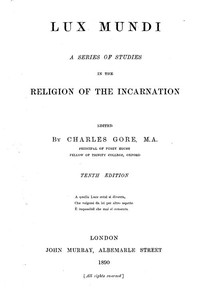
Lux Mundi: A Series of Studies in the Religion of the Incarnation, by Charles Gore
First things first: this isn't a beach read. Lux Mundi is a serious, collaborative work of theology published in 1889. Edited by a young Charles Gore, it features essays from a group of Oxford thinkers often called the "Lux Mundi school." They were steeped in tradition but couldn't ignore the world changing around them.
The Story
There's no plot in the usual sense. Instead, imagine a team of experts taking apart a complex machine—in this case, traditional Anglican Christian belief—to see how it works and if it can be updated. Each chapter tackles a big question from a new angle. How do we understand the Bible if it's not a simple history or science book? What does Christ's life mean in light of Darwin's theories of evolution? Can faith be both intellectually honest and spiritually deep? The writers didn't throw out old doctrines. Instead, they tried to reinterpret them, using ideas like development and progress, to show that faith could engage with modern thought rather than run from it. The central idea holding it all together is the Incarnation—the belief that God entered human history in Jesus—which they saw as the key to understanding everything else.
Why You Should Read It
I found it fascinating as a snapshot of a specific kind of intellectual courage. These writers weren't radicals looking to burn things down; they were insiders who loved their tradition enough to risk changing how they talked about it. You can feel the tension on every page—the sincere belief clashing with the need to address doubt and new knowledge. It's less about finding definitive answers and more about watching a live, thoughtful struggle. For me, the most compelling parts were about reconciling faith with science and rethinking how to read sacred texts. It shows that the debates we think are so modern have very deep roots.
Final Verdict
This book is perfect for history lovers, theology nerds, or anyone curious about how religions adapt (or try to adapt) to seismic cultural shifts. If you've ever wondered how people of faith dealt with the challenges of the modern world at the dawn of the 20th century, this is a primary source. It's not an easy read—the language is dense and Victorian—but it's a rewarding one if you're interested in the history of ideas. You won't find characters or a narrative, but you will find the passionate, anxious, and hopeful voices of thinkers at a crossroads.
Legal analysis indicates this work is in the public domain. Access is open to everyone around the world.
Ashley King
1 year agoAfter finishing this book, the storytelling feels authentic and emotionally grounded. Highly recommended.
James Clark
1 year agoEnjoyed every page.
Kenneth Robinson
1 year agoGreat read!
Steven Jackson
1 year agoVery helpful, thanks.





David Garcia
9 months agoThe balance between academic rigor and readability is perfect.