
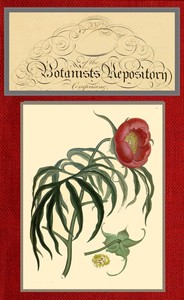
The botanist's repository for new and rare plants; vol. 08 [of 10] by Andrews
Let's be clear from the start: this is not a storybook. You won't find a plot with characters and a climax. Instead, Henry Andrews's 'The Botanist's Repository' is a different kind of adventure. It's a detailed, volume-by-volume record of rare and newly discovered plants, mostly from Australia and South Africa, that were flooding into England in the early 1800s. Volume 8 is a snapshot of that moment.
The Story
The 'story' here is the journey of the plants themselves. Each entry follows a simple but powerful pattern: a breathtaking, hand-colored engraving of a flower or shrub, followed by Andrews's careful notes. He tells you where it came from, who discovered it, what it looks like, and how it grows. But between the lines, you can feel the bigger drama. These plants were trophies of empire and exploration, often ripped from their native soil. Andrews's work was to document them, classify them, and—most importantly—make that knowledge available to other gardeners and scientists, not just the elite few who could afford the real thing.
Why You Should Read It
I love this book for its quiet urgency. Looking at these plates, you're seeing the first time many of these species were ever illustrated for a Western audience. There's a palpable sense of wonder and responsibility. Andrews isn't just making a pretty book; he's building an ark on paper. In an age before photography, these illustrations were
Final Verdict
This is a niche read, but a deeply rewarding one. It's perfect for gardeners with a historical bent, for art lovers fascinated by scientific illustration, or for anyone who enjoys 'slow' media that rewards close attention. It's not a page-turner; it's a book to sip and savor, one stunning plate at a time. Think of it as a museum visit for your coffee table, a chance to time-travel to the roots of modern botany and witness the birth of our global garden.
Kimberly Williams
1 year agoAfter finishing this book, it creates a vivid world that you simply do not want to leave. Exactly what I needed.
Kimberly Hill
11 months agoBased on the summary, I decided to read it and the content flows smoothly from one chapter to the next. I will read more from this author.
Logan Smith
1 year agoSolid story.
Susan Scott
1 year agoI didn't expect much, but it challenges the reader's perspective in an intellectual way. Definitely a 5-star read.







Barbara Torres
11 months agoFive stars!