
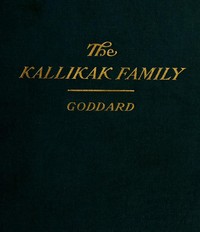
The Kallikak Family: A Study in the Heredity of Feeble-Mindedness by Goddard
Let's set the scene: It's the early 1900s, and people are scrambling to explain poverty, crime, and social disorder. Enter psychologist Henry Goddard. He gets his hands on the story of Martin Kallikak, a Revolutionary War soldier. According to Goddard, Martin had a brief relationship with a barmaid he considered 'feeble-minded,' then later married a 'worthy' Quaker woman. Goddard tracks down the descendants of both lines.
The Story
The book is built on this stark contrast. On one side, the descendants of Martin and his wife are doctors, lawyers, and upstanding citizens—Goddard's 'good' Kallikaks. On the other, the descendants from the barmaid are presented as a catalog of social ills: alcoholics, criminals, sex workers, and people institutionalized. Goddard uses photos, family trees, and anecdotal reports to argue that 'feeble-mindedness' is a hereditary unit, passed down like eye color, and is the root cause of these social problems. He presents it as a clear-cut case study, a scientific mystery solved.
Why You Should Read It
You don't read this book for its scientific accuracy—we know now its methods were terrible and its core premise wrong. You read it as a historical object. It's chilling to see how prejudice was dressed up as science. Goddard's certainty is breathtaking. He never questions his own assumptions or the biased way he collected his 'data.' Reading his confident conclusions today feels like watching a train wreck in slow motion, knowing this kind of thinking led to forced sterilizations and immigration bans. It makes you acutely aware of how stories we tell about 'good' and 'bad' blood can have real, devastating consequences.
Final Verdict
This isn't a book for casual entertainment. It's for anyone interested in the history of psychology, the dark side of the Progressive Era, or the origins of harmful social policies. It's a crucial, if uncomfortable, primary source. Read it to understand how a seemingly academic study could capture the public imagination and fuel injustice. Pair it with a modern critique to get the full picture. It's a stark reminder to always question who gets to define 'fitness' and what stories we accept as truth.
Nancy Jackson
11 months agoThis is one of those stories where the pacing is just right, keeping you engaged. Don't hesitate to start reading.
Jackson Hill
11 months agoI didn't expect much, but the depth of research presented here is truly commendable. A valuable addition to my collection.
Brian Scott
1 year agoI started reading out of curiosity and it creates a vivid world that you simply do not want to leave. Thanks for sharing this review.
Linda Nguyen
3 weeks agoI stumbled upon this title and the narrative structure is incredibly compelling. Exceeded all my expectations.







Jennifer White
5 months agoI started reading out of curiosity and the pacing is just right, keeping you engaged. Highly recommended.