
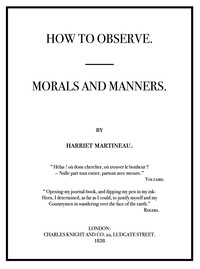
How to Observe: Morals and Manners by Harriet Martineau
Published in 1838, How to Observe: Morals and Manners isn't a novel or a travelogue in the usual sense. Harriet Martineau wrote it as the first volume in a series meant to guide British travelers. But she immediately flips the script. She argues that to understand a country, you must ignore the official tour and study its people—their daily habits, their unspoken rules, their casual conversations.
The Story
There's no traditional plot here. Instead, Martineau lays out a method. She walks you through what to look for. Don't just visit a church; notice who goes and how they behave. Don't just admire a factory; watch how the workers interact. She breaks society down into areas like domestic life, education, and class interaction, giving pointed questions to ask yourself in each. The 'conflict' is the observer's own prejudice against the reality in front of them. The goal is to move past snap judgments and see the underlying moral framework of a place, which she believes is revealed in its manners—the little things people do without thinking.
Why You Should Read It
This book is a quiet revolution. Martineau, writing in an era when women were rarely taken seriously as social scientists, insists that the 'soft' details of life are the key to hard truths. Her voice is confident, clear, and often witty. She scolds lazy travelers who come home with only complaints about foreign food. Reading her feels like getting advice from the most perceptive friend you've ever had. It turns every coffee shop visit or subway ride into a field study. You start seeing the 'manners' of your own office, your own family, and wondering what 'morals' they point to. It’s anthropology before the field even had a name, and it’s deeply human.
Final Verdict
Perfect for curious people who love history, travel, or just understanding others better. If you enjoy authors like Sarah Bakewell who make big ideas feel personal, you'll connect with Martineau. It’s also a fascinating piece of history, showing how a woman carved out intellectual space for herself. Fair warning: it's a 19th-century book, so the pace is thoughtful and some references are dated. But the core idea—that truth is in the details of daily life—feels incredibly fresh. Pick this up if you want to become a better observer of the world right outside your door.
There are no legal restrictions on this material. Knowledge should be free and accessible.
Mason Lewis
10 months agoComprehensive and well-researched.
Sandra Hill
2 years agoIf you enjoy this genre, the atmosphere created is totally immersive. I will read more from this author.
Margaret Smith
1 year agoCitation worthy content.
Joseph Thomas
7 months agoHigh quality edition, very readable.







Brian Williams
1 year agoHonestly, the character development leaves a lasting impact. Absolutely essential reading.