
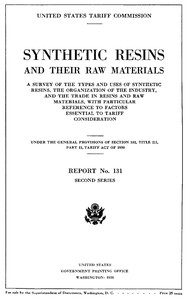
Synthetic resins and their raw materials by United States Tariff Commission
Let's be clear upfront: this is not a novel. There are no characters, unless you count chemicals like phenol and formaldehyde. Published in 1922, this is a formal report from a U.S. government commission. Its job was straightforward: investigate the young synthetic resin industry in America. The 'plot' is the commission's fact-finding mission. They looked at what raw materials we had, what we needed to import, how much things cost, and what tariffs (taxes on imports) might help American companies compete.
The Story
The story is one of national self-reliance. After World War I, the U.S. realized it was dangerously dependent on German chemical giants for advanced materials. This report maps the entire landscape of a brand-new industry. It's a snapshot of invention in progress. You get lists of factories, descriptions of processes for making early plastics and lacquers, and pages of data on prices and production volumes. The narrative tension comes from the quiet urgency of the question: Can we build this here, from the ground up?
Why You Should Read It
You should read it for the profound sense of context it provides. It’s easy to take the plastic world around us for granted. This document shows the moment when it was still a conscious, fragile project. There’s something fascinating about the plain language describing these revolutionary materials. The report doesn't get excited; it just states facts. But in those facts, you see the scaffolding for the 20th century being erected. It turns something invisible—the industrial policy behind everyday objects—into a tangible, page-by-page process.
Final Verdict
This is a niche read, but a powerful one. It's perfect for history buffs who love primary sources, for science and industry geeks who want to see the origins of modern chemistry, or for any curious reader who enjoys looking at the world and asking, 'How did this actually get started?' Don't expect a thrilling page-turner. Do expect to come away with a completely new appreciation for the stuff that makes up our world. Think of it as the ultimate 'special features' documentary for the age of plastic.
This publication is available for unrestricted use. It is now common property for all to enjoy.
Elizabeth Jones
4 months agoA sophisticated analysis that fills a gap in the literature.
Mary Gonzalez
1 month agoIt took me a while to process the complex ideas here, but the formatting on mobile devices is surprisingly crisp and clear. It definitely lives up to the reputation of the publisher.
Richard Moore
1 year agoAs a long-time follower of this subject matter, the cross-referencing of different chapters makes it a great study tool. I appreciate the effort that went into this curation.
Charles Miller
4 months agoThe digital index is well-organized, making research much faster.








Sarah Williams
11 months agoI was particularly interested in the case studies mentioned here, the argument presented in the middle section is particularly compelling. Finally, a source that prioritizes accuracy over hype.