
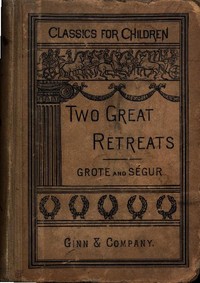
The Two Great Retreats of History by George Grote and comte de Philippe-Paul Ségur
This book is a fascinating, and frankly chilling, two-part look at military catastrophe. It binds together two epic failures separated by over two thousand years.
The Story
The first half covers the Retreat of the Ten Thousand, as told by the ancient historian Xenophon. After a Persian prince is killed, his army of Greek mercenaries is stranded deep in enemy territory. They have to fight their way home across hundreds of miles of hostile land, with no supplies and no friends.
The second half is where the book gets really personal. Comte de Ségur, a French general, gives us his firsthand account of Napoleon's retreat from Moscow in 1812. We follow the once-mighty Grande Armée as it disintegrates. The real enemy isn't the Russian army, but the winter. Men freeze solid by the roadside. Horses become food. Discipline vanishes. It's a slow-motion collapse of an empire, seen from the muddy, frozen ground level.
Why You Should Read It
What makes this special is the perspective. Ségur isn't a distant historian analyzing maps. He was in the snow, he felt the hunger, he saw the chaos. His writing has a raw, immediate quality that textbooks lack. You get the fear and confusion of the moment. Putting his story next to the ancient Greek one creates a powerful pattern. It shows that no matter how advanced an army is, the basics—logistics, weather, morale—can destroy it. The generals might be different, but the soldier's suffering is tragically similar. It's a sobering reminder of the human cost behind the grand strategies.
Final Verdict
This is perfect for anyone who enjoys real-life adventure stories or deep dives into historical turning points. It's for readers who want to look beyond the dates and battles to understand the experience of the people who lived through them. Be warned, it's not a cheerful read—it's often grim and unsettling. But if you're interested in leadership, survival, and the limits of human endurance, this dual account is absolutely gripping. You won't look at a map of Russia or read about ancient Greece the same way again.
This work has been identified as being free of known copyright restrictions. You are welcome to share this with anyone.
Christopher Perez
8 months agoThe methodology used in this work is academically sound.
George Martinez
1 year agoIt took me a while to process the complex ideas here, but the author manages to bridge the gap between theory and practice effectively. This has become my go-to guide for this specific topic.
Michael Davis
1 year agoThe fonts used are very comfortable for long reading sessions.
Mark Martinez
1 year agoFinally a version with clear text and no errors.

Christopher Perez
7 months agoUnlike many other resources I've purchased before, it addresses the common misconceptions in a very professional manner. I feel much more confident in my knowledge after finishing this.