
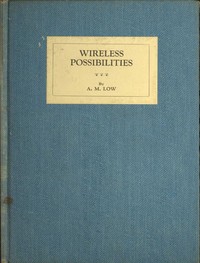
Wireless Possibilities by A. M. Low
I picked up this little yellowed book expecting a purely technical manual—maybe something with dusty diagrams and equations for building an 8-foot antenna. Boy, was I wrong. A. M. Low actually sounded like that brilliant, talkative uncle who rants, not just about knobs and tubes, but about the enormous burden and promise that came with spitting words into the air.
The Story
The book treats radio—or “wireless”—like a brand-new wonder, like if the internet fell from the sky yesterday. Low explains the basics—transmitters, receivers, how sound hangs out in a wave, even how to set up backyard broadcasts. So *technically*, the plot is about solving the problem: how can ordinary people (and governments and businesses) grab this thing?
But the unsaid story, the brilliant mystery, comes from the shoulders of history: Low worries that all this connection—public airwaves, home radio—will slip into profit and control before civilians can truly claim it. The subtext: what happens when people understand the technology? And what happens when they don’t?
Why You Should Read It
Don’t get me wrong—you don’t need to solder copper wire to find gold here. For me, the best part was feeling like I was eavesdropping on the initial great argument about what to do with a world that hears everyone in its room. Low still believed that making a ham radio set from a fruit crate + copper coil could make you a player in the global village. He felt this total geeky joy about it, like “you could *personally* know something your government didn’t.” I think today, in our subscription-service world, that homespun power stance is sugar coming off the page.
The moral crisis of the book: is infinite audio doom civilization? Or will it make actual one-world citizens? The debate pushed me to examine how I use screens—a pure mind trip under a history-speaker's charisma.
Final Verdict
Definitely read this if you like books that mix biography of technology with classic tinkering spirit. It is crazy perfect for: (1) hobbyists and DIY folk who don't mind rooting for obsolete guts. (2) Any big picture fan wondering how modern media came with all its broken promises. (3) You should pick it up if you like to wake someone at 2 a.m. because you just built a tank out of scrap bicycles. Basically if the ghost of Jules Verne moved in next to Tom Sawyer and a college science fair—read A. M. Low.
Don’t enter expecting a literary masterpiece; come for the 100 percent, un-ironic hope from the early-electronic frontier. The words sound so alive, they almost crackle with leftover static. One strong title that deserved shelf life beyond our nostalgia.
This masterpiece is free from copyright limitations. Knowledge should be free and accessible.
Sarah Garcia
10 months agoIf you're tired of surface-level information, the transition between theoretical knowledge and practical application is seamless. I feel much more confident in my knowledge after finishing this.
Matthew Moore
11 months agoThe clarity of the introduction set high expectations, and the way the author breaks down the core concepts is remarkably clear. A mandatory read for anyone in this industry.
Karen Thompson
4 months agoSolid information without the usual fluff.
Margaret Martin
2 years agoI've gone through the entire material twice now, and the footnotes provide extra depth for those who want to dig deeper. A mandatory read for anyone in this industry.



Sarah Lee
4 weeks agoOne of the most comprehensive guides I've read this year.