1

A Treatise on Tobacco, Tea, Coffee, and Chocolate — A Closer Reading
(0 User reviews)
611
Project Gutenberg
2016
Not confirmed
Chocolate -- Early works to 1800; Tobacco -- Early works to 1800; Tea -- Early works to 1800; Coffee -- Early works to 1800
Readers of public-domain and historical texts
Project Gutenberg digital edition
en
Edition facts
Words
39,813
Reading time
174 min
Text sections
6
For A Treatise on Tobacco, Tea, Coffee, and Chocolate — A Closer Reading, the stored edition analysis reports 39,813 words, 2 hr 54 min estimated reading time, and 6 detected text sections.
The text analysis averages about 38.0 words per sentence, while the detected sections provide another way to judge how the source is divided.
Project Gutenberg metadata also associates the work with “Chocolate -- Early works to 1800,” connecting these edition facts with the source record’s subject description.
Source:
Project Gutenberg record #53027
This 1746 translation of Simon Paulli's medical treatise examines tobacco, tea, coffee, and chocolate through early modern chemistry and observation, arguing that Chinese tea is the European shrub Chamelaeagnus and detailing preparation methods to correct intoxicating qualities.
Editorial Edition Score
4.7/5
★★★★★
★★★★★
Calculated from edition completeness, EPUB availability, text structure and catalogue metadata. Not a user rating.
How this score is calculated
- Description quality20 pts
- Title & short description10 pts
- Source metadata20 pts
- Text length15 pts
- Chapters / structure15 pts
- EPUB file integrity20 pts
Total of 100 points, scaled to a 2.5-5.0 range. Editions with an empty description or a missing EPUB file are not scored.
Edition quality
Read the Text
_Tobacco_, _Tea_, _Coffee_, and _Chocolate_.
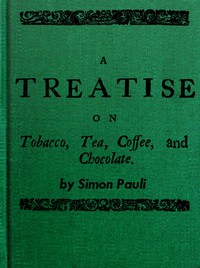
TOBACCO, TEA, COFFEE, _and_ CHOCOLATE.
I. The Advantages and Disadvantages attending the Use of these Commodities, are not only impartially considered, upon the Principles of _Medicine_ and _Chymistry_, but also ascertained by _Observation_ and _Experience_.
II. Full and distinct Directions laid down for knowing in what Cases, and for what particular Constitutions, these Substances are either beneficial, or hurtful.
III. The _Chinese_ or _Asiatic Tea_, shewn to be the same with the _European Chamelæagnus_, or _Myrtus Brabantica_.
_The Whole Illustrated with_ COPPER PLATES, _exhibiting the_ Tea _Utensils of the_ Chinese _and_ Persians.
Written originally by SIMON PAULI;
Now Translated by Dr. _JAMES_.
_Ante omnia scire convenit Naturam Corporis; quia alii graciles, alii obesi sunt, alii calidi, alii frigidiores, alii humidi, alii sicciores, alios adstricta, alios resoluta, alvus exercet._
Celsus, _Lib. 1._ _Cap. 3._
Printed for T. OSBORNE, in _Gray's Inn_; J. HILDYARD, at _York_; M. BRYSON, at _Newcastle_; and J. LEAKE, at _Bath_.
As _Nicolaus Monardus_, in _Simpl. Med. Histor._ has given so full and accurate an History and Description of _Tobacco_, that others have only borrowed their Accounts of it from his Works, we shall, in the Words of that Author, in _Cap. 14_, inform the Reader what _Tobacco_ is, where it is produced, and to what Uses it is applied.
"The Plant _Tobacco_, says he, was formerly used by the _Indians_, and especially by the Inhabitants of _New Spain_, for the Cure of Wounds. A few Years ago it was imported into _Spain_, rather for the Decoration of Gardens, than on Account of its medicinal Virtues: But it is now more celebrated for the latter, than used for the former.
"This Plant is among the _Indians_ called _Picelt_; for the _Spaniards_ first called it _Tobacco_ from a certain Island of that Name, where great Quantities of it were produced.
"It rises to a great Height, and is sometimes as tall as the _Lemon-Tree_. Its Trunk is strait, and sends out many large Branches, which bear Leaves almost resembling those of the _Lemon-Tree_, but larger, like those of the _Burdock_, of a faint green Colour, and a little rough and shaggy, as the Whole of the Plant is. The Tops of the Branches bear Flowers of the Shape of a small Bell, which are white at the Extremities, but of a purple Colour in the Middle; and when these Flowers fall off, they are succeeded by small Heads, which resemble those of the _Black Poppy_, and contain a very small cineritious blackish Seed. The Root is thick, divided into many Parts, internally of a ligneous or woody Nature, Saffron-coloured, bitter, and easily deprived of its Bark: But I am acquainted with no medicinal or other Quality of which it is possessed.
"The Plant grows in most Places of the _Indies_, and especially those of a moist and shady Nature, and in light well cultivated Soils: It may be sown at all Seasons; but when it appears above Ground it is to be preserved from the Cold, and may be transplanted for the Decoration of Garden-Walls; for, like the _Citron-Tree_, it continues green through the whole Year.
"The Leaves are only used; though when these cannot be had, some use the Seeds in their Stead. The Leaves are preserved by passing a Thread through them, suspending them in a shady Place, and thus drying them, after which they are used either whole or reduced to Powder.
"_Tobacco_ is hot and dry, and consequently heats, resolves, cleanses, and is a little astringent, as will appear from these following Virtues, of which it is possessed.
"The Leaves of _Tobacco_ heated and applied, prove an excellent Remedy for a _Cephalæa_, and _Hemicrania_, provided these Disorders arise from a cold Cause, or Flatulences, but the Use of them is to be often repeated, till the Disease is removed. Some, before the Application of them, anoint the Head with the Oil obtained from the Flowers of the _Orange-Tree_. The same Remedy is beneficial for a Rigidity of the Neck or _Tetanus_, and for Pains of the whole Body, arising from the same Cause.
"When a Tooth-ach proceeds from a cold Cause, the wiping the affected Tooth with a Linen-Cloth, soaked in the Juice of _Tobacco_, and then putting a Piece of the Leaf, made up in Form of a Pill, into the Hollow, not only removes the Pain, but also prevents the spreading of the Corruption.
Simon Paulli's treatise, translated by Dr. James in 1746, opens by grounding its analysis in the authority of Nicolaus Monardus, whose history of tobacco is deemed so complete that later writers merely borrowed from it. The work immediately establishes a method: it will consider each substance's advantages and disadvantages impartially, based on medical and chemical principles, and will offer specific guidance for different constitutions. The translator's preface and the title page's Latin epigraph from Celsus—stressing the need to know the body's nature—signal that this is a practical, not merely theoretical, text.
Borrowing from Authorities, Observing Plants
The treatise's opening section on tobacco relies heavily on Monardus, quoting his description of the plant's height, leaves like those of the lemon tree but larger, and bell-shaped flowers white at the tips and purple within. Paulli does not claim firsthand observation of tobacco in the New World; instead, he presents Monardus's account as the foundation. This reliance on earlier authorities recurs throughout, as when he later cites Galen on correcting drastic qualities by boiling, roasting, or maceration. The reader should note how the text weaves together classical medical sources, Renaissance natural history, and chemical experiments conducted in the laboratory.
The Central Argument: Tea as Chamelaeagnus
A striking feature of the treatise is its sustained argument that Chinese tea is identical to the European shrub Chamelaeagnus (also called Myrtus Brabantica). Paulli supports this by comparing the customs of Tartars and Chinese: the Tartars, he claims, are addicted to drunkenness yet robust, and they likely toast their Cha (tea) to correct its intoxicating quality. He then describes how the Chinese gather leaves in spring, not summer, and macerate them in warm water without boiling, lest the virtues be lost. The reasoning is grounded in chemical theory—sulphureous parts are easily exhaled—and in analogies to rhubarb and senna, which lose their purgative qualities when toasted or boiled.
Experiments and the Nature of Sulphur
Paulli reports a laboratory experiment in which he kindled Chamelaeagnus together with its seeds. The material did not burn suddenly like juniper but slowly like beech, with noises or explosions, filling the room with an acrid smell resembling beech twigs. From this he infers a large quantity of sulphur and volatile salt. He also compares the intoxicating effect to that of rue, wormwood, garlic, and laurel, each containing sulphur of varying volatility. These passages reveal the author's method: chemical experiment, comparative plant analysis, and deduction about how preparation methods (toasting, maceration) alter a substance's effects on the brain.
Practical Directions and the Reader's Constitution
The title page promises full directions for knowing in what cases these substances are beneficial or hurtful, and the excerpts show Paulli delivering on that promise. He advises that Europeans should imitate the Chinese by using only spring-gathered leaves of Chamelaeagnus, not the shrub itself, flowers, or seeds boiled in ale. The intoxicating quality, he argues, comes from the seeds' sulphur; if seeds are removed, intoxication would be less likely. The reader is thus guided not only by theory but by specific, actionable instructions. The text's structure—moving from plant description to chemical analysis to practical regimen—reflects its aim to serve both the learned physician and the lay consumer.
Readers approaching this treatise for the first time will benefit from tracking how Paulli moves between ancient authority, personal experiment, and dietary advice. The work is not a neutral survey but a polemical intervention, arguing for a specific botanical identity and preparation method. Pay attention to the recurring emphasis on sulphur and volatile salts, as these concepts underpin his judgments about each substance's effects. The copper plates mentioned on the title page, though not excerpted here, would likely illustrate the tea utensils of the Chinese and Persians, grounding the argument in material culture.
Reading about Simon Paulli's careful corrections to tobacco's intoxicating effects, I found myself thinking of another earnest guide from that era—one that likewise sought to tame harmful excess by demystifying natural urges. That book, Sane Sex Life and Sane Sex Living Some Things That All Sane People Ought to Know About Sex Nature and Sex Functioning; Its Place in the Economy of Life, Its Proper — A Closer Reading, shares the same quiet faith that knowledge, plainly stated, can settle a restless body.
There are no reviews for this eBook.
There are no comments for this eBook.
Reader reflection
How will you remember this book?
Save your reaction, strongest insight, and memorable passage.
Your progress
0
/
10
2
Was reading this book enjoyable?
3
Would you pass this book on to a friend?
4
Did the language feel accessible?
5
What did you think about the pace?
6
Did the book give you something worth debating?
7
How well did it match your expectations?
8
Could you see yourself revisiting this book?
9
Which lesson or insight stayed with you?
10