1

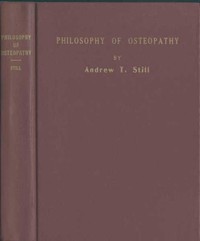
Philosophy of Osteopathy — Key Ideas to Explore
(0 User reviews)
432
Project Gutenberg
2008
Not confirmed
Osteopathic medicine
Readers of public-domain and historical texts
Project Gutenberg digital edition
en
Edition facts
Words
63,492
Reading time
277 min
Text sections
7
For Philosophy of Osteopathy — Key Ideas to Explore, the stored edition analysis reports 63,492 words, 4 hr 37 min estimated reading time, and 7 detected text sections.
The text analysis averages about 25.9 words per sentence, while the detected sections provide another way to judge how the source is divided.
Project Gutenberg metadata also associates the work with “Osteopathic medicine,” connecting these edition facts with the source record’s subject description.
Source:
Project Gutenberg record #25864
A.T. Still's 1899 founding text of osteopathy, structured as a series of exploratory chapters that move from anatomical principles to disease-specific reasoning, using recurring imagery of machinery, rivers, and the body as a self-sufficient engine.
Editorial Edition Score
4.7/5
★★★★★
★★★★★
Calculated from edition completeness, EPUB availability, text structure and catalogue metadata. Not a user rating.
How this score is calculated
- Description quality20 pts
- Title & short description10 pts
- Source metadata20 pts
- Text length15 pts
- Chapters / structure15 pts
- EPUB file integrity20 pts
Total of 100 points, scaled to a 2.5-5.0 range. Editions with an empty description or a missing EPUB file are not scored.
Edition quality
Read the Text
SOME INTRODUCTORY REMARKS.
Not a Work of Compilation--Authors Quoted--Method of Reasoning--The Osteopath an Artist--When I Became an Osteopath--Dr. Neal's Opinion--The Opinions of Others--What Studies Necessary--What I Mean by Anatomy--Principles--The Practicing Osteopath's Guide--The Fascia--Not a pleasing Task--Without Accepted Theories--Truths of Nature--Body, Motion and Mind--Osteopathy to Cure Disease--The Osteopath Should Find Health. Page 11
OSTEOPATHIC EXPLORATIONS.
Divisions of the Body--Searching for the Cause--Duty of the Osteopathic Explorer--Classification and Division--The Abnormal--Nerve Powers--Witnesses to Examine--Abnormal Growths--Cerebro Spinal Fluid--Body in Perfect Health--Chemistry--Nature's Chemistry. Page 29
A Free Circulation--Death Blows--Something of the Neck--Order of Treatment--The Pelvis--Brains of Animals--Arterial Motion--Mental Vibrations--Overburdening the Mind--Hemiplegia. Page 43
EAR WAX AND ITS USES.
Nature Makes Nothing in Vain--A Successful Experiment--A Question for Ages--The Position--Meaning of Life--Some Questions Asked--Condition in Certain Diseases Caused by Cold--Cerumen in Fluid State--Winter Kills Babies--Some Advice to Mothers--A Case in Point--Connection of the brain and Other Nerves in Digestion--Unaided Investigation. Page 53
DISEASES OF THE CHEST.
Where Confined--Consumption--Can Consumption Be Cured--Consumption Described--No Time for Surrender--Cerebral Spinal Fluid--How to Destroy Deadly Bombs of Decay--Battle of Blood for Life--Miliary Tuberculosis--Conversion of Bodies Into Gas--Forming a Tubercle--Breeding Contagion--The Seeds of Disease--Generating Fever--Whooping Cough--Clouds and Lungs Are Much Alike--The Wisdom of Nature--Water Formed in Lungs--The Law of Fives--Feeble Action of Heart--The Heart--From Neck to Heart--Dyspersia or Imperfect Digestion. Page 68
Importance of the Subject--Demands of Nature on the Lymphatics--Dunglinson's Definition--Dangers of Dead Substances--Lymph Continued--Solvent in Nature--Where Are the Lymphatics Situated?--The Fat and Lean. Page 104
Investigation--A Struggle With Nature--Lesson of Cause and Effect--Something of Medical Etiquette--The Medical Doctor--An Explorer for Truth Must Be Independent--The Diaphragm Introduced--A Useful Study--Combatting Effect--Is Least Understood--A Case of Bilious Fever--A Demand on the Nerves--Danger of Compression--A Cause for Disease--Was a Mistake Made in the Creation--An Exploration--Result of Removal of Diaphragm--Sustaining Life in Principles--Law Applicable to Other Organs--Power of Diaphragm--Omentum. Page 114
LIVER, BOWELS AND KIDNEYS.
Gender of the Liver--Productions of the Liver--A Hope for the Afflicted--Evidences of Truth--Loaded With Ignorance--Lack of Knowledge of the Kidney--How a Purgative Acts--Flux--Bloody Dysentery--Flux More Fully Described--Osteopathic Remedies--Medical Remedies--More of the Osteopathic Remedy. Page 138
Uses for Fluids--Blood an Unknown Fluid--Harvey Only Reached the Banks of the River of Life--Blood Is Systematically Furnished--Fatality of Ignorance--To Find the Cause Must Be Honest--Following Arteries and Nerves--Feeding the Nerves--The Blood on Its Journey--Powers Necessary to Move Blood--Venous Blood Suspended. Page 149
Where Is Disease Sown?--An Illustration of Conception--The Greatest Problem--A Fountain of Supply--Fascia Omnipresent--Connection with Spinal Cord--Goes With and Covers All Muscles--Proofs in Contagion--Study of Nerves and Fascia--Tumefy--Tumefaction. Page 161
Be Armed With Facts--Union of Human Gases With Oxygen--Fever and Nettle-rash. Nature Constructs for a Wise Purpose--Processes of Life Must be Kept in Motion--No Satisfaction from Authors--Animal Heat--Semeiology--Symptomatology--Definition of Fever--Fevers only Effects--Result of Stoppages of Vein or Artery--Aneurisms. Page 175
SCARLET FEVER AND SMALLPOX.
As defined by Allopathy--Scarlet Fever as Defined by Osteopathy--Smallpox--Power to Drive Greater Than in Measles. Page 190
A CHAPTER OF WONDERS AND SOME VALUABLE QUESTIONS.
Wonders on the Increase--What Is Life?--How Is Action Produced--Acquaint Yourself With the Machinery--Duty of the Osteopath--Formation of Sacrum--The Pelvis--Appearance of OEdema--Do All Diseases Have Appearance in OEdema. Page 193
The Advent of Man--Care of the Stock Raiser--Mental Degeneration Makes It Unpleasant for an Original Thinker--Original Thinkers of the Ancients--Methods of Healing--Failure of Allopathy--Primitive Man--Evidences of Prehistoric Man--Mental Dwarfage. Page 203
OSTEOPATHIC TREATMENT.
Five Points--Visceral List--Care in Treating the Spinal Column--Most Important Chapter--Perfect Drainage--A Natural Cure. Page 213
The Vermiform Appendix--Operating for Appendicitis--Expelling Power of the Vermiform Appendix--Care Exercised in Making Assertions--Reasoning Tests--A List of Unexplained Diseases--Concluding Remarks. Page 223
Overloading--Similarity of Stomach and Womb--Births--Preparation for Delivery--Caution--Lasceration Need Not Occur--Care of Cord--Severing Cord--Putting on Belly Band--Delivery of Afterbirth--Preparing for Mother's Comfort--Post-Delivery Hemorrhage--Treatment for--Food for Mother--Treatment for Sore Breast. Page 234
Old Phrases--Results of Stoppage of Fluids--Old Theory of Fits--What the Real Cause may be--Listen for the Cause--What is a Fit--Sensory System Demanding Nourishment--The Causes--The Remedy--Dislocation of Atlas and of the Four Upper Ribs. Page 250
Thoughts for Consideration--Offering a New Philosophy--Lymphatics and Fascia--A Satisfactory Experiment--Natural Washing Out. Page 258
THE SUPERIOR CERVICAL GANGLION.
With What It Has Communication--Its Course--One of its Functions--Stimulation or Inhibition--Result Produced. Page 263
Philosophy of Osteopathy.
SOME INTRODUCTORY REMARKS.
Not a Work of Compilation--Authors Quoted--Method of Reasoning--The Osteopath an Artist--When I Became an Osteopath--Dr. Neal's Opinion--The Opinions of Others--What Studies Necessary--What I Mean by Anatomy--Principles--The Practicing Osteopath's Guide--The Fascia--Not a Pleasing Task--Without Accepted Theories--Truths of Nature--Body, Motion and Mind--Osteopathy to Cure Disease--The Osteopath Should Find Health.
NOT A WORK OF COMPILATION.
Andrew Taylor Still's Philosophy of Osteopathy (1899) opens with a striking declaration: the book is not a compilation of medical authorities but a personal treatise written "in my own way." Still frames osteopathy as a science still in its infancy, comparing it to "a great unknown sea just discovered." The structure of the work reflects this exploratory stance: each chapter proceeds as a kind of anatomical and philosophical investigation, moving from general principles to specific diseases. Still repeatedly returns to the image of the body as a machine—a "machinery" whose parts must be in proper alignment for health. This mechanical metaphor, drawn from his background as a frontier physician and inventor, governs both the book's argument and its rhetorical movement.
A Philosophy of Self-Sufficient Anatomy
Still's central claim is that the body contains within itself all the resources needed to cure disease. He writes that the osteopath should "find health" rather than treat symptoms. This principle is expressed through a series of analogies: the fascia is described as a system of rivers and canals, the nerves as telegraph lines, and the bones as levers. The book's structure mirrors this belief: each chapter isolates a part of the body—the liver, the kidney, the bowels—and then shows how its proper function depends on unobstructed mechanical relationships. Still is careful to note what he does not know, confessing ignorance about the kidney's role in producing teeth or hair. This humility is part of his rhetorical strategy: by admitting limits, he clears space for a new system of reasoning based on anatomy rather than pharmacology.
The Body as a Hydraulic and Mechanical System
Recurring images of flow and obstruction structure Still's explanations. He describes the lymphatics as a "system of salivation" that washes out impurities, and veins as channels that must remain open for blood to return to the heart. In his discussion of flux (bloody dysentery), he asks whether irritation of sensory nerves causes veins to contract and block circulation. The question is typical: Still always traces disease back to a mechanical failure—a nerve impingement, a blocked vessel, a misaligned bone. His language is concrete and often vivid: the liver is "loaded down with ignorance," the kidney a "wonder" beyond conjecture. These metaphors are not decorative; they are the scaffolding of his argument that the body's health depends on unobstructed physical pathways.
Movement Between General Principle and Specific Case
The book alternates between broad philosophical statements and detailed clinical descriptions. Still begins with principles—"I do not instruct the student to punch or pull a certain bone"—then moves to specific diseases like flux, where he narrates the progression of symptoms from "tiresome feeling" to collapse and death. This movement is deliberate: the general principle (find and remove obstruction) is tested against a concrete case. The structure of each chapter follows a similar arc: a declaration of ignorance or wonder, a mechanical explanation, and a practical question for the osteopath. The effect is that of a lecture or demonstration, with Still guiding the reader from abstraction to application. The book's seven chapters are not rigidly separated; ideas recur and build across sections.
Rhetoric of Opposition and Independence
Still positions his work in explicit opposition to drug-based medicine. He states that the book "is free from quotations from medical authors" and expects it will not meet their approval. This adversarial stance shapes the book's structure: each positive claim about osteopathy is also a negative claim about allopathy. Still's description of how a purgative acts—poisons taken up by secretions, then washed out by salivation—is framed as a correction to conventional understanding. The recurring image of the body as a self-sufficient machine is itself a polemical tool: if the body can heal itself when properly aligned, then drugs are unnecessary. This rhetorical opposition gives the book a combative energy, but it also limits its scope: Still does not engage with competing theories on their own terms, preferring to assert his principles as self-evident truths derived from nature.
Readers approaching Philosophy of Osteopathy should attend to the way Still uses repetition and variation. The same mechanical metaphors recur, but each time they are applied to a different organ or disease, building a cumulative argument. The book is not a systematic textbook but a series of meditations on a single idea: that the body's structure determines its health. Still's prose is direct and sometimes abrupt, reflecting the haste he acknowledges in the preface. This is a work meant to be argued with, not passively absorbed.
Leafing through Still’s Philosophy of Osteopathy, his talk of the body as a sturdy, self-correcting engine reminded me of an old shelf of Victorian pamphlets. There’s a similar faith in hidden mechanisms, in remedies that promise to set things right quietly. It’s odd how two very different books can share that same earnest, hopeful shiver. That’s what Secret remedies — Themes and Context brought back to me.
There are no reviews for this eBook.
There are no comments for this eBook.
Reader reflection
What was your reading experience?
Capture what you thought, learned, and would like to remember.
Your progress
0
/
10
2
What was your overall reaction to the book?
3
Would you recommend this book to another reader?
4
What was the reading difficulty like?
5
How original did the book feel?
6
Did it raise ideas you would like to talk about?
7
How clearly were the main ideas presented?
8
Did the book meet your expectations?
9
Which lesson or insight stayed with you?
10