1

Body-snatching — Key Ideas to Explore
(0 User reviews)
536
Project Gutenberg
2022
Not confirmed
Surgery; Anatomy; Body snatching
Readers of public-domain and historical texts
Project Gutenberg digital edition
en
Edition facts
Words
21,725
Reading time
95 min
Text sections
2
The catalog record for Body-snatching — Key Ideas to Explore provides practical reading context through 21,725 words, 1 hr 35 min estimated reading time, and 2 detected text sections.
The text analysis averages about 33.1 words per sentence, while the detected sections provide another way to judge how the source is divided.
Project Gutenberg metadata also associates the work with “Surgery,” connecting these edition facts with the source record’s subject description.
Source:
Project Gutenberg record #69167
An anonymous 1824 pamphlet reprinting a Westminster Review article, arguing that public ignorance of anatomy hinders medical progress and that body-snatching for dissection is a necessary evil, tracing historical prejudices against dissection from ancient to modern times.
Editorial Edition Score
4.6/5
★★★★★
★★★★★
Calculated from edition completeness, EPUB availability, text structure and catalogue metadata. Not a user rating.
How this score is calculated
- Description quality20 pts
- Title & short description10 pts
- Source metadata20 pts
- Text length15 pts
- Chapters / structure15 pts
- EPUB file integrity20 pts
Total of 100 points, scaled to a 2.5-5.0 range. Editions with an empty description or a missing EPUB file are not scored.
Edition quality
Read the Text
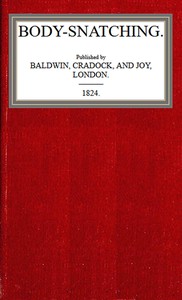
BALDWIN, CRADOCK, AND JOY,
T. C. HANSARD, Pater-noster-row Press.
The following pages are reprinted, with some modification, from the third Number of the Westminster Review. They treat of a subject on which it is of great importance that the public should be well informed, and it is in order to facilitate the circulation of the knowledge which they communicate respecting it, that the proprietors of the above-mentioned work have liberally consented to the re-publication of this article in the form of a pamphlet.
Every one desires to live as long as he can. Every one values health “above all gold and treasure.” Every one knows that, as far as his own individual good is concerned, protracted life and a frame of body sound and strong, free from the thousand pains which flesh is heir to, are unspeakably more important than all other objects, because life and health must be secured before any possible result of any possible circumstance can be of consequence to him. In the improvement of the art which has for its object the preservation of health and life, every individual is, therefore, deeply interested. An enlightened physician and a skilful surgeon, are in the daily habit of administering to their fellow men more real and unquestionable good, than is communicated, or communicable by any other class of human beings to another. Ignorant physicians and surgeons are the most deadly enemies of the community: the plague itself is not so destructive: its ravages are at distant intervals, and are accompanied with open and alarming notice of its purpose and power; theirs are constant, silent, secret; and it is while they are looked up to as saviours, with the confidence of hope, that they give speed to the progress of disease and certainty to the stroke of death.
It is deeply to be lamented that the community, in general, are so entirely ignorant of all that relates to the art and the science of medicine. An explanation of the functions of the animal economy; of their most common and important deviations from a healthy state; of the remedies best adapted to restore them to a sound condition, and of the mode in which they operate, as far as that is known, ought to form a part of every course of liberal education. The profound ignorance of the people on all these subjects is attended with many disadvantages to themselves, and operates unfavourably on the medical character. In consequence of this want of information, persons neither know what are the attainments of the man in whose hands they place their life, nor what they ought to be; they can neither form an opinion of the course of education which it is incumbent upon him to follow, nor judge of the success with which he has availed himself of the means of knowledge which have been afforded him. There is one branch of medical education in particular, the foundation, in fact, on which the whole superstructure must be raised, the necessity of which is not commonly understood, but which requires only to be stated to be perceived. Perhaps it is impossible to name any one subject which it is of more importance that the community should understand. It is one in which every man’s life is deeply implicated: it is one on which every man’s ignorance or information will have some influence. We shall therefore, show the kind of knowledge which it is indispensable that the physician and the surgeon should possess: we shall illustrate, by a reference to particular cases, the reason why knowledge of this kind cannot be dispensed with: and we shall explain, by a statement of facts, the nature and extent of the obstacles which at present oppose the acquisition of this knowledge. We repeat, there is no subject in which every reader can be so immediately and deeply interested, and we trust that he will give us his calm and unprejudiced attention.
The basis of all medical and surgical knowledge is anatomy. Not a single step can be made either in medicine or surgery, considered either as an art or a science, without it. This should seem self-evident, and to need neither proof nor illustration: nevertheless as it is useful occasionally to contemplate the evidence of important truth, we shall show why it is that there can be no rational medicine, and no safe surgery, without a thorough knowledge of anatomy.
Disease, which it is the object of these arts to prevent and to cure, is denoted by disordered function: disordered function cannot be understood without a knowledge of healthy function; healthy function cannot be understood without a knowledge of structure; structure cannot be understood unless it be examined.
The pamphlet opens with a blunt assertion: 'EVERY one desires to live as long as he can.' From this universal premise, the anonymous author builds a case that public ignorance of medicine is a deadly problem. The text, reprinted from the Westminster Review, adopts a polemical tone, contrasting the 'real and unquestionable good' done by skilled physicians with the silent, secret destruction wrought by ignorant ones—'the plague itself is not so destructive.' The author insists that understanding the functions of the animal economy should be part of a liberal education, and that without it, patients cannot judge their doctors' competence.
A Rhetoric of Urgency and Contrast
The author’s diction is consistently urgent and binary. Ignorant physicians are 'the most deadly enemies of the community,' their harm 'constant, silent, secret'—a triplet that drives home the insidious threat. In contrast, enlightened practitioners are described in superlatives: they administer 'more real and unquestionable good' than any other class. This rhetorical strategy frames the entire argument as a matter of life and death, leaving little room for nuance. The opening paragraph’s shift from individual desire for longevity to collective danger is swift, achieved through short, declarative sentences and a repeated 'every one' that universalizes the stakes.
Historical Prejudice as a Barrier to Knowledge
The pamphlet surveys ancient and medieval attitudes toward dissection with a catalog of specific prohibitions. The author notes that the Jewish 'tenet of pollution' formed an 'insuperable obstacle'; Egyptians regarded dissection with 'inexpressible horror'; and Pope Boniface VIII issued a bull against even preparing skeletons. The tone is one of exasperation: 'the voice of reason could not be heard.' The author highlights the irony that Abdollaliph, a teacher of anatomy, 'never saw and never thought of a human dissection,' instead taking students to burial grounds to study bones. This detail underscores how deeply ingrained the taboo was, even among those who sought anatomical knowledge.
The Gradual Emergence of Anatomical Study
The narrative of progress is marked by isolated breakthroughs. Mundinus ‘astonished the world’ with a public dissection in the 14th century; Leonardo da Vinci contributed anatomical plates in the 15th; and in the 16th, Emperor Charles V consulted divines on the morality of dissection. The author’s choice of the verb ‘astonished’ suggests the rarity and shock of such events. A telling anecdote describes Cortesius, who in 24 years could only dissect two human bodies, ‘with difficulty and in a hurry.’ This statistic—two dissections in nearly a quarter-century—conveys the practical obstacles that persisted even in Italy, the heart of Renaissance learning.
Balancing Veneration and Utility
The author directly confronts the emotional core of the debate: 'Veneration for the dead is connected with the noblest and sweetest sympathies of our nature: but the promotion of the happiness of the living is a duty from which we can never be exonerated.' This sentence encapsulates the pamphlet’s ethical calculus. The phrasing is careful—‘noblest and sweetest’ acknowledges the legitimacy of reverence, yet the duty to the living is absolute. The author does not dismiss sentiment but subordinates it to a utilitarian principle. This measured concession likely aimed to persuade readers who might otherwise recoil at the idea of body-snatching for dissection.
This pamphlet is a primary document in the history of medical ethics and public health advocacy. Readers should note that the author’s arguments are shaped by the specific legal and social context of 1824 Britain, where the only legal source of cadavers for dissection was executed criminals. The text’s rhetorical strategies—its stark contrasts, historical catalog, and appeal to reason over superstition—reveal how reformers sought to shift public opinion. The excerpts provided do not include the pamphlet’s later sections, so the full scope of its proposals remains unknown.
I keep thinking about that old pamphlet on body-snatching, how it quietly argued that our disgust often stands in the way of understanding. It reminded me of something gentler, though: this book on osteopathy, Philosophy of Osteopathy — Key Ideas to Explore, which probes similar fears about what we allow ourselves to learn. Both left me with a strange, tender respect for unexamined hesitation.
There are no reviews for this eBook.
There are no comments for this eBook.
Reader reflection
Record your reading impressions
A brief reflection can help important ideas stay with you longer.
Your progress
0
/
10
2
Was reading this book enjoyable?
3
How likely are you to recommend this book?
4
How much effort did this book require?
5
Did you gain anything practical from the text?
6
How much did the book move you?
7
How personally connected did you feel to the book?
8
How well did it match your expectations?
9
In one sentence, what did you learn?
10