1

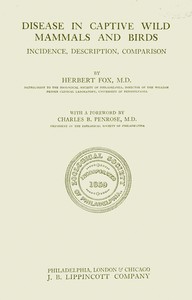
Disease in captive wild mammals and birds — A Reader’s Guide
(0 User reviews)
541
Project Gutenberg
2025
Not confirmed
Veterinary medicine
Readers of public-domain and historical texts
Project Gutenberg digital edition
en
Edition facts
Words
202,696
Reading time
882 min
Text sections
49
The catalog record for Disease in captive wild mammals and birds — A Reader’s Guide provides practical reading context through 202,696 words, 14 hr 42 min estimated reading time, and 49 detected text sections.
The text analysis averages about 19.0 words per sentence, while the detected sections provide another way to judge how the source is divided.
Project Gutenberg metadata also associates the work with “Veterinary medicine,” connecting these edition facts with the source record’s subject description.
Source:
Project Gutenberg record #76817
A 1923 veterinary pathology text by Herbert Fox, based on autopsies at the Philadelphia Zoo, comparing disease incidence across captive mammals and birds with detailed organ-system tables and microscopic findings.
Editorial Edition Score
4.9/5
★★★★★
★★★★★
Calculated from edition completeness, EPUB availability, text structure and catalogue metadata. Not a user rating.
How this score is calculated
- Description quality20 pts
- Title & short description10 pts
- Source metadata20 pts
- Text length15 pts
- Chapters / structure15 pts
- EPUB file integrity20 pts
Total of 100 points, scaled to a 2.5-5.0 range. Editions with an empty description or a missing EPUB file are not scored.
Edition quality
Read the Text
an Civil War. It is a real condition, capable in extreme cases of causing death and of so weakening the sufferer as to make him more susceptible to the invasion of other diseases. At the present day we hear less of it among civilized people than formerly, perhaps because the conception of home has been broadened by modern methods of intercommunication. The wild animal’s conception of home is narrow; he comes directly from it into an environment where he may see many other animals, but not one of his own kind. Predisposing causes of nostalgia are stronger with him than with the human. That home means a great deal to animals is shown by the migration of birds—the return of the carrier pigeon, and of the lost dog, and of the swallow, which returns every year to the same nesting place.
All animals long for the things of nature—open air, earth, grass and water. They are thrilled when their feet touch the sod. Even the hippopotamus gambols when he leaves his concrete house and his feet touch earth and grass.
The face and carriage of many animals cannot express feelings as in the human, though it is not unreasonable to assume that animals may indicate feelings by expression understood by their mates, though not understood or even noticed by man. When they can express it in a human way their feelings may be read. The dejection of nostalgia is especially shown by anthropoid apes. Gorillas have been noted for it from the earliest writers. The orang is prone to it, shows it by his attitude and expression, and sometimes dies of it.
It is stated in _A Handbook of the Management of Animals in Captivity in Lower Bengal_, p. 130, that elephants have been observed to shed tears abundantly if forced to leave their old home and surroundings. How much other animals who cannot express homesickness may feel it, and how often it is a cause of unhappiness, depression and predisposition to disease, it is impossible to say.
Most wild animals in captivity are sterile. The reason is not known. It shows the profound effect of captivity. It would be difficult to determine whether the sterility of a mating is the fault of the male or the female.
There is no apparent rule for sterility. Some families are always sterile in captivity, others are fertile, even with very unfavorable surroundings. The deer, horses, hippopotamuses, pigs, goats, sheep and oxen, are good breeders; while antelopes, rhinoceroses, giraffes, elephants, are poor breeders. Some members of a family may be good, others poor. The lion and puma breed fairly well; the tiger, leopard and jaguar, very poorly. Bears breed well, but the mother usually destroys her young.
We cannot mate wild animals and birds simply by putting males and females together in the same cage. Domestic mammals and birds usually mate under such conditions, but wild ones often refuse. Many mammals and probably all birds that are not polyandrous or polygamous reserve the right to select their mates, and if the sexes are put together by man they may view each other with indifference or with animosity. There are many males and females of the same species of mammals at the Zoological Garden that will not consent to live together. A male monkey in a cage with several females will very often select one female for his mate and will have nothing to do with the others.
Among monkeys fertility varies greatly. It is not practical to determine the ratio among the various kinds, as some kinds are much commoner in zoological collections than others. I think that in general the Old World monkeys (_Cercopithecidæ_) are better breeders in captivity than those of the New World (_Cebidæ_). The anthropoid apes are very poor breeders indeed; of the many gibbons, orangs, and chimpanzees, that for years have been captive in Europe and America, it is probable that only the chimpanzee has bred, and that very rarely.
Refusal to mate, sterility, infanticide by father and mother, and sexual killing keep down reproduction in zoological gardens; and the number of young ones is a good indication of the character of a garden and of the provisions made for the happiness, comfort and health of the animals.
With the birds in a zoological garden the conditions for nesting and laying are not good. Caged birds have no material for a nest, no privacy and rarely lay an egg. The outdoor water birds and the outdoor upland birds with natural surroundings, with secluded retreats, lay and hatch very well. Birds like mammals apparently are indifferent to publicity when copulating, but seek seclusion for laying and nesting—from maternal fear for the safety of the young.
Herbert Fox’s 1923 work is a systematic pathology of captive wild animals, grounded in 49 sections of autopsy records from the Philadelphia Zoological Society. The book’s structure follows organ systems—heart, blood vessels, respiratory tract, and others—each supported by numerical tables that quantify disease incidence across species. Fox, a pathologist, writes with clinical precision, describing microscopic changes such as “heart muscle fibres have lost all transverse striations” and noting species-specific reactions, as when avian thyroid hyperplasia “is less frank in development” than in mammals. The text includes contributions from E. P. Corson-White on diet and F. D. Weidman on parasites, broadening its scope beyond pure pathology.
Evidence from Autopsy Tables
The book’s core is a series of tables that condense hundreds of necropsies. Table 1, for instance, records “the incidence of degenerative and inflammatory changes in the heart” across species, while Table 5 tracks arteriosclerosis. These tables do not merely list diagnoses; they correlate lesions with associated conditions, as in Table 2, which pairs hypertrophy and dilatation with “principal associated lesions.” Fox uses the tables to draw comparisons—for example, noting that bone disease and atheroma, linked to thyroid insufficiency in humans, occurred only once each in carnivores and marsupials among his cases. The numerical approach allows readers to see patterns, such as the relative rarity of certain conditions in birds versus mammals, without relying on anecdote.
Microscopic Detail in Organ Descriptions
Fox’s prose shifts from tabular data to dense microscopic observations. In the thyroid section, he describes a gray wolf with “an enormous adenomatoid goitre, concentric hypertrophy of the heart, passive dilatation of all cervical and thoracic veins.” The language is technical: acini are “slightly enlarged,” colloid is “eosin-stained,” and “blood pigment free and in granule cells is abundant.” He distinguishes avian from mammalian thyroid reactions, noting that “the delicacy of the septa and the relative paucity of vessels” alters the gross picture. These passages demonstrate how Fox integrates histology with gross pathology, offering a granular view of disease processes that tables alone cannot convey.
Comparative Framework Across Species
A defining feature is Fox’s consistent comparison between mammals and birds, and among taxonomic groups. He observes that “the reaction of the avian thyroid in its hyperplasias is somewhat different from that of the mammalian,” and that birds show “less participation of the thyroid in infectious diseases.” The text also notes species-specific findings, such as the absence of exophthalmos in the wolf despite a goitre that resembled human exophthalmic goitre. Fox’s comparative lens extends to diet, with Corson-White’s chapter on “The Relation of Diet to Disease,” and to parasites, covered by Weidman. This multi-author approach enriches the work, though the excerpts leave the full extent of these contributions unclear.
Readers should approach this text as a specialized reference rather than a narrative. The tables reward careful study, while the descriptive sections demand familiarity with pathological terminology. Fox’s evidence is limited to the zoo population he examined; extrapolation to wild or domestic animals requires caution. The book’s value lies in its systematic documentation of diseases in captive species, a dataset that remains useful for historical and comparative pathology.
Turning Fox’s autopsy tables, I remembered my father’s dog-eared copy of Food Remedies: Facts About Foods And Their Medicinal Uses — Background and Themes, its margins penciled with family remedies. Both books feel like quiet confessions—one cataloguing what fails in bodies, the other what might sustain them. I found that same tender, unsentimental patience in each, a witness’s hand steadying a lantern. Strange, how diagnosis and nurture share such stillness.
There are no reviews for this eBook.
There are no comments for this eBook.
Reader reflection
Take a moment to reflect on this book
Create a short personal record of your experience with this book.
Your progress
0
/
10
2
Was reading this book enjoyable?
3
How likely are you to recommend this book?
4
How demanding did the text feel?
5
Did you relate to its people, ideas, or situations?
6
How valuable was this book for your own interests?
7
Did any part of the book stay with you emotionally?
8
How well did it match your expectations?
9
What is the main idea you are taking away?
10