1

Diseases of cattle, sheep, goats and swine — Reading Companion
(0 User reviews)
152
Project Gutenberg
2024
Not confirmed
Veterinary medicine
Readers of public-domain and historical texts
Project Gutenberg digital edition
en
Edition facts
Words
277,542
Reading time
1207 min
Text sections
49
This digital edition of Diseases of cattle, sheep, goats and swine — Reading Companion is described by source-level measurements including 277,542 words, 20 hr 7 min estimated reading time, and 49 detected text sections.
The text analysis averages about 20.8 words per sentence, while the detected sections provide another way to judge how the source is divided.
Project Gutenberg metadata also associates the work with “Veterinary medicine,” connecting these edition facts with the source record’s subject description.
Source:
Project Gutenberg record #73019
This editorial note examines the structure and recurring images in a 1905 veterinary treatise on cattle, sheep, goats, and swine, focusing on the detailed surgical description of pericarditis treatment and the movement from general principles to specific operative steps.
Editorial Edition Score
4.9/5
★★★★★
★★★★★
Calculated from edition completeness, EPUB availability, text structure and catalogue metadata. Not a user rating.
How this score is calculated
- Description quality20 pts
- Title & short description10 pts
- Source metadata20 pts
- Text length15 pts
- Chapters / structure15 pts
- EPUB file integrity20 pts
Total of 100 points, scaled to a 2.5-5.0 range. Editions with an empty description or a missing EPUB file are not scored.
Edition quality
Read the Text
es may broadly be divided into local and general. Local diseases like ostitis, periostitis, necrosis, fracture, etc., are somewhat rare, and are less important in cattle than such general diseases as rachitis and osseous cachexia.
Rachitis is a disease of young animals, and occurs during the growing period. Osseous cachexia is a disease of adults. Nevertheless, there is a relationship between these two morbid conditions, for they frequently co-exist in one family. Moreover, brood mares and cows suffering from osseous cachexia give birth to foals and calves, which, if left with their mothers, almost inevitably become rachitic.
The general characteristic common to both rachitis and osseous cachexia consisting in diminution in the normal proportion of mineral salts entering into the constitution of the bone, numerous theories have been advanced to explain this irregularity in nutrition.
=The theory of insufficiency= is one of the oldest. It presupposes that the young animals’ food contains insufficient mineral salts necessary for building up the skeleton, hence rachitis; or again, that the daily food of the adults does not afford sufficient mineral salts to compensate for the normal transformation which is continually going on within the organism, and for the direct losses which occur through the medium of the urine, milk, etc.
This extremely simple theory appears perfectly logical, but unfortunately does not fit in with all the observed facts. In reality, rachitis attacks children whose supply of milk, from a chemical point of view, leaves nothing to be desired. The same is true of animals, particularly of young pigs. The so-called “acid theory” has therefore been advanced to explain the points left obscure by its predecessor.
=The acid theory.= According to this theory, the food may contain more than sufficient mineral material without, however, preventing the development of rachitis or of osseous cachexia.
In animals suffering from digestive disturbance the alimentary tract may become the seat of excessive fermentation or of changes in secretion. There is thus produced an excess of lactic acid which passes into the circulation and accumulates in the tissues, checking the processes which end in ossification or, in the case of adults, even leading to decalcification.
It seems fairly well established that experimental administration of lactic acid to animals causes diminution in the quantity of calcium salts contained in the bones (Siedamgrotsky, Hofmeister). On the other hand however Arloing and Tripier failed to produce rachitis experimentally.
Bouchard revived this theory in a somewhat modified form. He considers that calcium salts are absorbed as carbonates and chlorides and phosphoric acid as phospho-glyceric acid. The reaction which these compounds undergo within the organism ends in the formation of the phosphate of calcium necessary to ossification, but this “phosphate of ossification” cannot be deposited if the organism contains an excess of lactic acid.
=Theory of inflammation.= A third theory which until now has received very little support is that called the theory of inflammation. The general lesions which characterise rachitis are regarded as resulting from primary attacks of ostitis and osteo-periostitis. The cause of these forms of inflammation is not suggested.
To the above views may be added that more recently emitted by Dr. Chaumier, according to which rachitis is of an infectious nature. Unfortunately no proof of this has yet been adduced.
Rachitis is a disease of youth, and is common both to the human species and to all domestic animals. It is characterised by irregularities in development and by imperfect consolidation of the bones. The boundary between rachitis and osseous cachexia is difficult to define and in fact at the present moment the two diseases can scarcely be defined with exactitude. Rachitis again is often complicated with softening of the bones, disease of the limbs, arrested development, etc., but it must not be forgotten that although the irregularities in ossification and development of the skeleton are the symptoms most striking to the eye, they do not stand alone, and that from the point of view of development all the tissues, including the muscles, are more or less affected and that most of the physiological functions such as digestion and the secretion of urine are deranged.
=Etiology.= One of the principal causes suggested is that of heredity, and so far as human beings are concerned, one seldom fails to discover the rachitic taint. Certainly the offspring of individuals marked by any debilitating disease like alcoholism, tuberculosis, syphilis, etc., are poorly equipped for their future development. Their tissues lack the necessary qualities and, _cæteris paribus_, their physiological functions are performed less perfectly than are those of normal individuals.
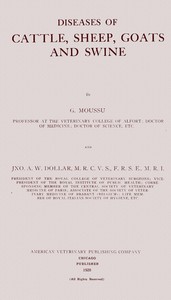
The work opens with a preface that establishes its international character, drawing on French, German, English, American, and Colonial sources. The authors, G. Moussu and Jno. A. W. Dollar, explicitly frame the volume as a response to the scantiness of permanent literature on cattle diseases. The text then moves into detailed anatomical and surgical descriptions, such as the treatment of traumatic pericarditis, where the narrative shifts from general pathological principles to precise operative steps. This movement between broad context and minute procedural detail is a structural hallmark of the treatise.
Structural Movement from General to Specific
The treatise consistently progresses from general disease descriptions to specific surgical interventions. For example, the discussion of traumatic pericarditis begins with the pathology of foreign body migration, then enumerates possible interventions—opening the rumen, puncture of the pericardium—before focusing on a single method: puncture through the xiphoid cartilage. This pattern recurs throughout the excerpts, where each condition is first situated within a broader clinical picture before narrowing to operative technique. The preface itself mirrors this structure, moving from the general need for a textbook to the specific contributions of Moussu and other sources.
Recurring Anatomical Imagery
Anatomical landmarks recur as fixed points of reference. In the pericarditis section, the xiphoid appendix, white line, circle of the hypochondrium, and external mammary vein are identified as guiding points. The text repeatedly visualizes the pericardium’s relation to the sternum and ensiform cartilage, using diagrams (Fig. 177) to reinforce spatial relationships. This emphasis on topographical anatomy—the point where the pericardium extends along the sternum—creates a consistent visual language. The same precision appears in descriptions of pleural sacs descending to the sternum, making anatomy the constant backdrop for surgical reasoning.
Cautious Surgical Judgment
The authors weigh risks with notable caution. Moussu’s own attempts to drain the pericardium through the pleura are described as having unsatisfactory results, and median trepanation of the sternum is dismissed as too dangerous for ordinary practice. The text identifies only one condition—fibrous adhesion between pericardium, lung, and chest wall—where intervention might succeed, but acknowledges the difficulty of ascertaining such adhesion before operation. This measured tone, avoiding overstatement, characterizes the work’s approach to surgical innovation.
International Sources and Collaborative Voice
The preface explicitly lists foreign sources: Moussu’s French treatise as the backbone, German works, and recent English, American, and Colonial literature. This international scope is not merely claimed but enacted in the text, where French and German techniques are discussed alongside English practice. The collaborative voice extends to acknowledgments of Professor McQueen and Dr. Salmon. The result is a work that presents itself as a synthesis, not a single author’s opinion, lending authority to its structural and surgical arguments.
Readers approaching this work will find a text that moves methodically from general principles to precise anatomical and surgical detail, with recurring attention to topographical landmarks and cautious evaluation of operative risks. The international sourcing and collaborative tone reinforce its claim to be a comprehensive reference. The excerpts suggest a work best read as a practical guide, where each disease is situated within a structured framework of diagnosis and intervention.
There’s something tender about old veterinary books, the way they slow down over a chest incision, drawing out each layer of hide and muscle like a quiet ritual. I finished it and thought of you—how certain texts stay with us not for their answers, but their patience. Disease and Its Causes — Context and Discussion holds that same gentle weight, like a hand resting on a fevered brow.
There are no reviews for this eBook.
There are no comments for this eBook.
Reader reflection
Before you leave, reflect on the book
Use these questions to collect your thoughts before moving on.
Your progress
0
/
10
2
What was your overall reaction to the book?
3
Would you encourage someone else to read it?
4
What was the reading difficulty like?
5
How did the pace of the book feel?
6
Did the book deliver what you hoped for?
7
Did the book give you something worth debating?
8
What did you appreciate most?
9
What did this book teach you most?
10