1

Dr. Elsie Inglis — Story, Setting & Ideas
(0 User reviews)
27
Project Gutenberg
2016
Not confirmed
Inglis, Elsie Maud, 1864-1917; Women physicians -- Scotland -- Biography; Suffragists -- Scotland -- Biography; World War, 1914-1918 -- Women -- Biography; World War, 1914-1918 -- Women -- Scotland; Scottish Women's Hospitals (Organization); World War, 1914-1918 -- Medical care -- Russia; World War, 1914-1918 -- Medical care -- Scotland
Readers of public-domain and historical texts
Project Gutenberg digital edition
en
Edition facts
Words
64,575
Reading time
281 min
Text sections
13
The source record for Dr. Elsie Inglis — Story, Setting & Ideas measures this digital text at 64,575 words, 4 hr 41 min estimated reading time, and 13 detected text sections.
The text analysis averages about 18.0 words per sentence, while the detected sections provide another way to judge how the source is divided.
Project Gutenberg metadata also associates the work with “Inglis, Elsie Maud, 1864-1917,” connecting these edition facts with the source record’s subject description.
Source:
Project Gutenberg record #51410
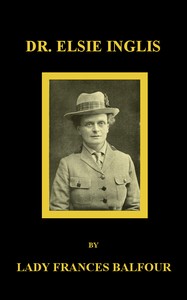
Lady Frances Balfour's biography of Dr. Elsie Inglis traces her life from family roots in Inverness-shire through medical training, suffrage activism, and founding the Scottish Women's Hospitals during World War I. The narrative draws on letters and family records to present a portrait of a woman whose professional and wartime work was shaped by her religious faith and national identity.
Editorial Edition Score
4.8/5
★★★★★
★★★★★
Calculated from edition completeness, EPUB availability, text structure and catalogue metadata. Not a user rating.
How this score is calculated
- Description quality20 pts
- Title & short description10 pts
- Source metadata20 pts
- Text length15 pts
- Chapters / structure15 pts
- EPUB file integrity20 pts
Total of 100 points, scaled to a 2.5-5.0 range. Editions with an empty description or a missing EPUB file are not scored.
Edition quality
Read the Text
ade enough to be able to keep a wife. In 1806 he married Martha Money, whose father was a partner in the firm. They came home in 1812, and all their younger children were born in England at Walthamstow, the home of the Money family. One of the descendants, who has read the letters of these three brothers and their families, makes this comment on them:--
‘The letters are pervaded with a sense of activity, and of wandering. Each one entering into any pursuit that came to hand. All the family were travellers. There are letters from aunts in Gibraltar and many other airts.
‘The extraordinary thing in all the letters, whether they were written by an Inglis, a Deas, or a Money, is the pervading note of strong religious faith. They not only refer to religion, but often, in truly Scottish fashion they enter on long theological dissertations. David Inglis, Elsie’s grandfather, when he was settled in England gave missionary addresses. Two of these exist, and must have taken fully an hour to read. Even the restless Alexander in Carolina, and the “whirlwind” David in India scarcely ever write a letter without a reference to some religious topic. You get the impression of strong breezy men sure of themselves, and finding the world a great playground.’
‘God of our fathers, known of old. . . . . . Beneath Whose awful hand we hold Dominion over palm and pine.’
John, the second youngest son of David and Martha Inglis, was born in 1820. His mother being English, there entered with her some of the douce Saxon disposition and ways. Though the call of the blood was to cast his lot in India, John, or as he was generally called David, appears first as a student. His tutor, the Rev. Dr. Niblock, wrote a report of him as he was passing out of his hands to Haileybury. Mrs. Inglis notes on the letter: ‘Dr. Niblock is esteemed one of the best Greek scholars in England, and his Greek Grammar is the one in use in Eton.’
‘Of Master David Inglis I can speak with pleasure and pride almost unmixed. I can only loudly express how I regret that I have not the finishing of such a boy, for I feel, and shall ever feel, that he is _mine_. He has long begun to do what few boys do till they are leaving, or have left, school, viz. to think. I shall long cherish the hope, that as I laid the foundation, so shall I have the power and pleasure of crowning my own and other’s labours. He will make a fine fellow and be a comfort to his parents, and an honour to his tutor.’
John Inglis received a nomination for Haileybury College from one of the directors of the East India Company, and went there as a student in 1839. There he was noted as a cricketer and a good horseman, and also for his reading. He knew Shakespeare almost by heart, and could tell where to find any quotation from his works. On leaving Haileybury he sailed for Calcutta, and was there for two years learning the language. He went as assistant magistrate to Agra. He married in 1846, and in 1847 he was transferred to the newly-acquired province of the Punjab. He was sent as magistrate to Sealkote, remaining there till 1856. He then brought his family home on three years’ furlough. With the outbreak of the Mutiny all civilians were recalled, and he returned to India in 1858. He was sent to Bareilly to take part in the suppression of the Mutiny, and was attached to the force under General Jones. He was present at the action at Najibabad, with the recapture of Bareilly, and the pacification of the province of Rohilcund. He remained in the province ten years till 1868, and during those years he rose to be Commissioner of Rohilcund. In 1868 he was made a member of the Board of Revenue in the North-West Provinces. As a member of the Legislative Council of India, he moved, in 1873, to Calcutta. From 1875 to 1877 he was Chief Commissioner of Oude.
The position Inglis made for himself in India, in yet early life, is to be gauged by a letter written in 1846 by Sir Frederick Currie, who was then Commissioner of Lahore. He had married Mrs. Inglis’ sister Katherine.
The biography opens not with Elsie Inglis herself but with a chapter titled 'Inglis of Kingsmills, Inverness-shire,' establishing her family lineage before her birth. The preface signals that the memoir is 'written among her own family and kindred,' relying on letters and stories that form 'a consistent whole.' This familial perspective shapes the narrative: the author, Lady Frances Balfour, was a sister-in-law to Inglis and had access to private correspondence. The book's dedication 'To Serbia and the Scottish Women’s Hospitals that served and loved their brethren 1914–1917' immediately frames the war work as central, while the epigraph from Luke 21:19—'In your patience possess ye your souls'—hints at the endurance that will be required.
A Portrait Built from Letters
The biography relies heavily on Inglis's own correspondence, especially with her father. Balfour notes that 'in her correspondence with her father, both in Glasgow and London, her interest was always living and vital in the things which belonged to the kingdom of heaven within.' These letters reveal a young woman wrestling with religious doctrine: she 'thought the Westminster Confession should either be accepted or rejected' and attended various churches—Episcopal, Y.W.C.A., and the ministry of Rev. Dr. Hunter. The excerpts show that Balfour uses these letters not merely to document events but to trace Inglis's intellectual and spiritual development. Readers should attend to how quoted passages from letters are woven into the narrative; they often carry the emotional weight of the story.
Faith as a Working Principle
A recurring thread is Inglis's religious life, which Balfour presents as practical rather than doctrinal. The text states that 'certain doctrines and formulas found no acceptance with her' and that she rejected the view of humans as 'miserable sinners.' Instead, she believed 'man was created in God’s image' and that service was a 'reasonable service.' Her eventual spiritual home became St. Giles' Cathedral in Edinburgh, where 'her alert active figure was a familiar sight' at daily services. Notably, Balfour observes that after these services 'she never talked of her work' but instead turned her attention to her companion's concerns. This detail suggests a disciplined separation between public duty and private devotion—a pattern that may recur in the war chapters.
Preparation for War
The chapter 'War and the Scottish Women' opens with a hymn stanza and the assertion that 'the year of the war coincided with that period in the life of Dr. Inglis when she was fully qualified for the great part she was to play.' Balfour frames the war not as an interruption but as the culmination of Inglis's earlier work. The preceding chapters on medical training, political enfranchisement, and professional life are thus positioned as preparation. Readers should note how Balfour connects Inglis's suffrage activism (Chapter VI) to her wartime organizing: the Scottish Women's Hospitals were an extension of the same drive for women's capacity and service. The biography's structure implies that Inglis's pre-war life was a deliberate apprenticeship for the crisis to come.
The Texture of Daily Work
Balfour includes small, concrete details that ground the narrative in routine. For instance, she describes how 'in an ordered round passed the days and years' before the war, with Inglis moving between hospital, church, and home. The image of 'the westering sun on the windows' falling on 'the fair hair and bright face' of Inglis after a day's work is one of the few physical descriptions in the excerpts. These moments are rare; the biography is more concerned with character and motive than with scene-setting. When reading, watch for such sensory details—they often appear at transitional points, signaling a shift in tone or period. The preface's claim that 'every letter or story of her is part of a consistent whole' invites the reader to treat each anecdote as evidence of a unified character.
Because the excerpts end before the war chapters, the reader encounters Inglis primarily through her formation—family, education, faith, and early career. The biography's method is cumulative: each chapter adds a layer of context for the wartime achievements that follow. Pay attention to how Balfour uses letters and family testimony to create a sense of intimacy, and note the recurring emphasis on Inglis's 'consistent' character. The book rewards a patient reading that traces these threads through to the later chapters on Serbia and Russia.
That rainy afternoon, I kept returning to Dr. Inglis’s stubborn practicality—how her faith never softened her diagnoses. Afterwards, I found myself reaching for an older volume on the shelf, A system of practical medicine. By American authors. Vol. 3 — Themes and Context, and noticing how similar quiet certainty could emerge from entirely different hands.
There are no reviews for this eBook.
There are no comments for this eBook.
Reader reflection
What did you think of this book?
Answer a few questions and save a private reflection on this device.
Your progress
0
/
10
2
How did the book work for you overall?
3
How likely are you to recommend this book?
4
What was the reading difficulty like?
5
Could you follow the author’s main argument?
6
Which part made the strongest impression?
7
Could you apply anything you learned?
8
How closely did the book connect with your experience?
9
In one sentence, what did you learn?
10