1

Encyclopedia of Diet: A Treatise on the Food Question, Vol. 4 — Story, Setting & Ideas
(0 User reviews)
239
Project Gutenberg
2014
Not confirmed
Food; Diet; Diet in disease
Readers of public-domain and historical texts
Project Gutenberg digital edition
en
Edition facts
Words
29,776
Reading time
130 min
Text sections
8
The source record for Encyclopedia of Diet: A Treatise on the Food Question, Vol. 4 — Story, Setting & Ideas measures this digital text at 29,776 words, 2 hr 10 min estimated reading time, and 8 detected text sections.
The text analysis averages about 38.3 words per sentence, while the detected sections provide another way to judge how the source is divided.
Project Gutenberg metadata also associates the work with “Food,” connecting these edition facts with the source record’s subject description.
Source:
Project Gutenberg record #47701
Eugene Christian's 1914 dietetic manual prescribes seasonal menus for ailments like eczema and low vitality, using repetitive structure, precise food lists, and a tone of authoritative simplicity.
Editorial Edition Score
4.6/5
★★★★★
★★★★★
Calculated from edition completeness, EPUB availability, text structure and catalogue metadata. Not a user rating.
How this score is calculated
- Description quality20 pts
- Title & short description10 pts
- Source metadata20 pts
- Text length15 pts
- Chapters / structure15 pts
- EPUB file integrity20 pts
Total of 100 points, scaled to a 2.5-5.0 range. Editions with an empty description or a missing EPUB file are not scored.
Edition quality
Read the Text
Transcriber's Note: ###################
This e-text is based on the 1914 edition. Inconsistent hyphenation (e.g., 'semi-acid'/'semiacid') and spelling ('purée'/'puree') have been retained.
Italic passages in the original version has been placed between underscores (_italic_); text in small caps have been symbolised by forward slashes (/small caps/).
The following passages have been corrected:
# Table of Contents: 'Low Vitality (continued)' has been added # Table of Contents: Page number for 'Colds' changed to match the original; corresponding header added to the text # p. 921: 'LaGrippe' --> 'La Grippe' # p. 971: 'cyicken' --> 'chicken'
_A Treatise on the Food Question_
/Explaining, in Plain Language, the Chemistry of Food and the Chemistry of the Human Body, together with the Art of Uniting these Two Branches of Science in the Process of Eating, so as to Establish Normal Digestion and Assimilation of Food and Normal Elimination of Waste, thereby Removing the Causes of Stomach, Intestinal, and All Other Digestive Disorders/
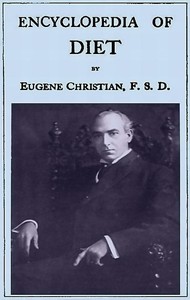
BY /Eugene Christian/, F.S.D.
NEW YORK THE CHRISTIAN DIETETIC SOCIETY 1914
/Copyright, 1914 by EUGENE CHRISTIAN ALL RIGHTS RESERVED
/Published August, 1914/
_Lesson XV_ (Continued) _Page_
Low Vitality (continued) 863
Rheumatism and Gout 947
Bright's Dis-ease 979
Dis-eases of the Skin 1013
Menus for the Pregnant Woman 1033
Importance of Food during Pregnancy 1033
The Nursing Mother 1040
Menus for the Nursing Mother 1042
Building up Nervous System 1053
Strength and Endurance 1069
Malassimilation and Autointoxication 1074
For Invalid Child 1098
For Mental Worker 1106
For School Teacher 1115
For Laboring Man 1122
For Cold Weather 1133
To Build Up Sexual Vitality 1138
LOW VITALITY (continued)
_LOW VITALITY--UNDERWEIGHT WEAK DIGESTION_
Take a cool sponge or a shower bath, a few minutes' vigorous exercise, and a cup of hot water just after rising.
Strained orange juice, diluted--one-half water
One egg whipped five or six minutes with a rotary egg beater, to which add a spoonful of sugar, a flavor of pineapple juice, and a glass of milk
Half-cup of wheat bran, cooked, and a spoonful or two of steamed wheat
Three eggs prepared as for breakfast, adding two glasses of milk. Drink slowly
A two-egg omelet rolled in cream and grated nuts
Puree of peas or beans
Take sufficient wheat bran night and morning to keep the bowels in normal action.
_LOW VITALITY--UNDERWEIGHT WEAK DIGESTION_
A very ripe peach or plum, a cup of cool water, exercise and deep breathing on rising.
Cantaloup, peaches, cherries, or any very ripe sweet fruit Buttermilk or egg, prepared choice A baked sweet potato
Three glasses of milk, taking one-half glass every five or six minutes A small portion of wheat bran, cooked
A green salad An ear of tender corn One or two fresh vegetables such as onions, beans, spinach, beets
_LOW VITALITY--UNDERWEIGHT WEAK DIGESTION_
A small portion of wheat bran, well cooked A cup of warm milk One egg, whipped very fine, to which add a very little sugar and lemon juice. Take this uncooked A few baked chestnuts eaten with butter
String beans or carrots--masticate very thoroughly A large Spanish onion, boiled A baked potato Wheat bran
Choice of tender fish or chicken A portion of spinach A baked potato Onions, en casserole A small portion of wheat bran
_LOW VITALITY--UNDERWEIGHT WEAK DIGESTION_
/First Day/: Drink two glasses of water immediately after rising. Eat one-fourth pound of grapes or some juicy fruit. Devote from three to four minutes to deep breathing exercises.
Whole wheat, cooked; serve with cream or butter A baked sweet potato A cup of milk A small portion of wheat bran eaten with thin cream
A large, boiled Spanish or Bermuda onion A small portion of carrots, thoroughly cooked A spoonful or two of wheat bran
A cream soup made from celery or onions Rice made into a thick purée, or a baked potato, carrots, onions, or turnips A spoonful or two of wheat bran
Just before retiring, take a spoonful or two of wheat bran, uncooked, in a little water, and devote as much time as possible to deep breathing exercises.
From one to two glasses of water should be drunk at each of the above meals. It may be taken hot if preferred. If something hot is desired, as a beverage, take a cup of sassafras tea with a little cream and sugar.
/Second Day/: The same as the first.
/Third Day/: The same as the second, slightly increasing the quantity of food if demanded by normal hunger.
/Fourth Day/: Exercises, water-drinking, and fruit as prescribed for the first day.
Two extremely ripe bananas, eaten with thin cream and nut butter or nuts masticated very fine. (They should be baked if not exceedingly ripe) A cup of sassafras tea or chocolate
Three glasses of buttermilk Two beaten egg whites with three teaspoonfuls of sugar A tablespoonful of wheat bran
Eugene Christian’s Encyclopedia of Diet, Vol. 4 (1914) presents itself not as a medical textbook but as a practical manual for the layperson. Its language is direct and instructional, built around lists of permitted foods and rigid daily routines. The voice is that of a confident advisor who expects obedience: “Take sufficient wheat bran night and morning to keep the bowels in normal action.” Christian rarely explains why a particular food works; instead, he relies on repetition and seasonal variation to convey authority.
The narrative pace is remarkably uniform. Each menu follows the same three-meal structure (breakfast, luncheon, dinner), with minor substitutions for season or condition. This repetition creates a rhythm that mirrors the regimen it prescribes—steady, predictable, and unvarying. The effect is hypnotic, reinforcing the idea that health comes from strict adherence to a system.
Repetition as Rhetoric
Christian’s prose relies heavily on repeated syntactic patterns. Menus for different ailments—low vitality, eczema, weak digestion—share nearly identical phrasing: “A baked potato,” “A green salad,” “A cup of hot water.” The same instructions for water consumption appear across multiple menus: “Drink from one to two glasses of water at each meal, but do not take water into the mouth until mastication is perfect.” This repetition serves a rhetorical purpose: it suggests that the same basic principles underlie all dietary cures. The reader is trained to expect consistency, not novelty.
Even the headings are formulaic. Each menu is labeled by season (Spring, Summer, Fall, Winter) and condition, creating a grid of possibilities. The effect is that of a reference work designed for quick consultation, not leisurely reading. The voice never wavers; it remains flat, imperative, and assured.
The Authority of Lists
Christian’s menus are essentially lists: of foods, of steps, of times of day. The list form dominates the text, with items separated by line breaks or dashes. For example, the Winter Menu for Eczema lists “Beans, Pumpkin, Beets, Squash, Carrots, Turnips, Parsnips” as dinner options. This format implies completeness—these are the only acceptable choices. The list also speeds the reading pace; the eye moves quickly down the page, mimicking the efficiency Christian advocates in eating and exercise.
The lists are often nested: a menu may include a sub-list of vegetables, then a sub-list of preparation methods (“baked,” “boiled”). This hierarchical structure gives the impression of a system that is both comprehensive and manageable. Christian’s authority rests on his ability to reduce complex dietary science to simple, actionable lists.
Seasonal Rhythm and Bodily Discipline
The seasonal organization of menus is not merely practical; it imposes a natural rhythm on the reader’s life. Spring menus emphasize “cool sponge or a shower bath” and “deep breathing”; summer menus feature “cantaloup, peaches, cherries”; winter menus prescribe “baked white potatoes or bran meal gems.” The body is to be attuned to the calendar, with food and exercise adjusted accordingly.
Christian’s language of discipline is explicit: “Do not carry any of these exercises, however, to a point beyond ordinary fatigue.” The reader is constantly reminded to measure, to limit, to obey. The pace of the prose mirrors this discipline—steady, unadorned, never deviating from its purpose. Even the occasional variation (a “cup of very thin cocoa” as a concession) is framed as an exception that proves the rule.
Christian’s Encyclopedia of Diet is best approached as a period artifact of dietary reform, not a modern nutrition guide. Its value lies in its systematic structure and the window it opens onto early twentieth-century attitudes toward health, self-discipline, and the authority of print. Readers interested in the rhetoric of health advice will find rich material in its repetitive menus and commanding tone.
There’s something comforting in Christian’s certainty—how every ailment has its prescribed plate, as if order alone might soothe the skin. It reminds me of old veterinary manuals, where diagnosis felt like a quiet conversation between generations of care. I keep thinking about The illustrated horse doctor — Edition Insights, and how both books share that gentle faith in practical wisdom. Time moves on, but that hope stays.
There are no reviews for this eBook.
There are no comments for this eBook.
Reader reflection
How will you remember this book?
Save your reaction, strongest insight, and memorable passage.
Your progress
0
/
10
2
Was reading this book enjoyable?
3
Would you pass this book on to a friend?
4
How easy was the book to follow?
5
How clearly were the main ideas presented?
6
Did the book offer a fresh perspective?
7
What was its emotional impact?
8
Would a second reading be valuable?
9
What changed or sharpened your thinking?
10