1

Gout, with a section on ocular disease in the gouty — Reading Notes
(0 User reviews)
232
Project Gutenberg
2023
Not confirmed
Gout; Eye -- Diseases
Readers of public-domain and historical texts
Project Gutenberg digital edition
en
Edition facts
Words
200,529
Reading time
872 min
Text sections
43
The source record for Gout, with a section on ocular disease in the gouty — Reading Notes measures this digital text at 200,529 words, 14 hr 32 min estimated reading time, and 43 detected text sections.
The text analysis averages about 23.8 words per sentence, while the detected sections provide another way to judge how the source is divided.
Project Gutenberg metadata also associates the work with “Gout,” connecting these edition facts with the source record’s subject description.
Source:
Project Gutenberg record #69874
A 1921 medical monograph on gout by Llewellyn J. Llewellyn, with a section on ocular disease by W. M. Beaumont. The preface frames gout as foundational to pathology, while the text advocates for systematic blood and urine analysis, complement-fixation tests, and X-ray barium meals, challenging assumptions about uric acid excretion and urging scrutiny of alimentary and infective foci.
Editorial Edition Score
4.9/5
★★★★★
★★★★★
Calculated from edition completeness, EPUB availability, text structure and catalogue metadata. Not a user rating.
How this score is calculated
- Description quality20 pts
- Title & short description10 pts
- Source metadata20 pts
- Text length15 pts
- Chapters / structure15 pts
- EPUB file integrity20 pts
Total of 100 points, scaled to a 2.5-5.0 range. Editions with an empty description or a missing EPUB file are not scored.
Edition quality
Read the Text
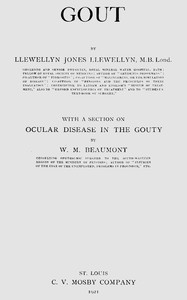
BY LLEWELLYN JONES LLEWELLYN, M.B. Lond.
GOVERNOR AND SENIOR PHYSICIAN, ROYAL MINERAL WATER HOSPITAL, BATH; FELLOW OF ROYAL SOCIETY OF MEDICINE; AUTHOR OF “ARTHRITIS DEFORMANS”; CO-AUTHOR OF “FIBROSITIS”; CO-AUTHOR OF “MALINGERING, OR THE SIMULATION OF DISEASE”; CO-AUTHOR OF “PENSIONS AND THE PRINCIPLES OF THEIR EVALUATION”; CONTRIBUTOR TO LATHAM AND ENGLISH’S “SYSTEM OF TREATMENT,” ALSO TO “OXFORD ENCYCLOPÆDIA OF TREATMENT” AND TO “STUDENT’S TEXT-BOOK OF SURGERY.”
WITH A SECTION ON OCULAR DISEASE IN THE GOUTY
CONSULTING OPHTHALMIC SURGEON TO THE SOUTH-WESTERN REGION OF THE MINISTRY OF PENSIONS; AUTHOR OF “INJURIES OF THE EYES OF THE UNEMPLOYED, PROBLEMS IN PROGNOSIS,” ETC.
ST. LOUIS C. V. MOSBY COMPANY 1921
_Printed in Great Britain._
“A knowledge of the real nature of gout ... is, in my opinion, at the very foundation of all sound pathology,” wrote Todd many years since; and the passing years have but invested his reflection with deeper significance and something of prophetic insight. For who can doubt that he who would elucidate the pathological groundwork of gout must be at once a clinical physician, a bio-chemist, a bacteriologist, a morbid anatomist? and well may we ask, Who is sufficient for all this?
How vivid the light thrown upon the problems of clinical medicine by the bio-chemists! The story of the fate of protein and purin substances in the animal body, at one time a medley of guesses and gaps, is gradually evolving into one of relative certitude and completeness. Revolutionary, in truth, the change, and many a cherished shibboleth has been ruthlessly cast aside! With admiration not unmingled with awe we see them laying well and truly the foundations upon which in the ultimate scientific medicine must inevitably rest.
Of these the very corner-stones are _chemical physiology_ and _chemical pathology_, the rapid evolution of which is profoundly altering our conceptions of health and disease. Those vital processes of the organism that but yesterday we saw “as through a glass, darkly,” are now in great part illumined, and the distortions wrought in them by disease made more manifest.
How pregnant, too, with warning their findings! Processes that to our untutored minds seem simple are revealed as infinitely complex. Through what a maze must we thread our way if we would disentangle the intricacies of metabolism! Intricate enough, forsooth, in health, but how much more so in disease! For, as Sir Archibald Garrod eloquently phrases it, “it is becoming evident that special paths of metabolism exist, not only for proteins, fats, and carbohydrates as such, but that even the individual primary fractions of the protein molecule follow their several katabolic paths, and are dealt with in successive stages by series of enzymes until the final products of katabolism are formed. Any of these paths may be locked while others remain open.”
It is with chastening reflections such as these that we may best approach our study of gout, that riddle of the ages upon which so many physicians from time immemorial have expended their dialectic skill. But, vast though the increase in our knowledge of the chemical structure of uric acid and its allies, uncertainty still dogs our steps, and, doubtful of the pathway to solution of the pathological mystery of gout, we must perforce approach the problem in a more strictly catholic attitude.
_Uric acid_ has apparently failed us as the _causa causans_. Neither this substance nor its precursors can be held responsible for the fever, local inflammation and constitutional disturbances in gout, being, as they are, practically _non-toxic_. Albeit, though I hold this view, I do not for one moment suggest that _uric acid_ has nothing whatever to do with gout. The fact that _tophi_, its pathognomonic stigmata, are compounded of _biurate of soda_, would _per se_ stamp such an attitude as untenable. On the other hand, _uric acid_ must be viewed at its proper perspective as a _concomitant_ or _sequel_ of _gouty inflammation_, the essential cause of which must be sought elsewhere.
“The old order changeth, giving place to new,” and happily with the advent of _bacteriology_ our views, or rather our hazards, as to the nature of joint diseases underwent profound modification. But, strange to say, though quick to apprehend the significance of infection, its causal relation to other joint disorders, we still seem unaccountably loth to discard our timeworn conception of “gouty” arthritis as of purely _metabolic_ origin. This to my mind is the more remarkable in that the onset, clinical phenomena, and course of acute gout, and no less the life history of the disorder as a whole, are emphatically indicative of the intrusion of an _infective element_ in its genesis.
The preface to this 1921 monograph opens with a striking claim: Todd’s assertion that knowledge of gout’s real nature is “at the very foundation of all sound pathology” is treated not as historical curiosity but as a still-unmet challenge. Llewellyn immediately sets a tone of methodological urgency, calling for a clinician who is also bio-chemist, bacteriologist, and morbid anatomist. The prose is dense with admiration for bio-chemists, whom he describes as laying “well and truly the foundations” of scientific medicine, yet it also bristles with frustration at persistent diagnostic shibboleths—particularly the overreliance on uric acid levels in urine. The voice is that of a physician arguing for a more rigorous, multi-modal investigation of gout, one that integrates laboratory findings with clinical observation.
A Plea for Routine Blood Examination
Llewellyn repeatedly insists that gout cannot be diagnosed from a single urine sample. He cites C. v. Noorden’s method of administering increasing purin doses to gauge tolerance, and quotes Von Fürth’s satire of physicians who base diagnoses on “any arbitrarily collected specimen.” The text advocates for routine blood examination, noting that leucocytosis and complement-fixation tests for local infections could illuminate the relationship between remote lesions and gout. The author’s tone is both exhortatory and precise: he wants practitioners to move beyond “the delusion that gouty subjects excrete large amounts” of uric acid. Instead, he urges a long series of quantitative analyses on a purin-free diet. This section shows how the narrative voice shifts from broad historical reflection to pointed clinical instruction.
The Search for Hidden Foci
A recurring structural pattern in the excerpts is the systematic enumeration of possible sites of infection or dysfunction. Llewellyn moves from oral sepsis to appendix and gall bladder disorders, then to pancreatic inefficiency, and finally to bacterial content of feces. He warns against dismissing symptoms as “gouty” without investigation: “we should not be content merely with dubbing these symptoms ‘gouty,’ as they are much more likely to be, not symptomatic of gout, but etiologically related thereto.” The prose gains momentum through a series of rhetorical questions and imperatives—“How valuable the existence of an X-ray barium or bismuth meal!”—creating a sense of diagnostic urgency. This section exemplifies the book’s method: a cascade of possibilities, each requiring modern tools to confirm or exclude.
Ocular Disease and the Gouty Diathesis
The final section, contributed by W. M. Beaumont, shifts focus to the eye. While the excerpts do not include Beaumont’s full text, the title and catalog subject indicate a specialized treatment of ocular manifestations in gout. The collaboration itself is noteworthy: Llewellyn’s preface emphasizes interdisciplinary approach, and Beaumont’s role as consulting ophthalmic surgeon to the Ministry of Pensions suggests a practical, clinical orientation. The change in pace from Llewellyn’s metabolic arguments to Beaumont’s likely case-based discussion mirrors the book’s broader movement from general pathology to specific organ systems. Readers should note that the two authors may employ different terminologies and evidentiary standards, reflecting their distinct specialties.
This edition preserves the original 1921 text, including its period-specific diagnostic tools (barium meals, complement-fixation tests) and its polemical edge against diagnostic shortcuts. Readers interested in the history of rheumatology or early 20th-century metabolic theory will find Llewellyn’s arguments both dated and prescient. The ocular section by Beaumont offers a complementary perspective, though its full content is not represented in the excerpts. Approach the work as a primary source for understanding how gout was conceptualized before modern biomarkers—a document of clinical reasoning in transition.
I keep thinking about that old 1921 gout monograph, how carefully it questioned everything, even uric acid. There's a similar quiet persistence in this one, The Black Death, and The Dancing Mania — Reading Companion. It doesn't explain away the strangeness; it just sits with it, like a friend who listens without rushing you to feel better.
There are no reviews for this eBook.
There are no comments for this eBook.
Reader reflection
What was your reading experience?
Capture what you thought, learned, and would like to remember.
Your progress
0
/
10
2
Did this book hold your interest?
3
Is this a title you would suggest to others?
4
How much effort did this book require?
5
Did anything about the book feel genuinely new?
6
How much did the book move you?
7
Do you expect to return to this book?
8
Did the book meet your expectations?
9
What is the main idea you are taking away?
10