1

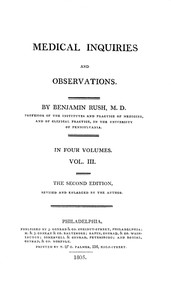
Medical Inquiries and Observations, Vol. 3 The Second Edition, Revised and Enlarged by the Author — Edition Insights
(0 User reviews)
32
Project Gutenberg
2019
Not confirmed
Medicine; Yellow fever -- Pennsylvania -- Philadelphia
Readers of public-domain and historical texts
Project Gutenberg digital edition
en
Edition facts
Words
91,145
Reading time
397 min
Text sections
10
The source record for Medical Inquiries and Observations, Vol. 3 The Second Edition, Revised and Enlarged by the Author — Edition Insights measures this digital text at 91,145 words, 6 hr 37 min estimated reading time, and 10 detected text sections.
The text analysis averages about 20.9 words per sentence, while the detected sections provide another way to judge how the source is divided.
Project Gutenberg metadata also associates the work with “Medicine,” connecting these edition facts with the source record’s subject description.
Source:
Project Gutenberg record #58861
Benjamin Rush's third volume of medical writings presents his theory of fever and detailed accounts of the 1793–1796 yellow fever epidemics in Philadelphia, emphasizing his controversial purging and bleeding treatments.
Editorial Edition Score
4.8/5
★★★★★
★★★★★
Calculated from edition completeness, EPUB availability, text structure and catalogue metadata. Not a user rating.
How this score is calculated
- Description quality20 pts
- Title & short description10 pts
- Source metadata20 pts
- Text length15 pts
- Chapters / structure15 pts
- EPUB file integrity20 pts
Total of 100 points, scaled to a 2.5-5.0 range. Editions with an empty description or a missing EPUB file are not scored.
Edition quality
Read the Text
rsal on the fruit-trees, in the gardens of Philadelphia, on the first day of April. The scarlatina anginosa continued to be the reigning epidemic in this month.
There were several warm days in May, but the city was in general healthy. The birds appeared two weeks sooner this spring than usual.
The register of the weather shows, that there were many warm days in June. The scarlatina continued to maintain its empire during this month.
The weather was uniformly warm in July. The scarlatina continued during the beginning of this month, with symptoms of great violence. A son of James Sharswood, aged seven years, had, with the common symptoms of this disease, great pains and swellings in his limbs, accompanied with a tense pulse. I attempted in vain to relieve him by vomits and purges. On the 10th day of the month, I ordered six ounces of blood to be drawn from his arm, which I observed afterwards to be very sizy. The next day he was nearly well. Between the 22d and the 24th days of the month, there died three persons, whose respective ages were 80, 92, and 96-1/2. The weather at this time was extremely warm. I have elsewhere taken notice of the fatal influence of extreme heat, as well as cold, upon human life in old people. A few bilious remitting fevers appeared towards the close of this month. One of them under my care ended in a typhus or chronic fever, from which the patient was recovered with great difficulty. It was the son of Dr. Hutchins, of the island of Barbadoes.
The weather, for the first two or three weeks in August, was temperate and pleasant. The cholera morbus and remitting fevers were now common. The latter, were attended with some inflammatory action in the pulse, and a determination to the breast. Several dysenteries appeared at this time, both in the city and in its neighbourhood. During the latter part of July, and the beginning of this month, a number of the distressed inhabitants of St. Domingo, who had escaped the desolation of fire and sword, arrived in the city. Soon after their arrival, the influenza made its appearance, and spread rapidly among our citizens. The scarlatina still kept up a feeble existence among children. The above diseases were universal, but they were not attended with much mortality. They prevailed in different parts of the city, and each seemed to appear occasionally to be the ruling epidemic. The weather continued to be warm and dry. There was a heavy rain on the 25th of the month, which was remembered by the citizens of Philadelphia, as the last that fell for many weeks afterwards.
There was something in the heat and drought of the summer months which was uncommon, in their influence upon the human body. Labourers every where gave out (to use the country phrase) in harvest, and frequently too when the mercury in Fahrenheit's thermometer was under 84°. It was ascribed by the country people to the calmness of the weather, which left the sweat produced by heat and labour to dry slowly upon the body.
The crops of grain and grass were impaired by the drought. The summer fruits were as plentiful as usual, particularly the melons, which were of an excellent quality. The influence of the weather upon the autumnal fruits, and upon vegetation in general, shall be mentioned hereafter.
I now enter upon a detail of some solitary cases of the epidemic, which soon afterwards spread distress through our city, and terror throughout the United States.
On the 5th of August, I was requested by Dr. Hodge to visit his child. I found it ill with a fever of the bilious kind, which terminated (with a yellow skin) in death on the 7th of the same month.
On the 6th of August, I was called to Mrs. Bradford, the wife of Mr. Thomas Bradford. She had all the symptoms of a bilious remittent, but they were so acute as to require two bleedings, and several successive doses of physic. The last purge she took was a dose of calomel, which operated plentifully. For several days after her recovery, her eyes and face were of a yellow colour.
On the same day, I was called to the son of Mrs. M'Nair, who had been seized violently with all the usual symptoms of a bilious fever. I purged him plentifully with salts and cremor tartar, and took ten or twelve ounces of blood from his arm. His symptoms appeared to yield to these remedies; but on the 10th of the month a hæmorrhage from the nose came on, and on the morning of the 12th he died.
Benjamin Rush opens this volume with a theoretical framework for fever, arguing that all fevers are preceded by general debility, which he classifies as natural (from the sanguineous temperament) or accidental. He then moves to a detailed narrative of the 1793 yellow fever epidemic in Philadelphia, blending clinical observation with personal testimony. The text shifts between abstract propositions and vivid case histories, such as the recovery of a patient who was the 'first fruits of the efficacy of mercurial purges.' Rush's prose is marked by a confident, sometimes triumphant tone, as when he describes the 'sublime joy' he felt at the success of his remedies.
Theory and Structure of Fever
Rush begins with a series of general propositions, asserting that fever is not a single entity but appears 'in so many different forms' that a definition can only be given through a minute detail of symptoms. He emphasizes debility as the precursor to all fevers, a claim he supports by listing causes such as 'the sanguineous temperament' and accidental factors like 'excessive action of the mind.' The structure is methodical: each proposition is numbered and followed by explanatory text. This deductive approach contrasts with the later narrative sections, where Rush recounts specific cases and his evolving treatment strategies.
The 1793 Epidemic: A Physician's Chronicle
Rush's account of the 1793 yellow fever is a first-person narrative of his clinical decisions and interactions with patients and colleagues. He describes the initial use of mercurial purges, noting that he 'communicated the prescription to such of the practitioners as I met in the streets.' The text includes specific names—Dr. Griffitts, Dr. Say, Dr. Pennington—and details of their adoption of his methods. Rush also records his caution with bloodletting after observing deaths in patients bled without his knowledge, but later he resumes the practice as the disease's 'type' changed. The narrative is punctuated by emotional exclamations, such as his note from September 10: 'Thank God! out of one hundred patients, whom I have visited or prescribed for this day, I have lost none.'
Recurring Images: Streets, Houses, and Bodies
Throughout the epidemic accounts, Rush repeatedly uses images of movement through the city: he runs across streets, visits houses, and describes patients appearing 'in the streets in good health.' These spatial details anchor the clinical narrative in a specific urban landscape. The body itself is a site of intervention—bloodletting, purging, cold applications—and Rush often describes the appearance of blood or the effects of remedies on the system. The recurring motif of 'triumph' over disease is linked to the physical act of administering medicine, as when he writes of 'the conquest of this formidable disease' as 'the triumph of a principle in medicine.'
Shifts Between Theory and Practice
The volume's structure alternates between theoretical exposition and practical case histories. The 'Outlines of a Theory of Fever' section is abstract and propositional, while the epidemic accounts are concrete and chronological. Rush explicitly acknowledges this shift, noting that his theory 'will suffer by being published in a detached state' from his lectures and from the remedies that illustrate it. This tension between general principle and specific application is a central feature of the work. Readers should attend to how Rush uses individual cases to support his theoretical claims, and how his language moves from the clinical to the personal, as when he describes the 'transport' of a colleague who found that purging 'yielded to them in every case.'
Rush's volume offers a window into late-18th-century medical reasoning and the experience of epidemic disease. Readers interested in the history of medicine will find a detailed record of therapeutic experimentation, while those studying rhetoric can observe how a physician constructs authority through narrative. The interplay between systematic theory and personal testimony makes this a rich text for examining how medical knowledge is produced and communicated.
There’s something humbling in Rush’s certainty about bleeding, and I kept thinking how much we trust our own remedies. It made me quietly grateful for bodies that heal quietly. Somewhere between those pages, I found myself lingering over Artificial Limbs — A Closer Reading, pondering how much of our resilience is simply adaptation, not cure.
There are no reviews for this eBook.
There are no comments for this eBook.
Reader reflection
Record your reading impressions
A brief reflection can help important ideas stay with you longer.
Your progress
0
/
10
2
What was your overall reaction to the book?
3
How likely are you to recommend this book?
4
How much effort did this book require?
5
How would you describe its reading pace?
6
Did the book give you something worth debating?
7
How did the reading compare with what you expected?
8
How understandable was the text?
9
What did this book teach you most?
10