1

Observation on the Use and Abuse of Mercury, and on the Precautions Necessary in Its Employment — Story, Setting & Ideas
(0 User reviews)
296
Project Gutenberg
2021
Not confirmed
Mercury; Mercury -- Therapeutic use; Mercury -- Toxicology
Readers of public-domain and historical texts
Project Gutenberg digital edition
en
Edition facts
Words
6,628
Reading time
29 min
Text sections
2
The source record for Observation on the Use and Abuse of Mercury, and on the Precautions Necessary in Its Employment — Story, Setting & Ideas measures this digital text at 6,628 words, 29 min estimated reading time, and 2 detected text sections.
The text analysis averages about 27.5 words per sentence, while the detected sections provide another way to judge how the source is divided.
Project Gutenberg metadata also associates the work with “Mercury,” connecting these edition facts with the source record’s subject description.
Source:
Project Gutenberg record #66016
This 1805 medical treatise by A. Philips Wilson examines mercury's therapeutic use, distinguishing beneficial applications from harmful overuse through clinical observations and practical precautions.
Editorial Edition Score
4.4/5
★★★★★
★★★★★
Calculated from edition completeness, EPUB availability, text structure and catalogue metadata. Not a user rating.
How this score is calculated
- Description quality20 pts
- Title & short description10 pts
- Source metadata20 pts
- Text length15 pts
- Chapters / structure15 pts
- EPUB file integrity20 pts
Total of 100 points, scaled to a 2.5-5.0 range. Editions with an empty description or a missing EPUB file are not scored.
Edition quality
Read the Text
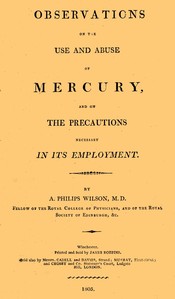
OBSERVATIONS ON THE USE AND ABUSE OF MERCURY, AND ON THE PRECAUTIONS NECESSARY _IN ITS EMPLOYMENT_.
BY A. PHILIPS WILSON, M. D. Fellow of the Royal College of Physicians, and of the Royal Society of Edinburgh, &c.
Winchester. Printed and Sold by JAMES ROBBINS.
Sold also by Messrs. CADELL and DAVIES, Strand; MURRAY, Fleet-street; and CROSBY and Co. Stationer’s Court, Ludgate Hill, LONDON.
The following Observations are addressed to the Public, with a view, on the one hand, to do away certain erroneous prepositions respecting the effects of Mercury, which impede the necessary employment of it; and on the other, to call its attention to the impropriety of an indiscriminate use of this medicine, by which much harm is often done, and the medicine itself brought into disrepute. The best way to effect these purposes seems to be, to make the public acquainted with what is really to be apprehended from an improper use of mercury, and the circumstances in which its bad effects shew themselves; by which every one may be enabled to distinguish these effects from such as proceed from other causes, as well as be warned against a use of this medicine which has become too prevalent.
Physicians will agree, that we do not possess a more valuable medicine than mercury. Not to mention the diseases for the cure of which it was first introduced, which, without its aid, almost uniformly prove fatal, and in which it is almost uniformly successful, we may appeal for the truth of this observation to its effects in some of the most dangerous forms of scrophula, in dropsies of different kinds, in inflammations, particularly chronic inflammations, and induration and enlargement of the different viscera.[A]
[A] If we except worm cases, in which mercury probably acts on the worms themselves, the various diseases in which mercury is useful, may perhaps be reduced to the two heads of inflammation and glandular obstruction. I believe there is nothing more erroneous than the opinion, that mercury will occasionally succeed in almost all diseases. This opinion has led to its employment in improper cases, and tended consequently to bring it into discredit. I have never found it successful except in the diseases here alluded to.
For many years after its introduction into practice, it was confined to a few diseases. At length it occurred to physicians, that a remedy, which in these proved so efficacious, might produce similar effects in other cases; and such has been the success of the trial, that during the last twenty years mercury has been coming into general use, with a rapidity unequalled in the history of any other medicine. But the more we are assured of its value, the more cautious we ought to be in its employment; both because it is of the greater consequence to prevent any prepossession against it, and because we know that there is no active medicine which can safely be trifled with.
The prejudices which prevail against the use of mercury seem to arise from three sources; the nature of the complaints in which it was first employed; the uneasiness which even its salutary operation, when carried to a certain extent, necessarily occasions; and the bad consequences which sometimes attend an improper use of it. It is surprising, that the first of these causes should operate against its use; yet such is the confusion which naturally creeps into our ideas on subjects in which we are not habitually interested, that the prejudices of not a few originate from this cause. Of such a prejudice it is surely unnecessary to say any thing. The other objections to the use of mercury are of more weight.
Like all other medicines which increase the secretion by the skin, the use of mercury tends to debilitate, and render the body more susceptible of cold. When mercury does not encrease any other excretion, the debility it occasions seems to be proportioned to the degree in which it promotes perspiration; and medicines which promote perspiration in a greater degree produce more sudden debility. We see a degree of weakness produced by the operation of James’s powders, or of Dover’s powders, (opium and ipecacuanha), in a few days which a moderate course of mercury would not occasion in many weeks.
Such is the tendency of mercury to promote the secretion by the skin, that it often runs off in this way almost as fast as it is received into the system, particularly on its first being used; so that it is sometimes difficult to make a sufficient quantity be retained to produce its desired effect. Some of the good effects of mercury seem, in a great measure, to arise from this action of it, particularly its tendency to counteract the inflammatory disposition and to relieve actual inflammation.
Alexander Philip Wilson opens his 1805 treatise by addressing the public directly, aiming to correct erroneous beliefs about mercury that either hinder its necessary use or encourage indiscriminate application. He structures the work around a central tension: mercury is a valuable medicine, yet its abuse brings it into disrepute. Wilson grounds his argument in clinical experience, asserting that mercury is not a panacea but effective in specific diseases, particularly inflammation and glandular obstruction. The text moves between general principles and detailed precautions, reflecting a methodical approach to balancing efficacy with safety.
A Targeted Remedy, Not a Universal Cure
Wilson explicitly rejects the notion that mercury can succeed in almost all diseases, calling this opinion erroneous. He narrows its proven utility to two categories: inflammation and glandular obstruction, with exceptions like worm cases where mercury acts on the parasites themselves. This precision contrasts with the prevailing tendency to prescribe mercury broadly. By limiting its scope, Wilson aims to protect the medicine’s reputation from the harm caused by improper use. He notes that for many years after its introduction, mercury was confined to a few diseases, and only later did physicians expand its application—sometimes unwisely. The structure of this argument moves from historical practice to contemporary caution, emphasizing that efficacy depends on correct diagnosis.
Countering Debility with Vigour
A recurring concern in the treatise is the fear that mercury causes debilitating weakness. Wilson challenges this, arguing that in a habit of ordinary strength, a moderate course of mercury produces little debility. He reports having seen patients recover both strength and flesh under such treatment. The mercury, he claims, gives vigour by removing the cause that impairs it. For debilitated patients, he advises a cautious approach: start with a dose too small to produce any effect, then gradually increase it. If strength improves, continue; if it declines, discontinue. This stepwise method reflects a practical, individualized strategy, moving between general principles and case-specific adjustments.
Air, Exercise, and the Risks of Confinement
Wilson devotes considerable attention to the patient’s environment during mercury treatment. He criticizes the idea that patients should be denied free air and exercise, which he believes contributes to debility. While confinement is necessary when inducing salivation or in damp, cold weather, Wilson insists that patients should otherwise be outdoors as much as their strength permits. He distinguishes between exposure to cold air and exposure to the causes of “taking cold,” arguing that dry cold air with exercise actually promotes perspiration. Sudden temperature changes and partial exposure to cold are the real dangers. This section moves from general advice to specific conditions, showing Wilson’s attention to practical details.
Diet and the Direction of Mercury’s Action
Wilson advises avoiding indigestible and irritating foods during mercury treatment, as they debilitate and divert the medicine from its intended channel. He warns against strong wine, highly seasoned food, and anything causing flatulence or acidity. However, he rejects the formerly recommended low diet, which combined with confinement produced much of the debility wrongly attributed to mercury. Instead, he prescribes nourishing, mild, and somewhat mucilaginous food, with wine preferred over other fermented liquors, diluted if strong, and proportioned to the patient’s habits. This dietary guidance is tightly linked to the physiological aim of directing mercury’s action, illustrating Wilson’s integrated approach to therapy.
Wilson’s treatise is structured as a series of practical observations, moving from general principles to specific precautions. Readers will find that the work’s value lies not in sweeping claims but in its careful delineation of when mercury helps and when it harms. The recurring emphasis on individualized dosing, environmental factors, and diet reveals a clinical mindset that balances therapeutic ambition with patient safety. This is a focused, evidence-based guide rather than a theoretical manifesto.
This old treatise on mercury’s careful use reminds me of another steady hand, the one that guided horse doctoring with the same quiet respect for fragile bodies. They share a patience, a willingness to watch and wait rather than rush. I often shelve them near each other, finding comfort in their mutual honesty. The illustrated horse doctor — Edition Insights holds that gentleness, too.
There are no reviews for this eBook.
There are no comments for this eBook.
Reader reflection
Record your reading impressions
A brief reflection can help important ideas stay with you longer.
Your progress
0
/
10
2
How did the book work for you overall?
3
Is this a title you would suggest to others?
4
What was the reading difficulty like?
5
Is this a title worth rereading?
6
Did any part of the book feel personally relevant?
7
How valuable was this book for your own interests?
8
Did the book meet your expectations?
9
Which lesson or insight stayed with you?
10