1

On chloroform and other anæsthetics: their action and administration — Inside the Classic
(0 User reviews)
344
Project Gutenberg
2022
Not confirmed
Chloroform; Anesthetics; Snow, John, 1813-1858
Readers of public-domain and historical texts
Project Gutenberg digital edition
en
Edition facts
Words
167,867
Reading time
730 min
Text sections
29
This digital edition of On chloroform and other anæsthetics: their action and administration — Inside the Classic is described by source-level measurements including 167,867 words, 12 hr 10 min estimated reading time, and 29 detected text sections.
The text analysis averages about 21.7 words per sentence, while the detected sections provide another way to judge how the source is divided.
Project Gutenberg metadata also associates the work with “Chloroform,” connecting these edition facts with the source record’s subject description.
Source:
Project Gutenberg record #68315
John Snow's posthumous treatise on chloroform, edited by Benjamin Ward Richardson, combines clinical observations, experimental data, and detailed protocols for anesthetic administration, revealing a physician's systematic approach to managing the fine line between insensibility and death.
Editorial Edition Score
4.9/5
★★★★★
★★★★★
Calculated from edition completeness, EPUB availability, text structure and catalogue metadata. Not a user rating.
How this score is calculated
- Description quality20 pts
- Title & short description10 pts
- Source metadata20 pts
- Text length15 pts
- Chapters / structure15 pts
- EPUB file integrity20 pts
Total of 100 points, scaled to a 2.5-5.0 range. Editions with an empty description or a missing EPUB file are not scored.
Edition quality
Read the Text
Simpson, than he began to institute a series of independent researches, and having satisfied himself personally as to the effects and greater practicability of chloroform, he at once commenced its use, and forgot sooner almost than others all predilections for ether. In 1848, he commenced a series of experimental papers on narcotic vapours in the _Medical Gazette_, and continued them until 1851, when the _Medical Gazette_ virtually ceased to exist. The papers on narcotics, in accordance with his other and earlier productions, were stamped with the evidences of profound and careful research, and still more careful deduction. I infer that they have been more talked about than read, for few people seem to be aware of the enlarged and positive physiological arguments which they contain. Chloroform and ether are not alone discussed, but all narcotics. Narcotics are not alone considered, but various of the great functions of life. The records of a vast number and variety of experiments are here related, and an amount of information, original in kind, collected, which will always remain as a memorable record in the history of medical literature. But the great points in these papers are those in which the author enters on the physiological action of narcotics. Here appear the generalizations and insights into the relations of allied phenomena which mark the man of true power. His greatest deduction on these matters, and the proofs on which it is based, are to be found in his observations, where he explains that the action of the volatile narcotics is that of arresting or limiting those combinations between the oxygen of the arterial blood and the tissues of the body, which are essential to sensation, volition, and all the animal functions. He demonstrated that these substances modify and, in large quantities, arrest the animal functions in the same way, and by the same power as that by which they modify and arrest combustion, the slow oxidation of phosphorus and other kinds of oxidation unconnected with the living body when they (the narcotics) are mixed with the atmospheric air.
In his modest way, he often spoke to me, with honest pride, on this observation. He himself thought it the best observation he had ever made, and believed that it would not be lost as an historical truth. Placing a taper, during one of our experiments, in a bottle through which chloroform vapour was diffused, and watching the declining flame, he once said, “There, now, is all that occurs in narcotism; but to submit the candle to the action of the narcotic without extinguishing it altogether, you must neither expose it to much vapour at once, nor subject it to the vapour too long; and this is all you can provide against in subjecting a man to the same influence. I could illustrate all the meaning of this great practical discovery of narcotism on a farthing candle, but I fear the experiment would be thought rather too commonplace.”
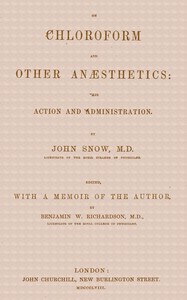
John Snow's On Chloroform and Other Anæsthetics, published posthumously in 1858 and edited by his friend Benjamin Ward Richardson, is a work of meticulous clinical science. Snow, already famous for his work on cholera, here turns his analytical eye to the action and administration of inhaled anesthetics. The book is built on a foundation of controlled experiments—Snow measured the exact amount of chloroform vapour absorbed to produce each degree of narcotism—and on careful observation of pulse, respiration, and patient response. Richardson's prefatory memoir, written in the raw grief of recent loss, frames the volume as a legacy completed literally at the moment of Snow's death.
A Taxonomy of Syncope
Snow devotes considerable space to distinguishing types of circulatory collapse, a concern central to safe anesthesia. He differentiates between syncope from impeded respiration (cardiac distension) and the more common anæmic syncope, where the heart empties and the patient turns pale. The discussion is grounded in specific cases: a man fainting during removal of a tumour “not larger than a nut,” and the disputed death of John Hunter, whose heart was found small and empty after a fatal fit of anger. Snow weighs competing explanations—gravity, fluid blood, venous tone—with the same caution he applies to chloroform deaths.
The Patient's Body as Variable
A substantial section catalogues factors that modify chloroform's effects: age, strength, hysteria, epilepsy, pregnancy, menstruation, lung and heart disease, cerebral disease, insanity, and hard drinking. Snow does not treat these as mere lists; he offers physiological reasoning for each. For instance, he notes that in hysteria the patient may require more chloroform, while in heart disease the risk of sudden arrest is heightened. This framework reveals Snow's conviction that anesthesia must be tailored, not standardized—a view that anticipates modern personalized medicine.
Signs of Insensibility and the Art of Administration
The practical core of the book is the chapter on administration, where Snow describes the signs of insensibility—changes in breathing, pulse, pupil, and muscle tone—that guide the practitioner. He emphasizes the need for a steady vapour concentration and warns against sudden overdosing. The text is dense with procedural detail: how to hold the inhaler, when to pause, how to judge the depth of narcotism. Snow's voice is that of a clinician who has watched hundreds of patients drift under chloroform and has learned to read the subtle signals that separate safe anesthesia from disaster.
Readers approaching this work should attend to Snow's dual identity as experimentalist and bedside physician. The book rewards those who follow his reasoning through the case histories and physiological arguments, rather than skipping to the practical instructions. Richardson's editorial hand is light, but his memoir adds a poignant layer: Snow died before seeing his magnum opus in print, leaving this text as both a scientific manual and a memorial to a life spent measuring the invisible.
I keep thinking about how John Snow mapped the exact breath between sleep and silence, that tender vigilance required of anyone holding another’s life. It reminded me of something quieter, almost pastoral—Man's Redemption of Man: A Lay Sermon — Reading Companion—where the same wonder at human care appears, but softened into hope rather than science.
There are no reviews for this eBook.
There are no comments for this eBook.
Reader reflection
Before you leave, reflect on the book
Use these questions to collect your thoughts before moving on.
Your progress
0
/
10
2
How did the book work for you overall?
3
Would you recommend this book to another reader?
4
How demanding did the text feel?
5
How clear did the writing feel?
6
Was the book moving at the right speed?
7
How personally connected did you feel to the book?
8
Did the book deliver what you hoped for?
9
Which lesson or insight stayed with you?
10