1

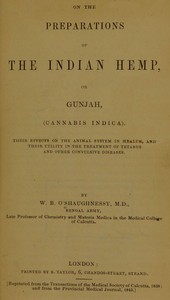
On the Preparations of the Indian Hemp, or Gunjah (Cannabis Indica) Their Effects on the Animal System in Health, and Their Utility in the Treatment of Tetanus and Other — Themes and Context
(0 User reviews)
32
Project Gutenberg
2022
Not confirmed
Cannabis -- Physiological effect; Cannabis -- Therapeutic use
Readers of public-domain and historical texts
Project Gutenberg digital edition
en
Edition facts
Words
15,565
Reading time
68 min
Text sections
5
This digital edition of On the Preparations of the Indian Hemp, or Gunjah (Cannabis Indica) Their Effects on the Animal System in Health, and Their Utility in the Treatment of Tetanus and Other — Themes and Context is described by source-level measurements including 15,565 words, 1 hr 8 min estimated reading time, and 5 detected text sections.
The text analysis averages about 23.3 words per sentence, while the detected sections provide another way to judge how the source is divided.
Project Gutenberg metadata also associates the work with “Cannabis -- Physiological effect,” connecting these edition facts with the source record’s subject description.
Source:
Project Gutenberg record #67959
W. B. O'Shaughnessy's 1838 medical report details experiments with Cannabis indica on animals and humans, including its effects on tetanus and cholera, with vivid accounts of intoxication and clinical observations.
Editorial Edition Score
4.5/5
★★★★★
★★★★★
Calculated from edition completeness, EPUB availability, text structure and catalogue metadata. Not a user rating.
How this score is calculated
- Description quality20 pts
- Title & short description10 pts
- Source metadata20 pts
- Text length15 pts
- Chapters / structure15 pts
- EPUB file integrity20 pts
Total of 100 points, scaled to a 2.5-5.0 range. Editions with an empty description or a missing EPUB file are not scored.
Edition quality
Read the Text
There was sufficient to show that hemp possesses, in small doses, an extraordinary power of stimulating the digestive organs, exciting the cerebral system, of acting also on the generative apparatus. Larger doses, again, were shown by the historical statements to induce insensibility or to act as a powerful sedative. The influence of the drug in allaying pain was equally manifest in all the memoirs referred to. As to the evil sequelæ so unanimously dwelt on by all writers, these did not appear to me so numerous, so immediate, or so formidable, as many which may be clearly traced to over-indulgence in other powerful stimulants or narcotics--viz, alcohol, opium, or tobacco.
The dose in which the hemp preparations might be administered, constituted, of course, one of the first objects of inquiry. Ibn Beitar had mentioned a _direm_, or forty-eight grains of _churrus_; but this dose seemed to me so enormous, that I deemed it expedient to proceed with much smaller quantities. How fortunate was this caution, the sequel will sufficiently denote.
An extensive series of experiments on animals was in the first place undertaken, among which the following may be cited:--
_Expt._ 1.--Ten grains of Nipalese _churrus_, dissolved in spirit were given to a middling sized dog. In half an hour he became stupid and sleepy, dozing at intervals, starting up, wagging his tail as if extremely contented; he ate some food greedily; on being called to he staggered to and fro, and his face assumed a look of utter and helpless drunkenness. These symptoms lasted about two hours, and then gradually passed away; in six hours he was perfectly well and lively.
_Expt._ 2.--One drachm of _majoon_ was given to a small sized dog; he ate it with great delight, and in twenty minutes was ridiculously drunk; in four hours his symptoms passed away, also without harm.
_Expts._ 3, 4, and 5.--Three kids had ten grains each of the alcoholic extract of _gunjah_. In one no effect was produced; in the second there was much heaviness, and some inability to move; in the third a marked alteration of countenance was conspicuous, but no further effect.
_Expt._ 6.--Twenty grains were given, dissolved in a little spirit, to a dog of very small size. In a quarter of an hour he was intoxicated; in half an hour he had great difficulty of movement; in an hour he had lost all power over the hinder extremities, which were rather stiff but flexible; sensibility did not seem to be impaired, and the circulation was natural. He readily acknowledged calls by an attempt to rise up. In four hours he was quite well.
In none of these or several other experiments was there the least indication of pain, or any degree of convulsive movement observed.
It seems needless to dwell on the details of each experiment; suffice it to say that they led to one remarkable result--that while carnivorous animals and fish, dogs, cats, swine, vultures, crows, and adjutants, invariably exhibited the intoxicating influence of the drug, the graminivorous, such as the horse,[4] deer, monkey, goat, sheep, and cow, experienced but trivial effects from any dose we administered.
Encouraged by these results, no hesitation could be felt as to the perfect safety of giving the resin of hemp an extensive trial in the cases in which its apparent powers promised the greatest degree of utility.
_Cases of Rheumatism treated by Hemp. Catalepsy produced by one grain._
The first cases selected were two of acute rheumatism and one of that disease in the chronic form, occurring among the patients in the Clinical Hospital of the Medical College. In the two former but little relief had been derived from a fair trial of antiphlogistic measures, and of Dover’s powder with antimonials; in the last case, sarsaparilla at first, and subsequently the Hemidesmus Indicus with warm baths had been tried without advantage.
On the 6th November, 1838, one grain of the resin of hemp was administered in solution, at two, p.m., to each of these three patients.
At four, p.m., it was reported that one was becoming very talkative, was singing songs, calling loudly for an extra supply of food, and declaring himself in perfect health. The other two patients remained unaffected.
At six, p.m., I received a report to the same effect, but stating that the first patient was now falling asleep.
At eight, p.m., I was alarmed by an emergent note from Nobinchunder Mitter, the clinical clerk on duty, desiring my immediate attendance at the hospital, as the patient’s symptoms were very peculiar and formidable. I went to the hospital without delay, and found him lying on his cot quite insensible, but breathing with perfect regularity, his pulse and skin natural, and the pupils freely contractile on the approach of light.
W. B. O'Shaughnessy opens his 1838 report by contrasting the widespread use of hemp in Asia, Africa, and the Americas with its near absence in Western Europe, noting that only a few youths in Marseilles had tried Egyptian hasheesh as a frolic. He identifies a resinous secretion as the source of hemp's narcotic power, which he argues is absent in European varieties due to climate. This framing sets up a systematic investigation: first a review of historical and popular uses, then animal experiments, and finally clinical trials on tetanus, hydrophobia, and cholera.
From Resinous Secretion to Clinical Trials
O'Shaughnessy structures his report as a progression from botanical and chemical observations to therapeutic application. He first establishes that the narcotic effects depend on a resinous secretion abundant in Indian hemp but absent in European kinds, attributing the difference to climate. He then moves to animal experiments, where he notes increased pulse, appetite, and loquacity, and finally to human cases. This logical sequence mirrors the scientific method of the era, moving from substance to effect to remedy.
Vivid Intoxication: The Case of Dinonath Dhur
Among the most striking passages is O'Shaughnessy's description of a student, Dinonath Dhur, who after ten drops of tincture enacted the role of a Rajah for over three hours. The author notes that Dhur displayed astonishing eloquence, discussed religious and political topics, and disclosed knowledge those who knew him were unprepared for. O'Shaughnessy compares this state to the inspiration of the Delphic oracles, drawing a direct line between hemp intoxication and ancient prophetic ecstasy. The scene is presented as both amusing and scientifically instructive.
Tetanus and the Limits of Hope
In the first case of tetanus treated with hemp, O'Shaughnessy admits he had no data to guide dosage. The patient died on the fifth day, but the author emphasizes that the remedy stripped the malady of its horrors, reducing suffering. He writes that he is not rash enough to hope for a cure, but values the ability to strew the path to the tomb with flowers. This cautious optimism contrasts with the enthusiasm of his students, who reported cures in cholera cases. The tension between hope and evidence runs through the clinical sections.
Recurring Images: Pulse, Surface, and Speech
Throughout the excerpts, O'Shaughnessy returns to a set of observable signs: increased pulse fullness and frequency, glowing skin, extraordinary appetite, and unusual loquacity. In the student experiments, these symptoms are consistently noted, with the pulse checked before dosing. The author also records a transitory cataleptic rigidity in one case. These recurring details anchor the narrative in empirical observation, even when describing the most dramatic effects. The emphasis on measurable bodily changes reflects O'Shaughnessy's training as a chemist and physician.
O'Shaughnessy's report moves between laboratory, clinic, and the streets of Calcutta, where students experimented on themselves and treated cholera patients. Readers should attend to the way he balances firsthand observation with historical and cross-cultural references, and how he navigates between the promise of a new remedy and the sobering realities of diseases like tetanus. The text rewards attention to its structure: a careful build from substance to effect to therapeutic hope, always grounded in specific cases.
I keep returning to O'Shaughnessy’s report, to its careful, almost tender notes on how the body surrenders to a drug, and I find myself thinking of the way Married Love: A New Contribution to the Solution of Sex Difficulties — Reading Companion likewise maps an uncharted interior—both writers, in their own era’s language, trying to name what the pulse already knows.
There are no reviews for this eBook.
There are no comments for this eBook.
Reader reflection
Take a moment to reflect on this book
Create a short personal record of your experience with this book.
Your progress
0
/
10
2
How much did you enjoy the reading experience?
3
How likely are you to recommend this book?
4
How much effort did this book require?
5
Was the book easy to understand?
6
How strongly did the book affect you emotionally?
7
Would this book work well in a reading group?
8
Could you apply anything you learned?
9
What is the main idea you are taking away?
10