1

Secret remedies — Themes and Context
(0 User reviews)
1954
Project Gutenberg
2025
Not confirmed
Patent medicines
Readers of public-domain and historical texts
Project Gutenberg digital edition
en
Edition facts
Words
70,063
Reading time
305 min
Text sections
27
The source record for Secret remedies — Themes and Context measures this digital text at 70,063 words, 5 hr 5 min estimated reading time, and 27 detected text sections.
The text analysis averages about 21.5 words per sentence, while the detected sections provide another way to judge how the source is divided.
Project Gutenberg metadata also associates the work with “Patent medicines,” connecting these edition facts with the source record’s subject description.
Source:
Project Gutenberg record #75168
An analysis of patent medicines' ingredients and costs, based on BMA laboratory tests, exposing the gap between advertised claims and actual composition.
Editorial Edition Score
4.8/5
★★★★★
★★★★★
Calculated from edition completeness, EPUB availability, text structure and catalogue metadata. Not a user rating.
How this score is calculated
- Description quality20 pts
- Title & short description10 pts
- Source metadata20 pts
- Text length15 pts
- Chapters / structure15 pts
- EPUB file integrity20 pts
Total of 100 points, scaled to a 2.5-5.0 range. Editions with an empty description or a missing EPUB file are not scored.
Edition quality
Read the Text
given of some of the proprietary articles which the public are induced to buy for the cure of ordinary colds and catarrh furnish a good example of the absurdity of the barefaced pretensions in which nostrum mongers indulge, for minor ailments are by no means neglected by the makers of nostrums; if the price to be obtained is somewhat lower than in the case of more serious disorders the cost price can be reduced in an equal or greater proportion. Alarming accounts, too, of the evils to be expected if resort be not had to the advertised articles are not wanting. Thus, in the advertisement of one of the articles described below, it is stated that catarrh “invariably creates biliousness, constipation, pleurisy, asthma, bronchitis, catarrhal fever, and consumption”; also that “it is estimated that over 20,000 people died in the United Kingdom last year of consumption caused by catarrh.” The remedy put forward for this malignant disease is shown by analysis to consist of a solution of a pinch of common salt with a trace of carbolic acid, the actual cost of the quantity sold for a shilling being one-thirtieth part of a farthing. The probability that many people would regard a slight cold in the head as not requiring a resort to a “specialist in chronic disease in every form” such as the proprietor of this preparation, is turned to account by a disparaging reference to the medical profession. “Catarrh,” we are told, “in its chronic form (and the complaints arising from it) is a malady which has not, up to the present time, received that attention and research from the medical faculty which it deserves. Most practitioners have given it merely a passing thought, or poohed at it as a mere cold which would soon pass off, and perhaps give some light tonic to tone up the stomach.” Another of the “remedies” described well illustrates the way in which the public is deluded by such “specialists”; camphor, quinine and ipecacuanha are frequently employed as domestic remedies in the early stages of a cold in the head, and persons who believe in their usefulness can no doubt be induced to buy a “cold cure” which professes to contain them in combination with other drugs, presented in a form convenient and agreeable to be taken; but in the tablets which are represented as consisting of cascara, bromide, quinine, ipecacuanha, camphor and bryonia, analysis did not reveal any appreciable traces of cascara, bromide, quinine, ipecacuanha, or camphor. The principal ingredients actually present were cinchonine, an alkaloid found in the bark from which quinine is prepared but cheaper than quinine, and acetanilide, a chemical better known under the name antifebrin, both in very small doses.
Many proprietary medicines of varied kinds are recommended for colds among a host of other complaints for which they are stated to possess curative powers. Apart, however, from such inclusive recommendations, a considerable number are put forward expressly and primarily for cold and catarrh, and it is a selection of these which is here described.
DR. LANE’S CATARRH CURE.
This is prepared and sold by a Company giving an address in London. The price is 1s. a bottle, containing 2½ fluid ounces.
Much printed matter is supplied with this preparation, and a few extracts are here given:
Catarrh, in its chronic form (and the complaints arising from it), is a malady which has not, up to the present time, received that attention and research from the medical faculty which it deserves. Most practitioners have given it merely a passing thought, or poohed at it as a mere cold which would soon pass off, and perhaps give some light tonic to tone up the stomach. And therein lies the fatal error, for Catarrh is a disease that cannot be trifled with, as millions can only too surely testify.
... to let any part or organ of the system become diseased breeds the seeds of a host of other complaints, as all the organs of the body are in sympathy with each other. The cause of this is easily explained in a case of Catarrh.... It invariably creates Biliousness, Constipation, Pleurisy, Asthma, Bronchitis, Catarrhal Fever, and Consumption.
It is estimated that over 20,000 people died in the United Kingdom last year of Consumption caused by Catarrh.
The speciality of myself and Associate Physicians is chronic disease in every form. Our library was selected to this end, and the Herbal World explored for this purpose—the successful treatment of chronic disease.
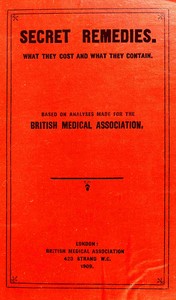
The British Medical Association's 1909 exposé opens with a blunt assertion: secrecy is the quack's chief asset. The preface argues that mystery, not efficacy, sells nostrums—whether the secret is a 'venerable chief's' herb or 'alchemical profundity.' The BMA's response was systematic: buy the products, analyze them, and publish the results. This book is that ledger.
What follows is not a general warning but a catalogue of specific deceptions. Each chapter targets a disorder—catarrh, consumption, obesity—and dissects the corresponding remedies. The tone is clinical, the evidence chemical. Readers should expect tables of ingredients, cost breakdowns, and the occasional reproduced advertisement, all laid out to let the facts speak.
The Anatomy of a Quack Letter
The obesity chapter offers a rare glimpse into the vendor's playbook. The BMA reproduces a sequence of letters from the 'Fell Formula Association,' each escalating the sales pitch. The first offers a free three-day trial promising a three-pound loss. When unanswered, a second letter arrives, now urging a 26-shilling 'case' as the only serious option. A third follows, signed by an 'Adviser,' complete with diet rules and a 'symptom blank.'
The letters share a pattern: initial modesty gives way to urgency, then to the promise of exclusive exercises only with the largest purchase. The language is carefully calibrated—'we can positively assure you,' 'you will never go hungry'—yet the BMA's inclusion of these documents turns advertising into evidence. Readers can watch the rhetorical machinery at work: the gradual shift from free sample to expensive cure, the invocation of authority ('Adviser'), the bundling of diet and exercise as proprietary secrets.
What the Labels Do Not Say
The core of each chapter is the analysis. The BMA does not merely list ingredients; it compares them to the advertised claims. A 'blood purifier' might turn out to be largely Epsom salts. A 'consumption cure' may contain little more than sugar and a trace of quinine. The cost is always noted: a shilling's worth of ingredients sold for half a guinea.
The structure is repetitive by design. Each entry follows a template: product name, price, claimed virtues, then the analyst's report. This repetition becomes its own argument. The same cheap drugs—sodium bicarbonate, aloes, potassium iodide—reappear under different brands, dressed in different promises. The BMA's method is cumulative: by the tenth or twentieth entry, the reader recognizes the pattern. The secrecy that once seemed mysterious now looks like a business model.
The Range of Human Gullibility
The table of contents is a map of early twentieth-century anxieties. Twenty chapters cover everything from baldness to epilepsy, from infant teething powders to cures for inebriety. The breadth is striking: no ailment is too trivial or too serious for a patent remedy. The 'Cure Alls' chapter at the end collects those products that claimed to treat everything at once.
This range tells us something about the market. These remedies were sold not to the desperate alone but to the hopeful—people who wanted a simple solution for a complex problem. The BMA's catalog implicitly argues that the variety of nostrums mirrors the variety of fears. Each chapter is a small case study in how advertising exploits a specific vulnerability. The book as a whole becomes a taxonomy of credulity.
The Limits of the Evidence
The excerpts do not reveal how the BMA selected which remedies to analyze, nor do they show the full analytical methods. The preface mentions that vegetable drugs were harder to identify than inorganic salts, but the technical details are sparse. Readers should note that the book is a snapshot, not a comprehensive survey. It covers only those products the BMA chose to investigate, likely the most heavily advertised.
What is missing is also instructive. There is no follow-up, no discussion of regulatory response, no patient testimonials. The BMA's stance is purely evidentiary: here are the ingredients, here are the prices, here are the claims. The reader is left to draw conclusions. This restraint is part of the book's power. It does not argue; it exhibits.
This is a book to be consulted, not read straight through. The table of contents is the best entry point: pick a disorder, read the corresponding chapter, and compare the claims with the analysis. The letters and advertisements scattered through the text are as revealing as the chemical reports. Pay attention to the pricing—the gap between cost and selling price is the real story. The BMA's work is a tool for skepticism, best used with a specific product in hand.
Reading about those secret remedies, I remembered my grandmother’s shelf of amber bottles, each promising relief yet holding only sugar and spirit. The same quiet ache surfaced when I later picked up A Treatise on Tobacco, Tea, Coffee, and Chocolate — A Closer Reading. That book’s calm reckoning with daily comforts, their hidden costs and quiet habits, felt like watching an old friend finally tell the truth about themselves. Both left me holding ordinary things more tenderly.
There are no reviews for this eBook.
There are no comments for this eBook.
Reader reflection
Before you leave, reflect on the book
Use these questions to collect your thoughts before moving on.
Your progress
0
/
10
2
How much did you enjoy the reading experience?
3
Would you recommend this book to another reader?
4
How demanding did the text feel?
5
Could you see yourself revisiting this book?
6
How distinctive were its ideas or approach?
7
Did any part of the book stay with you emotionally?
8
How clearly were the main ideas presented?
9
What is the main idea you are taking away?
10