1

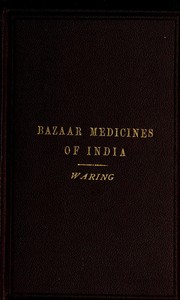
Remarks on the Uses of some of the Bazaar Medicines and Common Medical Plants of India With a full index of diseases, indicating their treatment by these and other agents — A Reader’s Guide
(0 User reviews)
40
Project Gutenberg
2018
Not confirmed
Medicinal plants -- India; Traditional medicine -- India; Botany, Medical -- India; Materia medica, Vegetable -- India
Readers of public-domain and historical texts
Project Gutenberg digital edition
en
Edition facts
Words
73,163
Reading time
319 min
Text sections
12
Before opening Remarks on the Uses of some of the Bazaar Medicines and Common Medical Plants of India With a full index of diseases, indicating their treatment by these and other agents — A Reader’s Guide, the edition data offers a quick orientation: 73,163 words, 5 hr 19 min estimated reading time, and 12 detected text sections.
The text analysis averages about 18.3 words per sentence, while the detected sections provide another way to judge how the source is divided.
Project Gutenberg metadata also associates the work with “Medicinal plants -- India,” connecting these edition facts with the source record’s subject description.
Source:
Project Gutenberg record #58525
This editorial note examines how Waring's 1897 fifth edition of a practical medical guide for India balances catalog subjects like medicinal plants and traditional medicine with its actual content, which includes European drugs, clinical thermometers, and treatments for drowning and snakebite.
Editorial Edition Score
4.8/5
★★★★★
★★★★★
Calculated from edition completeness, EPUB availability, text structure and catalogue metadata. Not a user rating.
How this score is calculated
- Description quality20 pts
- Title & short description10 pts
- Source metadata20 pts
- Text length15 pts
- Chapters / structure15 pts
- EPUB file integrity20 pts
Total of 100 points, scaled to a 2.5-5.0 range. Editions with an empty description or a missing EPUB file are not scored.
Edition quality
Read the Text
empty stomach it is almost sure to nauseate. Patients who can take it at no other time will sometimes retain a dose if given the last thing before going to bed.
_b._ For disguising the nauseous taste and preventing subsequent eructations, a good plan is to take a few grains of common salt, both immediately before and after a dose. As a vehicle, a little orange-wine, or solution of quinine, or lime juice, or hot strong coffee without milk, have been advocated by various writers. A little Omum water (317) is perhaps the best vehicle of all.
_c._ The bulk of the whole dose of the oil and vehicle together should be so small that it may be swallowed at a single draught; therefore the vehicle should not exceed a table-spoonful, with, at first, a teaspoonful of the oil, to be gradually increased to a table-spoonful. The spoon and glass used for taking it should be kept scrupulously clean, as any oil left adhering to them soon turns rancid. In taking this (as well as all other nauseous drugs) it is advisable to prevent, as far as possible, the tongue from coming in contact with it; to effect this the tongue should be projected on the surface of the glass or spoon, and the fluid thrown down as far back in the throat as can conveniently be done.
_d._ The dose, as a general rule, at the commencement is a teaspoonful three times daily, gradually increased as the stomach is able to bear it. It is rarely requisite to exceed a table-spoonful twice or thrice daily; large quantities either derange the stomach and liver, or pass off unabsorbed by the bowels.
_e._ The diet during the course of the oil should be plain and nutritious, consisting of bread, fresh meat roast or boiled, poultry, game, &c., with a fair proportion of vegetables, and fruit, and a moderate quantity of liquids. All rich articles of food, as pastry, fat meat, cream, &c., should be avoided. Wine is preferable to beer, the latter often disagreeing. Should a bilious attack come on, the oil should be discontinued, the diet lightened, and an occasional aperient administered. In a few days, when the attack has passed off, the oil may be resumed, beginning with the small doses as at the first. In all cases during the use of the oil, the bowels should be kept regular, if necessary, by mild aperients.
_f._ During its use the patient should be as much as possible in the open air, and take gentle exercise.
138. It is _in Pulmonary Consumption_ that the value of Fish-liver Oil is most manifest, but there are a large number of cases of a scrofulous character in which it proves almost equally valuable. _In Scrofulous Abscesses_, _Suppurating Glands_, _Ulcerations_, _Discharges whether from the Nose or Ears_, _and Skin Diseases_, especially when the patient is weak and emaciated, the oil is indicated and proves most beneficial. It proves equally useful in _Scrofulous Affections of the_ _Joints and Bones_, especially in _Rickets_; and in _Scrofulous Ophthalmia_.
139. _In the Mesenteric Affections of Children_ the best results often follow its use; the little patient rapidly gains strength and flesh, the tumefied belly becomes reduced, the stools lose their clayey colour and become bilious and healthy. It should not only be given internally, but should be _used as a liniment to the abdomen. The Obstinate Constipation of Children_ sometimes yields to the use of the oil, and its return is prevented while the remedy is continued. _In Stricture of the Rectum_, as an adjunct to dilatation cod-liver oil is an excellent remedy: it nourishes the patient, and softens the motions, rendering aperients unnecessary. (_Mr. Curling._) It is also well worthy of a trial in cases of _Chronic Hydrocephalus, or Water on the Brain_, occurring in children of a scrofulous habit.
140. _In the advanced stages of Hooping Cough, and in other Spasmodic Coughs, which often remain after an attack of Bronchitis_, especially when occurring in weakly children, marked benefit follows its use.
141. _Chorea_ (_St. Vitus's Dance_) _and Epilepsy_ sometimes are benefited by it when more active remedies have failed. The same remark applies to some forms of _Neuralgia_, especially _Tic Douloureux_; but the cases in which it will prove serviceable can only be ascertained by trials with the remedy.
Edward John Waring's Remarks on the Uses of some of the Bazaar Medicines and Common Medical Plants of India (fifth edition, 1897) is cataloged under medicinal plants and traditional medicine, yet the excerpts reveal a work that blends local plant remedies with European pharmaceuticals and emergency procedures. The preface notes the addition of clinical thermometer diagrams and a treatment for smallpox with carbolised oil—neither of which is a bazaar medicine. This note explores how the book's scope exceeds its title, incorporating imported drugs like Senna and castor oil alongside indigenous plants like Sesamum, and addresses conditions such as leprosy, dysentery, and amenorrhea with a mix of local and Western approaches.
Beyond Bazaar Medicines: The Inclusion of European Agents
Despite the title's emphasis on bazaar medicines, the excerpts show Waring routinely discussing imported or European pharmaceutical agents. For example, in the entry on Senna (section 336), he notes that imported Senna is often inferior and recommends Indian-grown Tinnevelly Senna as preferable. He provides a recipe for an infusion with ginger and cloves, comparing it to ordinary tea. Similarly, castor oil is mentioned as a preferred aperient for infants. The preface explicitly states that the fifth edition added diagrams of a clinical thermometer—a device not found in bazaars—with notes for non-professional use. This suggests the book targets a readership that includes European residents and Anglo-Indians who have access to both local markets and imported medical supplies.
Vernacular Names and Local Knowledge
Each plant or drug entry lists multiple vernacular names across Indian languages. For instance, Sesamum oil is given as Til-ká-tél (Hindi, Punjabi), Mittá-tél (Duk.), Nal-enney (Tamil), Manchi-núne (Telugu), and others in Malayalam, Kannada, Marathi, Gujarati, Sinhalese, Kashmiri, Burmese, and Malay. This multilingual cataloging reflects Waring's aim to make the work accessible to a diverse audience across the subcontinent. However, the excerpts also reveal that some remedies are attributed to European practitioners: Dr. Hilson's use of Sesamum oil for leprosy and Mr. B. Evers' trials with Sesamum leaves for dysentery are cited from the Indian Medical Gazette. The book thus functions as a bridge between local plant knowledge and colonial medical practice.
The Index of Diseases as a Practical Tool
The full title promises a 'full index of diseases, indicating their treatment,' and the excerpts confirm that Part II is a synopsis or index with disease names bolded. The entry on Sesamum (section 338a) discusses its use in dysentery, amenorrhea, and dysmenorrhea, with specific dosages and methods (e.g., ten-grain doses of powdered seeds, hip baths). Waring is careful to note limitations: the dysentery cases were mild, and opium was conjoined, so the benefit may not be solely due to the plant. This cautious, evidence-based tone—citing published trials and acknowledging uncertainty—distinguishes the work from a mere compilation of folk remedies. The index allows quick reference for conditions like constipation, leprosy, or snakebite, aligning with the book's stated purpose as a guide for non-professionals in India.
Readers should approach this work as a hybrid text: part pharmacopoeia, part clinical manual, and part colonial medical record. The catalog subjects accurately reflect the emphasis on medicinal plants and traditional medicine, but the excerpts show a broader scope that includes European drugs, emergency treatments, and a critical evaluation of local remedies. The fifth edition's updates, such as the clinical thermometer and carbolised oil for smallpox, indicate the book evolved with contemporary medical practice. For researchers, the vernacular name lists offer a linguistic snapshot of 19th-century Indian materia medica, while the disease index provides insight into prevalent health concerns of the time.
That old Indian pharmacopeia always reminds me how healing resists tidy lists. Its pages wander between herbs and thermometers, trusting the practitioner's hands. I find the same quiet pragmatism in Philosophy of Osteopathy — Key Ideas to Explore, where structure becomes its own remedy. Both books whisper that true knowledge lives not in categories, but in the attentive touch between them.
There are no reviews for this eBook.
There are no comments for this eBook.
Reader reflection
Record your reading impressions
A brief reflection can help important ideas stay with you longer.
Your progress
0
/
10
2
Was reading this book enjoyable?
3
Would you encourage someone else to read it?
4
Did the language feel accessible?
5
How closely did the book connect with your experience?
6
Which aspect of the book did you value most?
7
How valuable was this book for your own interests?
8
How original did the book feel?
9
What is the main idea you are taking away?
10