1

Shell-shock and other neuropsychiatric problems — Background and Themes
(0 User reviews)
417
Project Gutenberg
2016
Not confirmed
World War, 1914-1918 -- Medical care; War neuroses; World War, 1914-1918 -- Psychological aspects
Readers of public-domain and historical texts
Project Gutenberg digital edition
en
Edition facts
Words
321,315
Reading time
1398 min
Text sections
590
The source record for Shell-shock and other neuropsychiatric problems — Background and Themes measures this digital text at 321,315 words, 23 hr 18 min estimated reading time, and 590 detected text sections.
The text analysis averages about 14.0 words per sentence, while the detected sections provide another way to judge how the source is divided.
Project Gutenberg metadata also associates the work with “World War, 1914-1918 -- Medical care,” connecting these edition facts with the source record’s subject description.
Source:
Project Gutenberg record #52105
Southard's 1919 monograph presents 589 case histories from WWI medical literature, analyzing shell-shock through neurological and psychiatric lenses. The work examines diagnostic distinctions between organic and functional disorders, with detailed case narratives and clinical commentary.
Editorial Edition Score
4.9/5
★★★★★
★★★★★
Calculated from edition completeness, EPUB availability, text structure and catalogue metadata. Not a user rating.
How this score is calculated
- Description quality20 pts
- Title & short description10 pts
- Source metadata20 pts
- Text length15 pts
- Chapters / structure15 pts
- EPUB file integrity20 pts
Total of 100 points, scaled to a 2.5-5.0 range. Editions with an empty description or a missing EPUB file are not scored.
Edition quality
Read the Text
One was A Point Scale for Measuring Mental Ability by Robert M. Yerkes, James W. Bridges and Rose S. Hardwick. Published by Warwick and York. Baltimore 1915.)
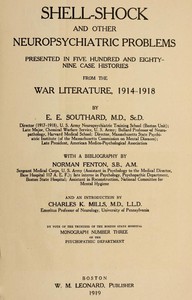
SHELL SHOCK AND OTHER NEUROPSYCHIATRIC PROBLEMS Printed in five hundred and eighty-nine Case Histories BY E. E. SOUTHARD, M.D., Sc.D. Being Monograph Number Three of the Psychopathic Department of the Boston State Hospital, Massachusetts
SHELL-SHOCK AND OTHER NEUROPSYCHIATRY PROBLEMS
Presented in Five Hundred and Eighty-Nine Case Histories from the War Literature, 1914-1918
E. E. SOUTHARD, M.D., Sc.D.
Director (1917-1918), U. S. Army Neuropsychiatric Training School (Boston Unit); Late Major, Chemical Warfare Service, U. S. Army; Bullard Professor of Neuropathology, Harvard Medical School; Director, Massachusetts State Psychiatric Institute (of the Massachusetts Commission on Mental Diseases); Late President, American Medico-Psychological Association
With a Bibliography by Norman Fenton, S.B., A.M.
Sergeant Medical Corps, U. S. Army (Assistant in Psychology to the Medical Director, Base Hospital 117 A. E. F.); late interne in Psychology, Psychopathic Department, Boston State Hospital; Assistant in Reconstruction, National Committee for Mental Hygiene
And an Introduction by Charles K. Mills, M.D., L.L.D.
Emeritus Professor of Neurology, University of Pennsylvania
By Vote of the Trustees of the Boston State Hospital Monograph Number Three of the Psychopathic Department
Boston W. M. Leonard, Publisher 1919
Copyright, 1919, by W. M. Leonard
To THE NATIONAL COMMITTEE FOR MENTAL HYGIENE AND ITS WORK IN WAR AND PEACE
This compilation was begun in the preparedness atmosphere of the U. S. Army Neuropsychiatric Training School at Boston, 1917-18. This particular school had to adapt itself to the clinical material of the Psychopathic Hospital. Although war cases early began to drift into the wards (even including some overseas material), it was thought well to supplement the ordinary “acute, curable, and incipient” mental cases of the hospital wards and out-patient service with representative cases from the literature.
As time wore on, this “preparedness” ideal gave place to the ideal of a collection of cases to serve as a source-book for reconstructionists dealing with neuroses and psychoses. Shortage of medical staff and delays incidental to the influenza epidemic held the book back still further, and, as meantime Brown and Williams had served the immediate need with their _Neuropsychiatry and the War_, it was determined to make the compilation the beginning of a case-history book on the neuropsychiatry of the war, following in part the traditions of various case-books in law and medicine.
With the conclusion of the armistice, there is by no means an end of these problems. Peace-practice in neuropsychiatry is bound to undergo great changes and improvements, if only from the influx into the peace-community of many more trained neuropsychiatrists than were ever before available. This is particularly true in the American community by reason of the many good men specially trained in camp and hospital neuropsychiatry, both at home and in the A. E. F., through the enlightened policy of our army in establishing special divisions of the Surgeon-General’s Office dealing separately with those problems.
Though a book primarily for physicians, some of its material has interest for _line-officers_, who may see how much “criming” is matter for medical experts, by running through the boxed headings (especially of Sections A and B) and reading the simulation cases. As Chavigny remarks, “shooting madmen neither restrains crime nor sets a good example.”
But parts of the book look ahead to _Reconstruction_. Surely occupation-workers, vocationalists, war risk insurance experts, and in fact all reconstructionists, medical and lay, must find much to their advantage in the data of Section D (Treatment and Results). Had time permitted, the whole old story of “Railway Spine”--Shell-shock’s congener--might have been covered in a series of cases from last century’s literature, together with others illustrating the effects of suggestion and psychotherapy; but this must be a post-bellum task.
The compiler, who has personally dictated (and as a rule redictated and twice condensed) all the cases from the originals (or in a few instances, _e.g._, Russian, from translations), hopes he has not added anything new to the accounts. The cases are drawn from the literature of the belligerents, 1914-1917, English, French, Italian, Russian, and--so far as available here--German and Austrian.
Elmer Ernest Southard's 1919 monograph compiles 589 case histories drawn from the war literature of 1914–1918, offering a systematic neuropsychiatric examination of shell-shock and related disorders. The work is structured as a case series, each entry presenting a soldier's symptoms, diagnosis, and often a brief clinical discussion. Southard, a Harvard neuropathologist and U.S. Army neuropsychiatric training school director, brings a rigorous diagnostic framework to the material, frequently citing contemporary neurologists such as Babinski and Roussy.
The excerpts reveal a text that moves between detailed case narratives—like that of a Zouave trapped under a trench beam—and analytical passages that weigh evidence for organic versus functional causes. Southard's authorial voice is clinical and precise, yet the cases themselves carry the raw immediacy of wartime injury.
Case Histories as Clinical Evidence
The monograph's backbone is its 589 case histories, each a compressed record of injury, symptom, and treatment. Southard presents these as primary evidence, often reproducing the original observer's language. For instance, Case 387 describes a Zouave who, after being pinned under a beam, was “entirely anesthetic in the legs” and diagnosed with functional paraplegia plus left internal popliteal neuritis. The narrative includes specific details: the date (December 21, 1914), location (Tracy-le-Mont), and evacuation route (to Paris, then Villejuif). Such granularity is typical, grounding the clinical discussion in verifiable events.
Southard does not simply list cases; he annotates them. After Case 387, he appends a note on popliteal nerve lesions, citing Athanassio-Benisty's comparison of the external popliteal to the musculospiral nerve. This layering of case and commentary is a deliberate structural choice, allowing the reader to see both the raw data and the interpretive framework.
Diagnostic Distinctions: Organic vs. Functional
A central concern in the excerpts is the differentiation between organic nerve damage and hysterical or functional paralysis. Southard devotes careful attention to Babinski's criteria for neuritis: loss of tendon reflexes, muscular atrophy, reaction of degeneration, hypotonus, and characteristic distribution of symptoms. He contrasts these with signs of hysterical paraplegia, which is recognized chiefly by the absence of such organic signs.
The case of the Zouave illustrates this diagnostic tension. The patient had absent Achilles jerk on the left, partial reaction of degeneration, and a history of trauma—yet the rapid recovery with motor reeducation (walking alone in a week) suggested a functional component. Southard's presentation leaves the ambiguity intact, allowing the evidence to speak without forcing a single conclusion. This restraint is a hallmark of his authorial approach.
The Role of Emotion and Suggestion
Southard engages directly with the question of whether emotional shock can produce physical symptoms like monoplegia. He summarizes Babinski's view that genuine monoplegia from sudden emotional shock is unproven, while gradual affective states, compounded with imagination and intellect, offer ample opportunity for suggestion to generate such phenomena. The discussion is careful to distinguish between “emotional shock” and “emotion of a gradual nature,” a distinction that shapes the diagnostic approach.
This theoretical passage sits alongside cases where emotional factors seem implicated. The Zouave's paralysis followed a terrifying event—a beam falling on eight men, killing one—and his symptoms resolved quickly when crutches were removed and he was isolated. Southard does not explicitly label this as suggestion, but the juxtaposition of theory and case invites the reader to consider the mechanisms at work.
Authorial Voice and Clinical Precision
Southard's prose is marked by clinical detachment and a preference for precise terminology. He writes of “functional paraplegia plus left internal popliteal neuritis” rather than using colloquial terms. His sentences are often dense with diagnostic criteria, as in the list of signs for organic paraplegia: alteration of tendon reflexes, the Babinski sign, exaggeration of defense reflexes, muscular atrophy with R.D., sphincter disorder, and skin changes. This vocabulary assumes a medically literate audience.
Yet the authorial voice is not entirely impersonal. The dedication page lists three neurologists “In Memoriam” (Horsley, Dejerine, Van Gehuchten), signaling a sense of professional lineage and loss. The monograph is Monograph Number Three of the Psychopathic Department of the Boston State Hospital, placing it within an institutional research program. Southard's role as director of the U.S. Army Neuropsychiatric Training School further contextualizes his authority and purpose.
Readers approaching this work should expect a dense, case-driven text that demands familiarity with early twentieth-century neurological terminology. Southard's method is cumulative: each case adds a piece to a diagnostic puzzle, and his commentary often raises more questions than it settles. The monograph is best read as a primary source for understanding how military medicine conceptualized shell-shock during and immediately after World War I, rather than as a narrative history. Pay attention to the footnotes and cross-references, which link cases and reveal the evolving clinical conversation.
I keep thinking about Southard’s case files—how each one felt like a quiet, unfinished story. There’s something grounding in old clinical writing, the way it holds suffering without rushing past it. I found that same patient weight in A system of practical medicine. By American authors. Vol. 2 — Text and Context, as if the pages still carry someone’s careful attention. It lingered, much like the other.
There are no reviews for this eBook.
There are no comments for this eBook.
Reader reflection
Record your reading impressions
A brief reflection can help important ideas stay with you longer.
Your progress
0
/
10
2
Was reading this book enjoyable?
3
Is this a title you would suggest to others?
4
How demanding did the text feel?
5
How strongly did the book affect you emotionally?
6
How would you rate its originality?
7
Was the book moving at the right speed?
8
How valuable was this book for your own interests?
9
In one sentence, what did you learn?
10