1

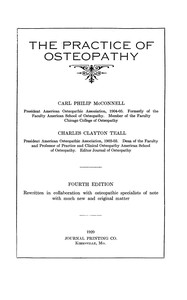
The practice of osteopathy — A Closer Reading
(0 User reviews)
578
Project Gutenberg
2025
Not confirmed
Osteopathic medicine
Readers of public-domain and historical texts
Project Gutenberg digital edition
en
Edition facts
Words
328,274
Reading time
1428 min
Text sections
68
Before opening The practice of osteopathy — A Closer Reading, the edition data offers a quick orientation: 328,274 words, 23 hr 48 min estimated reading time, and 68 detected text sections.
The text analysis averages about 18.0 words per sentence, while the detected sections provide another way to judge how the source is divided.
Project Gutenberg metadata also associates the work with “Osteopathic medicine,” connecting these edition facts with the source record’s subject description.
Source:
Project Gutenberg record #75696
A 1920 osteopathic textbook by McConnell and Teall, detailing manipulative treatments for diseases like smallpox, with precise hygienic and dietary regimens, reflecting early 20th-century clinical practice and the tension between manual therapy and conventional medicine.
Editorial Edition Score
4.9/5
★★★★★
★★★★★
Calculated from edition completeness, EPUB availability, text structure and catalogue metadata. Not a user rating.
How this score is calculated
- Description quality20 pts
- Title & short description10 pts
- Source metadata20 pts
- Text length15 pts
- Chapters / structure15 pts
- EPUB file integrity20 pts
Total of 100 points, scaled to a 2.5-5.0 range. Editions with an empty description or a missing EPUB file are not scored.
Edition quality
Read the Text
ctive and passive movements in the treatment of fractures and of severe sprains has been gradually gaining in the number of its advocates through the writings of Lucas-Championniere of Paris. We owe him a great debt for calling the attention of the profession to the employment of these methods in order to prevent atrophy and ankylosis as well as to promote healing....
“Before taking up my subject in detail permit me to recall a few salient points in the surgical pathology of fracture. Soon after the injury the blood clot around and between the ends of the fragments is absorbed and replaced by a jelly-like mass of young connective tissue cells called the callus. It corresponds to the solder which the plumber places over the ends of two pipes he desires to join. Bone begins to form at the periphery of the callus about the tenth day and advances toward the center rapidly, forming a ring of bone around the ends of the fragments so that by the end of the third week there is but slight abnormal motion at the point of fracture (exception to this is the femur). This entirely disappears by the end of the fourth week, especially in young people, and the union is firm. In the case of the femur it requires six or eight weeks. The greater the displacement of the ends of the fragment, the larger the callus and the slower the healing of the fracture.
“During these changes (callus formation) the muscles which supply the immobilized joints atrophy and the circulation in the skin and neighboring tissues is sluggish, resulting in swelling, etc., of the limb. The enforced rest causes more or less fluid to accumulate in the tendon sheaths and joints. This becomes organized and results in fibrous ankylosis of the joints and great impediment to the free action of the tendons within their sheaths. It is this atrophy, fibrous ankylosis and tenovaginitis which interfere with the restoration of the normal functions of the limb....
“Can we decrease the amount of wasting of muscles and control the stiffness of joints and tendons after fractures?
“It is the belief of the writer, based on a large experience, that the earlier use of massage, active and passive motions, will to a great extent eliminate the above conditions, which retard convalescence and in some cases cause permanent disability.
“Massage of an injured limb increases the amount of blood supplied to it, promotes the absorption of the swelling and prevents atrophy of muscles. In the case of a joint injury the exudate rapidly disappears and the articular surfaces can be again approximated so that movement is facilitated. By the cautious use of active and passive movements, either with or without the aid of apparatus, the normal functions of a joint can be rapidly restored....
“The active and passive movements of the limbs can be carried out immediately after the massage, but should only be permitted for a period of =five minutes= at first and the time then gradually increased. When a severe sprain, say the elbow or ankle, is first massaged, the pain seems to be almost unbearable, but this discomfort as well as the swelling rapidly disappears, and it is surprising to those who have never applied this treatment how quickly the normal function of the joint reappears. The same applies to the synovitis which accompanies fractures in close proximity or even into joints.”
The relief given these cases by massage, movements and manipulations by the osteopath is a daily experience, and results to him are not surprising. Then in addition to what the surgeon would do, the osteopath applies his principles of careful detail readjustment.
Eisendrath continues his paper by referring to the principal varieties of fractures and giving the treatment for each. He says that if correct treatment is carried out with proper massage and movements in fractures of one or both bones of the leg, the patient will be at work in six or seven weeks instead of three or four months, that in Colle’s fracture some surgeons do not employ a splint, and that in fractures of the olecranon, massage from the first week on is of the greatest use. This part is very interesting but space forbids giving it.
He then concludes his article with citation of several very interesting cases of fractures and severe sprains. These cases are exceptionally interesting to the osteopath, but still the same good treatment and results are duplicated every day in the osteopathic school.
The doctor’s contraindications to the use of early massage in fractures or sprains are the following:
“1. Tendency to displacement of fragments in oblique fractures. Under such conditions it is best not to begin either massage or movements until the union is firm (fourth to fifth week).
The fourth edition of The Practice of Osteopathy opens with a striking admission: osteopathy's literature is 'backward' despite a 'vast amount of unclassified journalistic matter.' The authors, both former presidents of the American Osteopathic Association, position their work as a consolidation of scattered knowledge, drawing on reports from experienced practitioners and signed contributions from specialists. The preface reveals a deliberate strategy: to avoid 'undue optimism' while not losing sight of osteopathy's reputation for performing 'the so-called impossible.' This tension between humility and advocacy sets the tone for a text that is at once a clinical manual and a defense of a still-young profession.
The Borderline Between Osteopathy and Surgery
The preface explicitly acknowledges a 'border line between osteopathy and surgery' that the book attempts to delineate 'as well as can be done on paper without the actual patient in hand.' This phrase captures a central challenge: the authors must define osteopathy's scope without access to the individual case, relying on general principles. Throughout the excerpts, this boundary is tested. For instance, in treating smallpox, manipulative treatment is deemed unnecessary during the pustular stage due to skin tenderness, yet 'constitutional treatment' is recommended during convalescence. The text also references medical literature freely, borrowing 'its store of knowledge' where needed, suggesting a pragmatic rather than dogmatic approach. The authors do not claim osteopathy can replace surgery, but they resist drawing 'a hard and fast line on our limitations,' leaving room for the practitioner's judgment.
The Mechanical Eye Behind All Motions
A recurring motif in the excerpts is the emphasis on the practitioner's 'individuality' and 'mechanical eye.' The authors assert that osteopathy is 'not so much a question of books as it is of intelligence,' privileging tactile and observational skill over textual knowledge. This is reflected in the detailed treatment protocols for smallpox, which include specific spinal adjustments: 'relaxation and adjustment of the great splanchnic and cervical areas' for vomiting, and 'deep, steady digital pressure in the suboccipital fossa' for headache. The language is precise—'eighth thoracic spine,' 'fourth and fifth dorsal vertebræ'—yet the outcomes depend on the operator's ability to feel and respond. The text thus functions as a guide for developing that 'mechanical eye,' offering patterns without prescribing rigid formulas.
Hygiene, Diet, and the Body's Environment
The smallpox section devotes considerable space to hygienic care and diet, revealing osteopathy's holistic bent. Instructions include cleansing the nose with glycerine, washing eyes with warm boric acid, and using cold compresses to reduce edema. Diet progresses from 'pellets of ice' during vomiting to barley water, then milk, eggs, and broths, and finally a 'full, well-regulated, nutritious diet' during convalescence. The authors also address environmental factors: a 'filthy environment' worsens prognosis, and plenty of fresh air is 'best of all' for controlling odor. These details show that osteopathic practice extended beyond spinal manipulation to encompass the patient's surroundings and nutrition, reflecting a comprehensive model of health that integrated manual therapy with general medical care of the era.
Readers approaching this text should note its dual character: it is both a practical handbook for the osteopathic clinician and a document of professional self-definition. The authors' willingness to cite medical literature and acknowledge limitations makes it a valuable historical record of how osteopathy positioned itself relative to mainstream medicine in 1920. The detailed treatment regimens, from spinal adjustments to dietary plans, reward close reading for the insight they offer into early osteopathic reasoning.
There’s something touching about how those old osteopaths treated smallpox with such precise hands and hygienic rituals, a faith in the body’s own turning. It reminds me of another quiet volume, On Snake-Poison: Its Action and Its Antidote — Text and Context, where poison and remedy wrestle in the margins. Both feel like whispers from a slower, more trusting medicine.
There are no reviews for this eBook.
There are no comments for this eBook.
Reader reflection
What was your reading experience?
Capture what you thought, learned, and would like to remember.
Your progress
0
/
10
2
How did the book work for you overall?
3
Would you pass this book on to a friend?
4
How demanding did the text feel?
5
How strong was your personal connection to the text?
6
How much did the book move you?
7
How distinctive were its ideas or approach?
8
How valuable was this book for your own interests?
9
What is the main idea you are taking away?
10