1

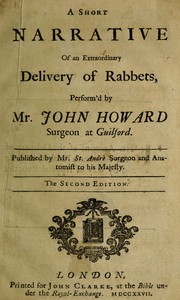
A Short Narrative of an Extraordinary Delivery of Rabbets, Perform'd by Mr. John Howard Surgeon at Guilford — Context and Discussion
(0 User reviews)
1792
Project Gutenberg
2020
Not confirmed
Fraud; Obstetrics -- Early works to 1800; Toft, Mary, 1703-1763; Factitious disorders
Readers of public-domain and historical texts
Project Gutenberg digital edition
en
Edition facts
Words
8,555
Reading time
38 min
Text sections
1
A Short Narrative of an Extraordinary Delivery of Rabbets, Perform'd by Mr. John Howard Surgeon at Guilford — Context and Discussion can be approached with a clearer sense of reading commitment from its source measurements: 8,555 words, 38 min estimated reading time, and 1 detected text section.
The text analysis averages about 27.5 words per sentence, while the detected sections provide another way to judge how the source is divided.
Project Gutenberg metadata also associates the work with “Fraud,” connecting these edition facts with the source record’s subject description.
Source:
Project Gutenberg record #62720
Nathanael St. André's 1727 pamphlet recounts his involvement in the Mary Toft case, where a woman allegedly gave birth to rabbits. The narrative is built on affidavits, letters, and clinical observations, revealing a guarded authorial voice that shifts from credulity to cautious neutrality.
Editorial Edition Score
4.4/5
★★★★★
★★★★★
Calculated from edition completeness, EPUB availability, text structure and catalogue metadata. Not a user rating.
How this score is calculated
- Description quality20 pts
- Title & short description10 pts
- Source metadata20 pts
- Text length15 pts
- Chapters / structure15 pts
- EPUB file integrity20 pts
Total of 100 points, scaled to a 2.5-5.0 range. Editions with an empty description or a missing EPUB file are not scored.
Edition quality
Read the Text
Mr. _Howard_’s House, we found her dress’d in her Stays, sitting on the Bed-side with several Women near her. I immediately examined her, and not finding the Parts prepared for her Labour, I waited for the coming on of fresh Pains, which hapned in three or four minutes, at which time I deliver’d her of the entire Trunk, strip’d of its Skin, of a Rabbet of about four Months growth, in which the Heart and Lungs were contained with the Diaphragm entire. I instantly cut off a piece of them, and tried them in Water; they seemed but just specifically lighter than it, and Mr. _Molyneux_ pressing them to the Bottom they rose again very slowly; the Heart was very large, and its _Foramen Ovale_ entirely open; the Lungs were remarkably small, and of a much darker Colour than commonly the Lungs are of such Rabbets, who have breathed for some time. No Person but my self touch’d her, from the first time that I had examined her, to the time of her being deliver’d by me: Her Pains were pretty smart, and lasted for some Minutes; they went off the Moment she was deliver’d, and she seem’d chearful and easy; walked by herself from the Bed-side to the Fire, and sat on a Chair, where I examined her; and found, that in the Course of the _Fallopian Tubes_, there were some Inequalities, but more sensibly on the right side of her Belly; which made me conjecture that the Rabbets were bred in those Tubes, and only came into the _Uterus_, when they gave her those Agitations, which, according to the account of Mr. _Howard_ and of several other Persons, were sensibly felt many Hours before their Exclusion.
As there was no Blood nor Water that issued from the _Vagina_, after I had delivered her, I again examined that Part, and found it not in the least inflamed or lacerated.
Upon examining her Breasts, I found Milk in one of them, but only a little yellowish _Serum_ in the other.
Her Pulse was regular, but somewhat low, her Tongue florid; and upon asking for her Water, those about her answered, she made very little, and that they had not saved any.
She informed us, that in the Intervals of her Labour-Pains she was tolerably easy, and had no inclination for any sort of Food but Beef.
About two Hours after we had left her, they came again to call Mr. _Howard_, she being at that Time in violent Labour-Pains; but he and my self were gone to see the Mayor, who was then ill. The Nurse that attended her had delivered her, before our return, of the lower Part of a Male Rabbet, which we found totally with the Trunk, which I had before extracted: This was also strip’d of its Skin, and compleatly perfect in all its Parts, but more manifestly so in those of Generation.
In the _Rectum_ of this Animal, which remain’d affix’d to the Body, we found five or six Pellets, much of the same Colour and Consistence as the common Dung of a Rabbet, little Bodies, like dried Fragments, being matted together with a mucous Matter. The like was observed in some other Parts of those Rabbets, which had come away before. In the other Bowels there was a dirty colour’d _Mucus_, of the Nature of that which is constantly found in the Bowels of all _fœtus_ Animals, and which in those that void their Excrements in Pellets, is commonly hard and dry; but the Matter in the Guts of the first Animal was of an entire different Kind, Colour and Substance from any of the rest, this being like little Filaments of an Animal Substance. In the Middle of the Gut _Ilium_ of this Creature, I found a very slender, brittle, white Body, of the Length of half an Inch, which in Shape was like a very small Fish-bones.
St. André opens his narrative with a defensive declaration: he will relate only what he saw and transacted himself, disclaiming responsibility for the broader account. This immediate narrowing of scope sets a tone of cautious self-preservation. The pamphlet is structured around dated letters, affidavits, and clinical observations, creating a documentary feel that contrasts with the extraordinary claim at its center.
A Voice of Guarded Credulity
St. André's language oscillates between professional detachment and implicit belief. He describes Mr. Howard as 'a Man of known Probity, Character, and Capacity in his Profession,' a phrase that does more than vouchsafe Howard—it signals the author's own investment in the credibility of the source. The repetition of 'Fact' and 'Truth' (e.g., 'the Truth of such an Extraordinary Event') suggests an anxiety to preempt skepticism. Yet the narrative voice remains oddly passive: St. André 'received Intelligence,' saw an account, and transcribed letters. He rarely asserts his own judgment, instead letting documents speak. This technique both shields him from accusation and subtly implies that the evidence is too weighty to dismiss.
Clinical Detail as Rhetorical Anchor
The pamphlet grounds its extraordinary claim in precise, almost tedious clinical observation. St. André notes the woman's 'exquisite Torture,' an irregular pulse, a white tongue, and urine 'deeply stained with a Mucus, and livid Blood.' These details mimic the language of a medical case report, lending an air of objectivity. The description of a membrane 'in Structure, Shape and Size exactly like the former' repeats a formula of exactitude. Yet the very specificity—seven or eight minutes of labour, a rabbit of 'about three Months Growth'—invites scrutiny. St. André seems to anticipate doubt by overwhelming the reader with sensory data, but the accumulation of such detail also exposes the narrative to the charge of over-protesting.
Shifts in Pace and the Weight of Affidavit
The narrative's rhythm changes markedly when St. André introduces legal documents. The opening letters are summarized in flowing prose, but the affidavit of John Howard is quoted verbatim, with its formal oath and repetitive phrasing ('this Deponent saith,' 'this Deponent finding'). This shift to legal language slows the pace and imports a different kind of authority—that of sworn testimony. The affidavit recounts Howard directing Mr. Ahlers in extraction, a moment that undercuts Ahlers's later claims of skepticism. St. André then appends a certificate from S. Molyneux, who affirms the narrative's agreement with his own relation but refuses to judge whether fraud occurred. This abrupt halt—from dramatic delivery to cautious legalism—leaves the reader suspended between belief and doubt, exactly where St. André positions himself.
Readers should attend to the pamphlet's silences: St. André never describes Mary Toft's own words or demeanor. The woman is a passive body, acted upon by surgeons and officials. This absence is itself a clue to the narrative's purpose—not to understand Toft, but to manage the reputations of the men involved. The shifting registers, from clinical to legal to defensive, reward a slow reading that tracks who speaks and who is silent.
The rain kept time with St. André’s hedging affidavits, that strange mix of belief and retreat. Afterwards, I found myself thinking about how much trust rests on a doctor’s word—how it morphs across centuries. That quiet thread led me to Sir James Young Simpson and Chloroform (1811-1870) Masters of Medicine — Edition Insights, another man whose certainty redrew what medicine could promise.
There are no reviews for this eBook.
There are no comments for this eBook.
Reader reflection
Before you leave, reflect on the book
Use these questions to collect your thoughts before moving on.
Your progress
0
/
10
2
How did the book work for you overall?
3
Would you pass this book on to a friend?
4
How much effort did this book require?
5
Did any part of the book feel personally relevant?
6
Was the book what you thought it would be?
7
Could you apply anything you learned?
8
What was the strongest part of the book?
9
In one sentence, what did you learn?
10