1

A Text-book of Diseases of Women — Background and Themes
(0 User reviews)
1176
Project Gutenberg
2017
Not confirmed
Women -- Diseases
Readers of public-domain and historical texts
Project Gutenberg digital edition
en
Edition facts
Words
144,047
Reading time
627 min
Text sections
20
The catalog record for A Text-book of Diseases of Women — Background and Themes provides practical reading context through 144,047 words, 10 hr 27 min estimated reading time, and 20 detected text sections.
The text analysis averages about 19.3 words per sentence, while the detected sections provide another way to judge how the source is divided.
Project Gutenberg metadata also associates the work with “Women -- Diseases,” connecting these edition facts with the source record’s subject description.
Source:
Project Gutenberg record #54982
A 1908 gynecology textbook by Charles B. Penrose, written for medical students, emphasizing practical treatment over theory. Excerpts reveal a preference for single-treatment plans and detailed surgical reasoning, such as bilateral salpingo-oöphorectomy for pyosalpinx.
Editorial Edition Score
4.9/5
★★★★★
★★★★★
Calculated from edition completeness, EPUB availability, text structure and catalogue metadata. Not a user rating.
How this score is calculated
- Description quality20 pts
- Title & short description10 pts
- Source metadata20 pts
- Text length15 pts
- Chapters / structure15 pts
- EPUB file integrity20 pts
Total of 100 points, scaled to a 2.5-5.0 range. Editions with an empty description or a missing EPUB file are not scored.
Edition quality
Read the Text
THE GENERAL CAUSES OF DISEASES OF WOMEN 15
METHODS OF EXAMINATION 19
Examination of the Abdomen, 19.--Examination of the External Genitals and Pelvic Structures, 22.--Vaginal and Bimanual Examination, 23.--Examination of the Rectum, 33.--Examination of the Bladder, 34.--Antisepsis, 35.
DISEASES OF THE EXTERNAL GENITALS 36
Vulvitis, 36.--Inflammation of the Vulvo-vaginal Glands, 38.--Suppuration of the Vulvo-vaginal Gland, 39.--Cysts of the Vulvo-vaginal Glands, 40.--Pruritus Vulvæ, 42.--Kraurosis Vulvæ, 44.--Varicose Tumors of the Vulva, 46.--Hematoma of the Vulva, 46.--Papilloma, 46.--Elephantiasis, 47.--Adhesions of the Clitoris, 48.
DISEASES OF THE VAGINA 49
Inflammation of the Vagina, 49.--Tumors of the Vagina, 51.--Atresia of the Vagina, 52.--Vaginismus, 53.--Coccygodynia, 54.
ANATOMY AND MECHANISM OF THE PERINEUM 56
INJURIES TO THE PERINEUM 62
Slight Median Laceration of the Perineum, 67.--Median Tear involving the Sphincter Ani, 68.--Laceration through the Sphincter Ani, involving the Recto-vaginal Septum, 73.--Laceration in One or Both Vaginal Sulci, 75.--Subcutaneous Laceration of the Muscles and Fascia, 85.
RESULTS OF LACERATION OF THE PERINEUM 87
Rectocele, 87.--Cystocele, 88.--Enterocele, 91.--Subinvolution of the Vagina, 92.
THE POSITION OF THE UTERUS AND THE MECHANISM OF ITS SUPPORT 94
PROLAPSE OF THE UTERUS 101
ANTEFLEXION OF THE UTERUS 119
RETROFLEXION AND RETROVERSION OF THE UTERUS 127
LACERATION OF THE CERVIX UTERI 148
_Inflammation of the Cervical Mucous Membrane_ (_Cervical Catarrh_) 166
CONGENITAL EROSION AND SPLIT OF THE CERVIX 174
CERVICAL POLYPI; HYPERTROPHIC ELONGATION OF THE CERVIX; CHANCRE OF THE CERVIX; TUBERCULOSIS OF THE CERVIX 178
Cervical Polypi, 178.--Hypertrophic Elongation of the Vaginal Cervix, 178.--Chancre of the Cervix, 180.--Tuberculosis of the Cervix, 180.
CANCER OF THE CERVIX UTERI 181
DISEASES OF THE BODY OF THE UTERUS 199
Acute Corporeal Endometritis, 199.--Chronic Corporeal Endometritis, 201.--Exfoliative Endometritis, or Membranous Dysmenorrhea, 212.--Senile Endometritis, 213.
SUBINVOLUTION OF THE UTERUS; SUPERINVOLUTION OF THE UTERUS 215
CANCER AND SARCOMA OF THE UTERUS 218
Cancer of the Body of the Uterus, 218.--Malignant Adenoma, 221.--Sarcoma of the Uterus, 225.--Diffuse Sarcoma of the Mucous Membrane, 225.--Sarcoma of the Uterine Parenchyma, 227.--Chorio-epithelioma or Syncytioma Malignum, 228.
FIBROID TUMORS OF THE UTERUS 230
Adenomyoma of Uterus, 257.
HEMATOMETRA; HYDROMETRA; PYOMETRA 259
TUBERCULOSIS OF THE UTERUS 261
INVERSION OF THE UTERUS 264
DISEASES OF THE FALLOPIAN TUBES 272
Inflammation of the Fallopian Tubes, or Salpingitis, 276.--Acute Salpingitis, 277.--Chronic Salpingitis, 279.--Suppuration of the Pelvic Cellular Tissue, 303.
DISEASES OF THE FALLOPIAN TUBES (_Continued_) 306
Tuberculosis, 306.--Adenoma, Myoma, Cancer, Sarcoma, Actinomycosis, and Syphilitic Gummata of the Fallopian Tubes, 313.
Ovarian Pregnancy, 329.
DISEASES OF THE OVARIES 330
DISEASES OF THE OVARIES (_Continued_) 334
Hernia of the Ovary, 334.--Prolapse of the Ovary, 335.--Inflammation of the Ovary, Oöphoritis, or Ovaritis, 339.--Acute Oöphoritis, 339.--Chronic Oöphoritis, 341.--Apoplexy of the Ovary, 346.--Ovarian Hydrocele, 346.
CYSTIC TUMORS OF THE OVARY 349
Oöphoritic Cysts, 350.--Follicular Cysts, 350.--Glandular Cysts, 354.--Dermoid Cysts, 359.--Teratoma, 361.--Paroöphoritic Cysts, or Papillomatous Ovarian Cysts, 362.
CYSTS OF THE PAROVARIUM 368
Comparison of Oöphoritic, Paroöphoritic, and Parovarian Cysts, 372.--Glandular Oöphoritic Cyst, 372.--Paroöphoritic Cyst, 373.--Cysts of the Parovarium, 373.
NATURAL HISTORY AND TREATMENT OF OVARIAN CYSTS 374
Secondary Changes or Accidents of Ovarian Cysts, 374.--Inflammation and Suppuration, 374.--Torsion of the Pedicle, or Axial Rotation, 375.--Rupture of Ovarian Cysts, 377.--The Clinical History of Ovarian Cysts, 378.--Examination, 383.--Treatment of Ovarian Cysts, 387.
SOLID TUMORS OF THE OVARY 390
Fibromata, 390.--Myomata, 390.--Sarcomata, 391.--Carcinomata, 392.--Ovarian Papillomata, 393.--Tuberculosis of the Ovary, 393.--Tumors of the Ovarian Ligament, 394.
MALFORMATIONS OF THE GENITAL ORGANS 395
Uterus Unicornis, 396.--Uterus Didelphys, 396.--Uterus Bicornis Duplex, 396.--Uterus Bicornis Unicollis, 397.--Uterus Cordiformis, 397.--Uterus Septus, 397.--Malformation of the Vagina, 397.--Hermaphroditism, 399.
DISORDERS OF MENSTRUATION 402
Amenorrhea, 405.--Acute Suppression of Menstruation, 407.--Scanty Menstruation, 407.--Vicarious Menstruation, 408.
Vesico-vaginal Fistula, 412.--Urethro-vaginal Fistula, 420.--Vesico-uterine Fistula, 420.--Uretero-vaginal Fistula, 421.--Recto-vaginal Fistula, 421.
DISEASES OF THE URETHRA AND BLADDER 423
Diseases of the Urethra, 426.--Urethritis, 427.--Stricture of the Urethra, 430.--Prolapse of the Mucous Membrane of the Urethra, 431.--Vesico-urethral Fissure, 431.--Dilatation of Urethra, 433.--Urethrocele, 434.--Urethral Neoplasms, 434.--Urethral Caruncle, 434.--Urethral Cysts, 435.--Polypus, 435.--Sarcoma and Cancer of the Urethra, 436.--Diseases of the Bladder, 436.--Cystitis, 437.--Vesical Calculus, 447.
GONORRHEA IN WOMEN 448
THE TECHNIQUE OF GYNECOLOGICAL OPERATIONS 457
Operating-room, 461.--Apparatus, 462.--Operator, Assistants, Nurses, 463.--Sterilization of Dressings, Towels, etc., 466.--Sterilization of Instruments, 466.--The Water, 467.--Sponges, 468.--Discipline of the Operating-room, 469.--Anesthesia, 470.--Preparation of the Patient, 471.--Instruments, 475.--The Dressing, 479.
THE TECHNIQUE OF GYNECOLOGICAL OPERATIONS (_Continued_) 480
Abdominal Drainage, 480.--Gauze-drainage, 482.--Indications for Drainage, 484.--Vaginal Drainage, 487.--The Incision of the Abdominal Wall, 487.--Exploration of the Abdomen, 489.--Protection of the Intestines and Omentum, 489.--Toilet of the Peritoneum, 490.--Closing the Abdominal Incision, 491.
TREATMENT AFTER CELIOTOMY 404
THE SPECIAL TECHNIQUE OF OPERATIONS UPON THE UTERUS AND THE UTERINE APPENDAGES 502
Removal of the Uterine Appendages (Salpingo-oöphorectomy), 504.--Removal of an Ovarian Cyst, 512.--Operation for the Removal of Intra-ligamentous Cysts, 514.--Marsupialization of the Cyst, 516.--Operation for Removal of the Uterus, 517.--Supra-vaginal Amputation of the Uterus, 518.--Preservation of the Ovaries in Hysterectomy, 523.--Complete Abdominal Hysterectomy, 523.--Vaginal Hysterectomy, 527.--Combined Vaginal and Abdominal Hysterectomy, 531.--Abdominal Myomectomy, 533.
THE EFFECT OF THE REMOVAL OF THE UTERINE APPENDAGES 535
THE GENERAL CAUSES OF DISEASES OF WOMEN.
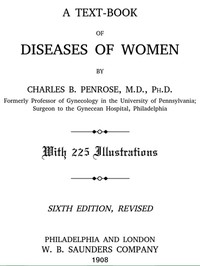
Charles B. Penrose’s A Text-book of Diseases of Women (sixth edition, 1908) was written expressly for the medical student, aiming to present “the best teaching of modern gynecology, untrammelled by antiquated theories.” The preface states that for each disease, Penrose typically recommends only one plan of treatment, to avoid confusing the reader. The excerpts show a work grounded in surgical decision-making, with detailed discussions of when to remove both Fallopian tubes versus one, and when to also remove the uterus. The text reflects early 20th-century gynecological practice, before antibiotics, where infection management relied on surgery and antisepsis.
Surgical Reasoning in Tubal Disease
The excerpts devote considerable space to the management of pyosalpinx and other tubal infections. Penrose describes a common clinical dilemma: when only one tube appears diseased, should both be removed? He notes that in gonorrheal salpingitis, infection may persist in the utricular glands despite thorough curetting, leading to recurrence in the second tube. He reports that many women, “profiting by the experience of their friends,” request removal of both tubes even when only one is found diseased. For hydrosalpinx or adherent tubes without cystic distention, unilateral operation is safer. The text emphasizes that thorough treatment of endometritis at the same operation reduces the risk of recurrence. This section illustrates how the author weighs patient history, infection type, and surgical risk in his recommendations.
The Evolution of Pelvic Abscess Understanding
Penrose discusses suppuration of pelvic cellular tissue, noting that before modern abdominal surgery, such abscesses were drained through the vagina, rectum, or abdominal wall, often resulting in persistent sinuses. He states that “there were many theories in regard to the origin of the suppuration,” but that opening the abdomen revealed that the majority originated from septic infection of the Fallopian tubes, with cellular tissue infection secondary. This passage shows how surgical exploration transformed understanding of pelvic pathology. The text acknowledges rare primary cellular tissue suppuration but frames it as exceptional. The author’s language is cautious, grounding claims in surgical observation rather than speculation.
Structure and Intended Audience
The book’s organization is systematic: chapters cover general causes, examination methods, then diseases by anatomical region (external genitals, vagina, etc.). The preface states that anatomy, physiology, and pathology are omitted unless “peculiar to the diseases under consideration,” directing students to general textbooks for foundational knowledge. The excerpts show a direct, instructional tone, with numbered lists and clear recommendations. The sixth edition was revised to reflect “the increase of our knowledge of gynecology.” The text includes 225 illustrations, though none are reproduced in the excerpts. This structure suggests a practical reference for clinical decision-making rather than a comprehensive treatise.
Readers should note that this textbook represents gynecological knowledge from over a century ago. The excerpts reveal a strong reliance on surgical intervention and a hierarchical approach to treatment. The author’s preference for single-treatment plans may simplify learning but omits alternative approaches. The text is best understood as a historical document of medical practice, not a current clinical guide.
There’s something humbling about old medical texts—their certainty, their narrow zeal. I kept thinking how that same earnest practicality runs through Encyclopedia of Diet: A Treatise on the Food Question, Vol. 1Encyclopedia of Diet: A Treatise on the Food Question, Vol. 1 — Inside the Classic, both trusting in one clean answer for bodies that rarely cooperate. It lingers quietly, like knowing a friend’s forgotten conviction.
There are no reviews for this eBook.
There are no comments for this eBook.
Reader reflection
Before you leave, reflect on the book
Use these questions to collect your thoughts before moving on.
Your progress
0
/
10
2
What was your overall reaction to the book?
3
How likely are you to recommend this book?
4
How easy was the book to follow?
5
How distinctive were its ideas or approach?
6
How much did the book move you?
7
How valuable was this book for your own interests?
8
Did any part of the book feel personally relevant?
9
What did this book teach you most?
10