1

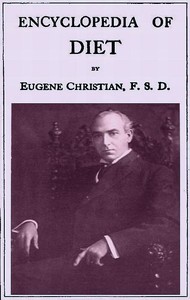
Encyclopedia of Diet: A Treatise on the Food Question, Vol. 1 — Inside the Classic
(0 User reviews)
861
Project Gutenberg
2014
Not confirmed
Food; Diet; Diet in disease
Readers of public-domain and historical texts
Project Gutenberg digital edition
en
Edition facts
Words
43,736
Reading time
191 min
Text sections
8
Before opening Encyclopedia of Diet: A Treatise on the Food Question, Vol. 1 — Inside the Classic, the edition data offers a quick orientation: 43,736 words, 3 hr 11 min estimated reading time, and 8 detected text sections.
The text analysis averages about 25.9 words per sentence, while the detected sections provide another way to judge how the source is divided.
Project Gutenberg metadata also associates the work with “Food,” connecting these edition facts with the source record’s subject description.
Source:
Project Gutenberg record #46511
This editorial note examines how Eugene Christian's 1914 treatise on diet and digestion blends scientific claims with moral rhetoric, focusing on the tension between the catalog subjects (Food, Diet, Diet in disease) and the actual content of the excerpts.
Editorial Edition Score
4.7/5
★★★★★
★★★★★
Calculated from edition completeness, EPUB availability, text structure and catalogue metadata. Not a user rating.
How this score is calculated
- Description quality20 pts
- Title & short description10 pts
- Source metadata20 pts
- Text length15 pts
- Chapters / structure15 pts
- EPUB file integrity20 pts
Total of 100 points, scaled to a 2.5-5.0 range. Editions with an empty description or a missing EPUB file are not scored.
Edition quality
Read the Text
_A Treatise on the Food Question_
EXPLAINING, IN PLAIN LANGUAGE, THE CHEMISTRY OF FOOD AND THE CHEMISTRY OF THE HUMAN BODY, TOGETHER WITH THE ART OF UNITING THESE TWO BRANCHES OF SCIENCE IN THE PROCESS OF EATING SO AS TO ESTABLISH NORMAL DIGESTION AND ASSIMILATION OF FOOD AND NORMAL ELIMINATION OF WASTE, THEREBY REMOVING THE CAUSES OF STOMACH, INTESTINAL, AND ALL OTHER DIGESTIVE DISORDERS
EUGENE CHRISTIAN, F. S. D.
NEW YORK CITY CORRECTIVE EATING SOCIETY, INC. 1917
COPYRIGHT 1914 BY EUGENE CHRISTIAN
ENTERED AT STATIONERS HALL, LONDON SEPTEMBER, 1914
BY EUGENE CHRISTIAN, F. S. D.
PUBLISHED AUGUST, 1914
TO THE MOTHERS AND TO THE NOBLE WORKERS IN THE GREAT CAUSE OF HUMAN HEALTH AND OF HUMAN SUFFERING THESE VOLUMES ARE Dedicated BY THE AUTHOR
Countless centuries have come and gone and have left on the earth myriad forms of life; but just what life is, from whence it came, whether or not there is purpose or design behind it, whether or not all the sacred books are mere conceptions of the infant mind, of the whence and whither, we do not know; but when we put life beneath the searchlight of science, we do know that it is a mere assembling of ionic matter into organic forms, and that this strange work is done in accordance with certain well-defined laws.
We know that these laws are a part of the great cosmic scheme. In harmony with them works evolution, which tends to lift to higher and higher degrees of perfection all forms of both animate and inanimate life. We believe that if all the natural laws governing life could be ascertained and obeyed, the number of disorders or interferences with Nature's scheme would be very greatly decreased.
Man's system of co-operating with his fellow-creatures, which we call civilization, has imposed certain restrictions, duties and limitations upon him, which make it impossible for him to live in strict accordance with these laws; therefore if he would have his birthright, which is health, he must employ science to fit him into his artificial environment.
Man has been brought to his present state of physical development on the rural, outdoor, close-to-nature plan, and since he must live in houses and pursue occupations foreign to those through which he was developed, he must make corresponding changes in the material from which his body is constantly being repaired and made; therefore, as the selections, combinations, and proportions of the various things he needs for nourishment are determined by his age, activity, and exposure to the open air, if he accurately or even approximately ascertains and observes these things, life will continually ascend in the scale of power and grandeur, and his endurance and period of longevity will be increased.
Nearly all forms of life on this globe, except man, live approximately eight times their period of maturity. Man matures at twenty-four; measured by this scale he should live about two hundred years. But the average life of civilized man, reckoning from the age of six, is only about forty years, while if we include the infant class, and reckon the average age from his birth, he scarcely gets his growth before his hair and teeth are disappearing, and his eyesight is being propped up by the lens of the oculist, and he quietly drops into his grave. One hundred and sixty years of life, then, is about what civilization has cost him up to date. This is very expensive, but of course he has something to show for it. He has aeroplanes, wireless communication, the mile-a-minute train, politics, several kinds of religion, rum and cocain, the tramp, the billionaire, and the bread line.
We cannot consistently leap over ten thousand years of heredity and habit, but we can recover some part of the one hundred and sixty years of life civilization has cost us. This can be done by feeding our bodies according to their requirements determined by age, temperature of environment, and work or activity; by cultivating mental tranquillity; by loving some one besides ourselves, and proving it; by breathing an abundance of fresh air, and by doing useful work. Of all these things food is the most important because it is the raw material that builds the temple wherein all other things dwell.
Eugene Christian's Encyclopedia of Diet: A Treatise on the Food Question, Vol. 1 (1914) opens with a preface that frames human health as a matter of aligning with cosmic laws—a rhetorical move that sets the tone for a work that is part science manual, part moral exhortation. The catalog subjects—Food, Diet, Diet in disease—suggest a straightforward medical reference, but the excerpts reveal a text that is as much about philosophy as about physiology. Christian argues that civilization has made it impossible to live in strict accordance with natural laws, so science must be employed to adapt. This tension between the natural and the artificial pervades the volume.
The Rhetoric of Cosmic Law
The preface immediately establishes a grand, almost metaphysical framework: life is described as “a mere assembling of ionic matter into organic forms,” yet Christian insists that this process follows “well-defined laws” that are part of “the great cosmic scheme.” This language is not typical of a dietetic manual. The catalog subject “Food” might lead a reader to expect tables of nutrients or meal plans, but the excerpts instead emphasize a worldview in which health is achieved by harmonizing with nature. Christian asserts that if these laws were “ascertained and obeyed,” disorders would decrease—a claim that blends science with a kind of secular faith. The preface does not cite specific studies or authorities; it speaks in broad, declarative statements about evolution and perfection.
Digestive Chemistry as Moral Instruction
The technical sections on digestion reveal a similar pattern. Christian explains the role of hydrochloric acid as an antiseptic, noting that it “kills bacteria” and that the alternation of alkali and acid in the digestive juices serves a dual purpose: to reduce food to a fine solution and to destroy harmful organisms. This is standard early-20th-century physiology. Yet the text quickly pivots to a warning: when we eat without proper mastication, causing fermentation, “the nutritive material supplied to our tissues will not be perfectly adapted to the needs of human cell-growth.” The language of “perfectly adapted” and “consequent derangement” echoes the preface’s moral tone. The discussion of antipepsin—an enzyme that prevents the stomach from digesting itself—is presented as a recent discovery, but the anecdote about a dog’s stomach wall being digested due to lack of blood supply is offered without citation, relying on the authority of the author’s narrative.
What the Excerpts Do Not Show
The catalog subject “Diet in disease” suggests that the volume will address therapeutic eating for specific illnesses, but the excerpts provided focus almost entirely on general principles of digestion and the chemistry of food. There is no mention of particular diseases, case studies, or dietary prescriptions. The word “disease” appears only in the subtitle and catalog fields. The secondary topics are not represented in the excerpts. This gap between cataloging and content is significant: a reader expecting a clinical guide to dietetics will instead find a philosophical treatise on natural law, with detailed but decontextualized explanations of gastric juice, bile, and antipepsin. The excerpts end before any practical application is discussed, leaving the volume’s practical utility unclear.
Readers approaching this volume should be prepared for a work that is as much a manifesto as a manual. Christian’s prose oscillates between the technical and the prophetic, and his claims about digestion are embedded in a broader argument about civilization and health. The excerpts suggest that the Encyclopedia is less a reference work than a sustained argument for a particular philosophy of eating. Those seeking specific dietary advice for disease may need to look beyond Volume 1.
That afternoon, the rain kept time against the window while Eugene Christian’s confident pronouncements on digestion slowly dissolved into something stranger—the way certainty erodes when you read closely. By evening, I found myself wondering about other remedies treated with similar assurance, which led me, quite without intent, to On the Preparations of the Indian Hemp, or Gunjah (Cannabis Indica) Their Effects on the Animal System in Health, and Their Utility in the Treatment of Tetanus and Other — Themes and Context. Different century, same quiet faith in written words.
There are no reviews for this eBook.
There are no comments for this eBook.
Reader reflection
How will you remember this book?
Save your reaction, strongest insight, and memorable passage.
Your progress
0
/
10
2
Was reading this book enjoyable?
3
Is this a title you would suggest to others?
4
How easy was the book to follow?
5
Could you apply anything you learned?
6
How understandable was the text?
7
How strong was your personal connection to the text?
8
How would you describe its reading pace?
9
In one sentence, what did you learn?
10