1

Getting ready to be a mother — Themes and Context
(0 User reviews)
2089
Project Gutenberg
2022
Not confirmed
Pregnancy; Infants -- Care; Obstetrics
Readers of public-domain and historical texts
Project Gutenberg digital edition
en
Edition facts
Words
67,954
Reading time
296 min
Text sections
21
This digital edition of Getting ready to be a mother — Themes and Context is described by source-level measurements including 67,954 words, 4 hr 56 min estimated reading time, and 21 detected text sections.
The text analysis averages about 26.7 words per sentence, while the detected sections provide another way to judge how the source is divided.
Project Gutenberg metadata also associates the work with “Pregnancy,” connecting these edition facts with the source record’s subject description.
Source:
Project Gutenberg record #67971
An editorial note on Carolyn Conant Van Blarcom's 1922 guide for expectant mothers, examining its direct address, clinical precision, and shifts between poetic opening and practical postpartum advice.
Editorial Edition Score
4.9/5
★★★★★
★★★★★
Calculated from edition completeness, EPUB availability, text structure and catalogue metadata. Not a user rating.
How this score is calculated
- Description quality20 pts
- Title & short description10 pts
- Source metadata20 pts
- Text length15 pts
- Chapters / structure15 pts
- EPUB file integrity20 pts
Total of 100 points, scaled to a 2.5-5.0 range. Editions with an empty description or a missing EPUB file are not scored.
Edition quality
Read the Text
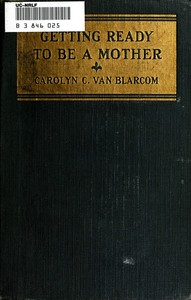
GETTING READY TO BE A MOTHER
THE MACMILLAN COMPANY NEW YORK · BOSTON · CHICAGO · DALLAS · ATLANTA · SAN FRANCISCO
MACMILLAN & CO., LIMITED LONDON · BOMBAY · CALCUTTA · MELBOURNE
THE MACMILLAN CO. OF CANADA, LTD. TORONTO
“Where did I come from, where did you pick me up?” the baby asked its mother.
She answered, half crying, half laughing, and clasping the baby to her breast:
“You were hidden in my heart as its desire, my darling.
“You were in the dolls of my childhood’s games: and when with clay I made the image of my god every morning, I made and unmade you then.
“You were enshrined with our household deity, in his worship I worshiped you.
“In all my hopes and my loves, in my life, in the life of my mother you have lived.
“In the lap of the deathless spirit, who rules our home, you have been nursed for ages.
“When, in girlhood, my heart was opening its petals, you hovered as a fragrance about it.
“Your tender softness bloomed in my youthful limbs like a glow in the sky before sunrise.
“Heaven’s first darling, twin-born with the morning light, you have floated down the stream of the world’s life, and at last you have stranded on my heart.
“As I gaze on your face mystery overwhelms me; you who belong to all who have become mine.
“For fear of losing you I hold you tight to my breast. What magic has snared the world’s treasure in these slender arms of mine?”
From “The Crescent Moon” (child poems), by Rabindranath Tagore.
GETTING READY TO BE A MOTHER _A Little Book of Information and Advice for the Young Woman Who is Looking Forward to Motherhood_
CAROLYN CONANT VAN BLARCOM, R.N.
AUTHOR OF “OBSTETRICAL NURSING,” “THE MIDWIFE IN ENGLAND”
_Formerly Assistant Superintendent and Instructor in Obstetrical Nursing and the Care of Infants and Children at the Johns Hopkins Hospital Training School for Nurses. Honorary Member of the Midwives’ Institute, England._
WITH AN INTRODUCTION BY
J. CLIFTON EDGAR, M.D.
_Emeritus Professor of Obstetrics and Clinical Midwifery in the Cornell University Medical College; Consulting Obstetrician to Bellevue Hospital; Surgeon to the Manhattan Maternity and Dispensary; Consulting Obstetrician to the New York Maternity, Jewish Maternity, and Greenwich General Hospitals._
FREDERICK W. RICE, M.D.
_Associate Professor of Obstetrics, New York University and Bellevue Hospital Medical College; Attending Obstetrician to Bellevue Hospital; Assistant Surgeon to the Manhattan Maternity and Dispensary; Assistant Surgeon to St. Bartholomew’s Clinic and Hospital._
_WITH SEVENTY ILLUSTRATIONS_
New York THE MACMILLAN COMPANY 1922
_All Rights Reserved_
PRINTED IN THE UNITED STATES OF AMERICA
COPYRIGHT, 1922, BY THE MACMILLAN COMPANY.
Set up and electrotyped. Published December, 1922.
UPON WHOSE WELLBEING DEPENDS THE FUTURE OF THE RACE
The young woman who is looking forward to motherhood is very often torn by sharply conflicting emotions. Her eagerness to have a baby and her happy anticipations may be dimmed by fears and misgivings, by superstitious and erroneous beliefs born of an ignorance that is little less than pathetic. A little information about physiological functions and an explanation of some of the facts of motherhood prove to be very reassuring to the mystified, uninformed young woman.
There is, too, the immeasurably important question of the expectant mother’s personal hygiene—the general scheme of her living in such a way as to promote her own and her baby’s welfare—concerning which the average young woman is almost wholly ignorant.
But the busy doctor, who gives of himself, impartially, to a large number of patients, often finds it difficult to discuss with each one, in a leisurely, reassuring way, the facts that he would like to have her grasp, the misinformation he would like to dispel and the small but influential details of her daily life that he wishes her to consider. It is just such simple information and such details of personal hygiene that I have attempted to set forth in this little book, with the hope that it may help the expectant mother intelligently and confidently to do her part in making ready for the baby; and to spend the period of her expectancy in a happy frame of mind, free from haunting anxieties. And I have given some space to a description of the course of the baby’s development in order that his mother might have an abiding sense of his reality and his need of her protecting care from the very moment of his origin.
Carolyn Conant Van Blarcom's Getting Ready to Be a Mother (1922) opens not with clinical instruction but with a poem by Rabindranath Tagore, 'The Crescent Moon,' in which a mother tells her child, 'You were hidden in my heart as its desire.' This lyrical choice immediately establishes a dual voice: the book will speak both to the emotional gravity of motherhood and to the physical realities of pregnancy and birth. Van Blarcom, a registered nurse and former instructor at Johns Hopkins, writes with the authority of medical training, yet she consistently addresses her reader as 'you'—a young woman 'looking forward to motherhood'—creating an intimate, instructional tone that blends reassurance with precise detail.
A Nurse’s Direct Address
Van Blarcom’s narrative voice is that of a knowledgeable guide who anticipates her reader’s anxieties. She uses second-person address throughout, as in 'you will be kept very quiet for a day or two' and 'you may not be allowed to have any visitors.' This directness is not merely stylistic; it reflects the book’s purpose as a practical manual. The author frequently qualifies her instructions with caveats about individual variation: 'The whole question of the time for sitting up … varies so with different individuals.' Such phrasing acknowledges that no two recoveries are identical, while still offering a clear framework. The voice remains calm and authoritative, never alarmist, even when discussing complications like perineal tears, which she notes 'usually occur when the first baby is born.'
Clinical Precision in Postpartum Care
The excerpts reveal a striking shift in pace and detail when Van Blarcom turns to the postpartum period. She itemizes the sequence of recovery with almost day-by-day specificity: 'About the sixth or eighth day you will probably begin to sit up in bed and about the ninth or tenth day you may be allowed to sit up in a chair.' The prose becomes dense with concrete instructions—'the bathing of the perineum … using pledgets soaked in some kind of antiseptic solution'—and warnings against self-infection: 'women sometimes seriously infect themselves after the doctor and nurse have taken the most scrupulous care.' This clinical precision contrasts with the book’s opening lyricism, yet both modes serve the same end: preparing the mother for what lies ahead, whether emotional or physical.
Shifts in Pace and Register
The most notable structural feature of the excerpts is the abrupt transition from Tagore’s poetic epigraph to Van Blarcom’s plainspoken prose. The poem’s metaphorical language—'you were enshrined with our household deity'—gives way to sentences like 'Your breasts will be given painstaking care in order that the baby may nurse satisfactorily.' This shift in register is not a flaw but a deliberate framing: the emotional weight of motherhood is acknowledged, then set aside for practical instruction. Later, the pace slows again when Van Blarcom discusses individual variation, using longer sentences and conditional clauses ('if you cared for your breasts … you will continue'). These rhythmic changes mirror the book’s alternating focus on ideal outcomes and the messy realities of recovery.
Readers approaching Getting Ready to Be a Mother should attend to how Van Blarcom balances two kinds of authority: the emotional authority of the opening poem and the clinical authority of her nursing background. The book is best read as a period document that reveals early twentieth-century obstetrical practices—such as the routine use of antiseptic solutions and the emphasis on bed rest—while also demonstrating a persistent effort to speak directly and calmly to a woman’s fears. The shifts in pace and register are not inconsistencies but deliberate rhetorical strategies.
Reading this 1922 manual, I recall my own mother’s dog-eared copy, its clinical tone oddly reassuring. The way Van Blarcom pivots from poetic expectancy to flat postpartum logistics—that’s the exact rhythm of my own anxious mind. Vitality Supreme — Reading Notes once gave me that same sense of leaning into the body’s stubbornness, and I felt less alone for it.
There are no reviews for this eBook.
There are no comments for this eBook.
Reader reflection
What was your reading experience?
Capture what you thought, learned, and would like to remember.
Your progress
0
/
10
2
Did this book hold your interest?
3
Is this a title you would suggest to others?
4
How much effort did this book require?
5
Would you like to discuss this book with someone?
6
What did you appreciate most?
7
How understandable was the text?
8
Did the book meet your expectations?
9
What changed or sharpened your thinking?
10