1

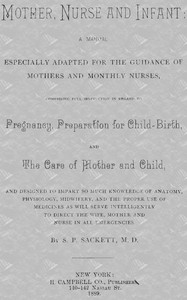
Mother, Nurse and Infant A Manual Especially Adapted for the Guidance of Mothers and Monthly Nurses, Comprising Full Instruction in Regard To Pregnancy, Preparation — Key Ideas to Explore
(0 User reviews)
642
Project Gutenberg
2018
Not confirmed
Women -- Health and hygiene; Materia medica; Infants -- Care; Obstetrics -- Popular works
Readers of public-domain and historical texts
Project Gutenberg digital edition
en
Edition facts
Words
108,447
Reading time
472 min
Text sections
23
For Mother, Nurse and Infant A Manual Especially Adapted for the Guidance of Mothers and Monthly Nurses, Comprising Full Instruction in Regard To Pregnancy, Preparation — Key Ideas to Explore, the stored edition analysis reports 108,447 words, 7 hr 52 min estimated reading time, and 23 detected text sections.
The text analysis averages about 18.3 words per sentence, while the detected sections provide another way to judge how the source is divided.
Project Gutenberg metadata also associates the work with “Women -- Health and hygiene,” connecting these edition facts with the source record’s subject description.
Source:
Project Gutenberg record #57979
This 1889 manual by Dr. S. P. Sackett aims to equip mothers and monthly nurses with practical midwifery and childcare knowledge, blending anatomy, symptom observation, and medicinal guidance for home emergencies.
Editorial Edition Score
4.9/5
★★★★★
★★★★★
Calculated from edition completeness, EPUB availability, text structure and catalogue metadata. Not a user rating.
How this score is calculated
- Description quality20 pts
- Title & short description10 pts
- Source metadata20 pts
- Text length15 pts
- Chapters / structure15 pts
- EPUB file integrity20 pts
Total of 100 points, scaled to a 2.5-5.0 range. Editions with an empty description or a missing EPUB file are not scored.
Edition quality
Read the Text
Conduct of the Mother before and after Marriage 13
Conduct of the Mother during Pregnancy 18
Diseases of Pregnancy 22
Instructions to a Woman during the last stages of Gestation 26
Directions to the Monthly Nurse 33
Care of the Mother during Labor and Confinement 36
Directions to the Nurse during the month 43
ANATOMY AND PHYSIOLOGY OF THE FEMALE ORGANS—FŒTAL DEVELOPMENT.
Parts contained in the Pelvis 64
Physiology of the Uterus and Ovaries 70
Displacements of the Uterus 76
The Ovum and its development 98
PREGNANCY AND PARTURITION.
Diagnosis of Pregnancy 113
Mechanical Phenomena of Labor 132
Diagnosis of Artificial Labor 138
SKILLED NURSING AND MIDWIFERY.
Preliminary instruction to the Nurse Midwife 145
The Natural Labor 149
Cases of Difficult Labor 177
Concluding instructions in Midwifery 192
ÆTIOLOGY—SYMPTOMOTOLOGY—MEDICATION—NURSING.
Causes of Disease 196
Symptoms of Disease 203
Diagnosis of Diseases of Children 217
Treatment of Inflammation in its initial stages 223
Various circumstances, Contagion, Death, &c. 237
REMEDIES AND REGIMEN.
Hints in regard to the treatment of Common Diseases 262
Emergencies, Accidents, Sudden Sickness 279
Slight Hurts and Ailments 295
Dietetics, Food for Children 307
Prescribing and Prescriptions 327
Medical Formulary 333
From the nature of the subjects treated in this work, the information given becomes of interest to every woman, and is not intended for the nurse of lying-in women only. It is believed that many young women will study it carefully, that they may be prepared for all the duties and responsibilities of life; some, perhaps, that they may be fitted for a vocation under certain contingencies. But many of the instructions are addressed particularly to mothers, because they especially will be able to make a practical application of the knowledge received. Hence considerable matter is inserted which is designed to be used by mothers in their daily life, and having only a slight bearing on monthly nursing. Necessarily, as the two objects are combined to suit the wants both of the mother and nurse, there is not as much order and system in the topics presented as would otherwise be desirable. I seek only to have my instructions in the form that will be most useful, and I believe that if mothers at the present time are sufficiently taught there will be no lack, a few years hence, of nurses who are fully competent to care for the sick, under the direction of competent physician. Hence I address myself, first,
To those who are mothers, every part of this small book is especially commended. Upon the knowledge and skill and right action of those who have the care of children and of the household, it will depend that the right thing shall be done in such emergencies as are liable to occur. You must necessarily care for your children, both to guard them from sickness and to relieve their ailments. You must know the symptoms, at least, how to observe the symptoms of diseases; and you may be called upon, in the absence of the physician, to act as midwife. Be especially careful to learn the instructions in regard to emergencies, because upon your knowledge and prompt action the lives of your dear ones may depend.
TO THE PROFESSIONAL NURSE.
This work is written for you, and to you is especially commended the modicum of medical knowledge herein contained. It is better for you to learn well what you read than it is to read very extensively. You will find sufficient in this small volume to demand your time and study for months, and even for years, in connection with your nursing. It is not expected that you will learn all the formulæ and prescriptions given. These are inserted partly that you may learn to read prescriptions in the various forms in which they are written, and partly that you may occasionally use one, after consulting with your physician. Sometimes you may copy one of them accurately and use it at the drug store, consulting only with the apothecary.
Dr. S. P. Sackett’s 1889 manual, written after forty-five years of practice in a small city, directly addresses a gap he perceived in available literature: a single volume that combines midwifery instruction with the specific duties of a monthly nurse. The preface frames the book as a response to repeated inquiries for such a work, and it explicitly targets women who cannot attend training schools in large cities. Sackett’s tone is practical and authoritative, yet he acknowledges that many excellent nurses have learned without formal schooling. The excerpts show a text that moves from general principles of health—such as the effects of cold and season on disease—to detailed symptom observation, always with the nurse or mother as the primary audience.
Intended Audience and Vocational Purpose
The preface makes clear that this book is not a general health guide but a vocational manual for women who wish to make “monthly nursing” a profession. Sackett notes that “mother and nurse are often combined in the same person,” and that every mother may be called upon to act as an accoucheur in an emergency. He emphasizes that training schools are doing noble work but are inaccessible to many; his book aims to provide “plain, practical instruction” at a moderate price. The catalog subjects list “Women -- Health and hygiene” and “Obstetrics -- Popular works,” but the excerpts reveal a stronger focus on the nurse’s role in observing and reporting symptoms than on pregnancy itself. The text repeatedly addresses the nurse’s need for accurate observation and truthful reporting, suggesting that Sackett saw the nurse as a crucial intermediary between patient and physician.
Symptom Observation as a Core Skill
Chapter II, “Symptoms of Disease, with Instruction to Nurses,” treats symptom recognition as the foundation of the nurse’s competence. Sackett defines symptoms as “the signs by which we know that disease is present” and insists that a nurse must “cultivate the habit of strict observation, and simple and truthful statement.” He advises keeping a written record of changes in the patient’s condition. This emphasis on documentation and clear communication aligns with the catalog subject “Materia medica,” though the excerpts do not detail specific remedies. Instead, the text stresses the nurse’s judgment in deciding whether to call a physician. The language is methodical: symptoms are “phenomena” upon which “the whole art of the physician proceeds.” This framing positions the nurse as a trained observer rather than a passive attendant.
Environmental and Hereditary Influences on Health
In a section on the effects of season, Sackett notes that “catarrh and coughs and pectoral complaints” prevail in winter and spring, while bowel complaints dominate summer. He warns against “hardening” children through exposure to cold if they are delicate or show signs of disease, and he cautions that marriages between two people with hereditary predispositions will likely produce unhealthy children. These passages reflect the catalog subject “Infants -- Care,” but they also reveal a broader concern with preventive medicine. The advice is cautious: cold baths are beneficial only if followed by a warm glow, not by headache or chill. Sackett’s tone is empirical, drawing on observed patterns rather than theory. The excerpts do not cover childbirth itself, so the book’s obstetric content remains largely unrepresented in this sample.
Readers should note that the excerpts focus on general principles and symptom observation, not on the manual’s promised midwifery instructions. The full text likely contains the detailed guidance on pregnancy, childbirth, and medicinal use that the title advertises. Sackett’s voice is that of a seasoned practitioner who values clear communication between nurse and doctor. The book is best approached as a period document of late-nineteenth-century domestic medicine, reflecting both the limitations and the practical ambitions of home healthcare before the standardization of nursing education.
There is something tender in how that old manual speaks of a mother’s watchfulness—each small symptom noted, each remedy chosen with care. It reminds me of another voice, gentler and meant for little ears, which teaches health through story rather than instruction. That quiet bedside tone lingers in Keep-Well Stories for Little Folks — Background and Themes, as if both books understood the same soft, patient way we learn to care.
There are no reviews for this eBook.
There are no comments for this eBook.
Reader reflection
Take a moment to reflect on this book
Create a short personal record of your experience with this book.
Your progress
0
/
10
2
Did this book hold your interest?
3
Would you pass this book on to a friend?
4
How easy was the book to follow?
5
Did anything about the book feel genuinely new?
6
How well did it match your expectations?
7
Do you expect to return to this book?
8
How did the pace of the book feel?
9
What changed or sharpened your thinking?
10