1

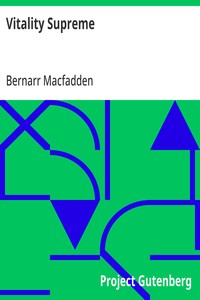
Vitality Supreme — Reading Notes
(0 User reviews)
97
Project Gutenberg
2006
Not confirmed
Hygiene; Physical education and training
Readers of public-domain and historical texts
Project Gutenberg digital edition
en
Edition facts
Words
52,701
Reading time
230 min
Text sections
5
Vitality Supreme — Reading Notes can be approached with a clearer sense of reading commitment from its source measurements: 52,701 words, 3 hr 50 min estimated reading time, and 5 detected text sections.
The text analysis averages about 22.4 words per sentence, while the detected sections provide another way to judge how the source is divided.
Project Gutenberg metadata also associates the work with “Hygiene,” connecting these edition facts with the source record’s subject description.
Source:
Project Gutenberg record #19208
Bernarr Macfadden's 1915 health manual promotes physical vitality through posture, breathing, diet, and exercise, using forceful rhetoric and personal experiments to advocate vegetarianism and condemn white flour.
Editorial Edition Score
4.7/5
★★★★★
★★★★★
Calculated from edition completeness, EPUB availability, text structure and catalogue metadata. Not a user rating.
How this score is calculated
- Description quality20 pts
- Title & short description10 pts
- Source metadata20 pts
- Text length15 pts
- Chapters / structure15 pts
- EPUB file integrity20 pts
Total of 100 points, scaled to a 2.5-5.0 range. Editions with an empty description or a missing EPUB file are not scored.
Edition quality
Read the Text
Produced by Jerry Kuntz as part of the Lawson's Progress Project.
The war cry of to-day in peace no less than in war is for efficiency. We need stronger, more capable men; healthier, superior women. Force is supreme-the king of all mankind. And it is force that stands back of efficiency, for efficiency, first of all, means power. It comes from power, and power either comes directly from inheritance or it is developed by an intelligent application of the laws that control the culture of the physique. The value of efficiency is everywhere recognized. The great prizes of life come only to those who are efficient. Those who desire capacities of this sort must recognize the importance of a strong, enduring physique. The body must be developed completely, splendidly. The buoyancy, vivacity, energy, enthusiasm and ambition ordinarily associated with youth can be maintained through middle age and in some cases even to old age. If your efforts are to be crowned with the halo of success, they must be spurred on by the pulsating throbbing powers that accompany physical excellence. These truly extraordinary characteristics come without effort to but few of us, but they can be developed, attained and maintained.
Why not throb with superior vitality! Why not possess the physical energy of a young lion? For then you will compel success. You will stand like a wall if need be, or rush with the force of a charging bison towards the desired achievements. This book sends forth a message of paramount importance to those who need added efficiency. Adherence to the principles laid down herein will add to the characteristics that insure splendid achievements. They will increase the power of your body and mind and soul. They will help each human entity to become a live personality. They will enable you to live fully, joyously. They will help you to feel, enjoy, suffer, every moment of each day. It is only when you are thus thrilled with the eternal force of life that you reach the highest pinnacle of attainable capacities and powers. Hidden forces, sometimes marvelous and mysterious, lie within nearly every human soul. Develop, expand and bring out these latent powers. Make your body splendid, your mind supreme; for then you become your real self, you possess all your attainable powers. And men thus developed possess a capital that can not be financially measured. It is worth infinitely more than money. Within the pages of this volume the pathway leading to these gratifying rewards is clearly described. Adhere to the principles set forth and a munificent harvest of physical, mental and spiritual attainments will surely be yours.
I. VITALITY--WHAT IS IT?
II. FUNCTIONAL ACTIVITY-THE SECRET OF POWER
III. THE PROPER BODILY POSTURE
IV. STIMULATING THE SOURCE OF STAMINA AND VITALITY
V. STRAIGHTENING AND STRENGTHENING THE SPINE
VI. CLEANSING AND STIMULATING THE ALIMENTARY CANAL
VII. EXERCISE FOR VITALITY BUILDING
X. STRENGTHENING THE STOMACH
XI. PRESERVING THE TEETH
XIV. FOODS IN THE CURE OF CONSTIPATION
XV. PRESSURE MOVEMENTS FOR BUILDING INNER STRENGTH
XVI. BLOOD PURIFICATION
XVII. HINTS ON BATHING
XVIII. SOME FACTS ABOUT CLOTHING
XIX. SUGGESTIONS ABOUT SLEEP
XX. MIND--THE MASTER-FORCE FOR HEALTH OR DISEASE
XXII. SINGING-THE GREAT TONIC
XXIII. THE DAILY REGIMEN
CHAPTER I: Vitality--What is it?
Vitality first of all means endurance and the ability to live long. It naturally indicates functional and organic vigor. You cannot be vital unless the organs of the body are possessed of at least a normal degree of strength and are performing their functions harmoniously and satisfactorily. To be vital means that you are full of vim and energy, that you possess that enviable characteristic known as vivacity. It means that you are vibrating, pulsating with life in all its most attractive forms. For life, energy, vitality-call it what you wish-in all its normal manifestations, will always be found attractive.
A vital man is at all times thoroughly alive. The forces of life seem to imbue every part of his organism with energy, activity and all characteristics opposed to things inanimate. A vital man is naturally enthusiastic. He can hardly avoid being ambitious. And consequently success, with all its splendid rewards, comes to such a man in abundance. Life to such a man should be resplendent with worthy achievements.
Bernarr Macfadden opens Vitality Supreme with a martial call for efficiency, declaring that "force is supreme" and that physical power underpins all success. The preface sets a tone of urgent self-improvement, urging readers to "throb with superior vitality" and develop hidden forces within. Macfadden, a prominent figure in the physical culture movement, structures the book as a series of practical chapters on posture, breathing, diet, and exercise, each promising to build stamina and inner strength. The text moves briskly between exhortation and instruction, often citing personal experiments—such as a two-week fast compared to a white-flour diet—to support his claims. This editorial note examines how Macfadden uses recurring images of force and energy, the structural rhythm of his chapters, and the way he shifts between general principles and specific regimens.
Force as a Recurring Image
Throughout the preface and the excerpted chapters, Macfadden returns to the image of force as both a physical and metaphysical quality. He describes the body as needing to "stand like a wall" or "rush with the force of a charging bison," linking vitality to animal power. This imagery is not merely decorative; it structures his argument that health is an active, aggressive state. The word "force" appears repeatedly in the preface, paired with "power" and "efficiency," creating a semantic field that equates physical excellence with dominance. Even when discussing diet, Macfadden frames choices in terms of energy output: a vegetarian diet is praised for giving "more endurance," while white flour is condemned as a "slow-acting poison" based on a strength-loss experiment. The reader is constantly reminded that every habit either builds or drains force.
Structure: From Principle to Practice
The book's table of contents reveals a clear structural pattern: each chapter moves from a general principle (e.g., "Vitality—What Is It?") to a specific practice ("How to Breathe," "How to Eat"). This movement mirrors Macfadden's rhetorical strategy in the preface, where he first establishes the value of efficiency and then promises that "within the pages of this volume the pathway... is clearly described." The chapters on diet exemplify this: after explaining the superiority of vegetarianism, Macfadden immediately addresses practical obstacles, such as the difficulty of maintaining a strict regimen when family and friends eat differently. He then offers a compromise—selecting wisely from a "well supplied table"—before returning to a firm condemnation of white flour. This back-and-forth between ideal and real keeps the advice grounded, even as the rhetoric remains lofty.
Movement Between Scenes: The Body as a System
Macfadden frequently shifts his focus from the whole body to specific organs or processes, creating a sense of movement through the human physique. In the preface, he speaks of "pulsating throbbing powers" and "the eternal force of life," but later chapters zoom in on the spine, the alimentary canal, and the stomach. This zooming effect is reinforced by the chapter titles themselves: "Stimulating the Source of Stamina and Vitality" is followed by "Straightening and Strengthening the Spine." The reader is led from abstract vitality to concrete exercises. In the diet excerpt, Macfadden moves from general advice about meatless diets to a detailed anecdote about a fasting experiment, then to a list of forbidden foods (white flour products) and recommended ones (green salads). Each paragraph shifts scale, keeping the text dynamic.
The Rhetoric of Personal Experiment
Macfadden bolsters his authority by citing personal experiments, a technique that appears in the preface and recurs in the diet chapter. He describes a two-week fast followed by a two-week white-flour diet, noting that the subject "lost more weight and more strength" on the flour regimen than during the fast itself. This anecdote is presented as conclusive proof that white flour is "not a food, but a slow-acting poison." The experiment is described in precise terms—weights and strength tests are mentioned—but no details about the subject or controls are given. Macfadden uses such evidence to create an impression of scientific rigor while maintaining a conversational tone. The reader is invited to trust the author's firsthand experience, a strategy that aligns with the book's overall message of self-reliance and personal testing.
Vitality Supreme is best approached as a period piece of the early twentieth-century physical culture movement, where self-help merged with quasi-scientific claims. Macfadden's forceful prose and structured chapters reward readers interested in the history of health advice, but his assertions should be weighed against modern nutritional science. The book's value lies less in its specific prescriptions than in its vivid illustration of how bodily ideals were promoted through energetic, image-laden language.
Flipping through Vitality Supreme, I paused at Macfadden’s insistence on breath and gentle preparation—not force, but readiness. That quiet focus on nurturing the body’s foundation reminded me of something softer, more specific, in Getting ready to be a mother — Themes and Context. Both felt like old letters from a different era, spoken in a voice that believed deeply in beginnings. I closed the book, and for a moment, the room felt very still.
There are no reviews for this eBook.
There are no comments for this eBook.
Reader reflection
Take a moment to reflect on this book
Create a short personal record of your experience with this book.
Your progress
0
/
10
2
How did the book work for you overall?
3
Would you pass this book on to a friend?
4
How demanding did the text feel?
5
Would you read this book again?
6
Was the book moving at the right speed?
7
Did it raise ideas you would like to talk about?
8
Did the book deliver what you hoped for?
9
Which lesson or insight stayed with you?
10