1

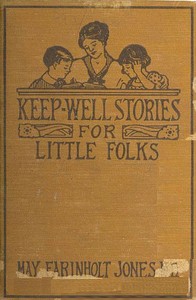
Keep-Well Stories for Little Folks — Background and Themes
(0 User reviews)
1694
Project Gutenberg
2010
Not confirmed
Hygiene -- Juvenile literature
Readers of public-domain and historical texts
Project Gutenberg digital edition
en
Edition facts
Words
28,350
Reading time
124 min
Text sections
4
For Keep-Well Stories for Little Folks — Background and Themes, the stored edition analysis reports 28,350 words, 2 hr 4 min estimated reading time, and 4 detected text sections.
The text analysis averages about 16.5 words per sentence, while the detected sections provide another way to judge how the source is divided.
Project Gutenberg metadata also associates the work with “Hygiene -- Juvenile literature,” connecting these edition facts with the source record’s subject description.
Source:
Project Gutenberg record #32521
A 1916 hygiene primer for children that uses imaginative stories, personified germs, and a conversational tone to teach cleanliness, nutrition, and fresh air. The author, a physician, frames health lessons as adventures, with narrative voice shifting between didactic and playful.
Editorial Edition Score
4.6/5
★★★★★
★★★★★
Calculated from edition completeness, EPUB availability, text structure and catalogue metadata. Not a user rating.
How this score is calculated
- Description quality20 pts
- Title & short description10 pts
- Source metadata20 pts
- Text length15 pts
- Chapters / structure15 pts
- EPUB file integrity20 pts
Total of 100 points, scaled to a 2.5-5.0 range. Editions with an empty description or a missing EPUB file are not scored.
Edition quality
Read the Text
She had a dear little baby in her arms. You know how I love little babies. I love to tickle their noses and to lick the sweets from their juicy little mouths. I sat and watched the little fellow, awaiting my chance to make his acquaintance. Presently the lady gave the baby some milk to drink from the pitcher in which I had had such a nice bath. After the little fellow was fed, the lady put him to sleep and laid him in his crib in the next room for his morning nap. My friends told me to come with them into this room, the nursery. The lady had forgotten to put a net over the little fellow; so I crawled around and ate some sugar from his lips. It tasted so good that I crawled almost into his mouth.
Since that happy morning, I have spent almost every day between the farm-house and out-houses. I have my daily bath in the milk pitcher and my dinner from the nice juicy food on the table. Very often I get my lunch of sweets from the corners of the baby's mouth, and I like this best of all.
For several days I have felt lonely. I noticed that the baby did not come to the dining-room to get his milk and sugar. I kept wondering why he did not come, and finally I wandered into the nursery to see for myself. What do you think? The baby was lying in his crib all red and hot. While his mother was busy, I crawled on his mouth to see if there was any sugar in the corners for a lunch. Then away I flew.
This morning I flew over to the farm-house again, through the kitchen door, and into the nursery. I thought I would find a glass of milk and have a nice bath and my breakfast. But, alas! the baby was not in his crib. The room was so still and cold it frightened me and I flew out. I saw several strange men and women; the women were all crying and the men looked sad. A man was fastening something white on the front door. I tried to understand it all, but I could not catch any word except "TYPHOID." I wonder what that means, anyhow? As no one will tell me, I must be off to the next farm-house to hunt a good dinner.
This was a sensible fly, do you not think so, children? Thousands of other flies might tell the same story if we would only watch their habits and listen to what they have to say.
1. I wonder if any of you can guess what was the matter with the baby on the morning the fly found it red and hot?
2. What had happened when the fly went back to it?
3. What caused the baby to have typhoid fever?
5. Where did the little fly say he was hatched? It is in such places as this--in stables and other filthy places--that all flies are hatched and raised. They all like good things to eat. Flies can smell a good thing to eat a long way off; so they soon find their way to the kitchen and dining-room. On their way to the kitchen, they often stop by the out-houses and gather on their feet and legs a lot of dirt and germs. I must tell you now that the fly can get the typhoid germ or plant only from human filth.
NOTE.--The teacher should have an inexpensive microscope and show the children a fly,--its head and its feet especially.
6. Have you ever seen a fly under a magnifying glass? On the bottom of the fly's feet are little glue-like pads and a number of little hairs on his body and feet, to which germs and bits of dirt stick. The fly in this story had come to the farm-house for the first time, you know, when he found the pitcher of milk and had such a nice bath. He had been gathering germs and dirt on his feet, both from his early home in the barn-yard and from the out-house at which he stopped on his way. Some of these germs gathered at the out-house had come from some person who had typhoid fever. As he crawled over the baby's bottle and its little mouth, he left some of the germs there and he left some in the milk pitcher also. It was careless of the mother to give her baby milk that was not covered. The mother did not know she was giving the baby milk in which there were these little plants, or germs, which cause typhoid fever.
May Farinholt-Jones, a physician and professor of hygiene, opens her 1916 collection with a foreword that explicitly rejects dry facts in favor of storytelling. She aims to let hygienic truths “creep up on the blind side” of young readers, a phrase that signals the book’s central strategy: embedding lessons in narrative rather than lecture. The excerpts show a striking range of voices—from a dialogue between personified Consumption and Pneumonia germs to a cautionary poem about a girl who skips brushing her teeth. This blend of scientific fact and fancy is the book’s defining feature.
Personified Germs and a Conversational Tone
The most vivid excerpt presents Mrs. Consumption Germ and Mrs. Pneumonia Germ gossiping about their enemies: Dr. Sunshine, Dr. Fresh Air, Dr. Good Food, and the scientists Pasteur and Jenner. The germs speak in a colloquial, almost conspiratorial register—“one can’t even hide in an old stump of a tooth”—that turns hygiene into a battle narrative. The author gives the germs distinct personalities: Mrs. Pneumonia Germ admits that fresh air makes her nervous, and both lament that modern sanitation is ruining their hiding places. This personification makes abstract concepts concrete, but it also introduces a darkly comic tone unusual for a children’s health book. The germs are not monsters but beleaguered survivors, which may invite both amusement and unease.
Rhyme, Repetition, and a Shift to Moral Verse
Alongside the germ dialogue, the book includes a short poem, “One Little Girl,” which uses a simple AABB rhyme scheme and incremental repetition to dramatize the consequences of neglecting dental hygiene. The poem moves from the girl’s excuse (“Just to put off a while, I know will be all right”) to the germs’ swift multiplication (“A million little germs / Got to work right then”) and ends with the girl in pain, vowing never to forget again. The shift from prose to verse marks a change in pace and didactic intensity: the poem compresses cause and effect into a tight, memorable pattern. Unlike the germ conversation, which allows for ambiguity, the poem delivers a clear moral with no room for interpretation.
Historical Narrative as a Hygienic Vehicle
The excerpt from “Clovis, the Boy King” departs from the domestic settings of the other stories. It recounts the early life of a Frankish king, emphasizing his bravery and leadership at age sixteen. The connection to hygiene is not immediately obvious from the snippet, but the foreword indicates that such historical tales are meant to illustrate principles of health indirectly. The narrative voice here is more straightforward and heroic, lacking the playful personification of the germ dialogue. This variety in genre—from fable to history to poem—suggests that the author experimented with different paces and registers to sustain a child’s interest. The historical story may serve as a break from the more overtly instructional pieces, offering a different kind of engagement.
Readers should approach Keep-Well Stories for Little Folks as a hybrid work: part textbook, part story collection, part moral instruction. The author’s willingness to let germs speak for themselves and to shift between prose, verse, and historical anecdote creates a varied reading experience. Pay attention to how the narrative voice changes—from conspiratorial to cautionary to heroic—and consider how these shifts might affect a young listener’s understanding of health as something to be fought for, not merely practiced.
That old hygiene book made me think about how we learn to care for something before we even understand it—like those little germs being cast as tiny villains. There’s a gentle tenderness in that, similar to what I felt reading Getting ready to be a mother — Themes and Context, where preparation itself becomes a kind of quiet love. It stays with you, that notion.
There are no reviews for this eBook.
There are no comments for this eBook.
Reader reflection
Before you leave, reflect on the book
Use these questions to collect your thoughts before moving on.
Your progress
0
/
10
2
Was reading this book enjoyable?
3
Would you recommend this book to another reader?
4
How demanding did the text feel?
5
Could you apply anything you learned?
6
Did this book create an emotional response?
7
Is this a title worth rereading?
8
How would you describe its reading pace?
9
In one sentence, what did you learn?
10