1

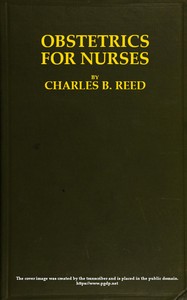
Obstetrics for Nurses — Reading Companion
(0 User reviews)
1120
Project Gutenberg
2020
Not confirmed
Maternity nursing
Readers of public-domain and historical texts
Project Gutenberg digital edition
en
Edition facts
Words
83,731
Reading time
365 min
Text sections
33
The source record for Obstetrics for Nurses — Reading Companion measures this digital text at 83,731 words, 6 hr 5 min estimated reading time, and 33 detected text sections.
The text analysis averages about 15.4 words per sentence, while the detected sections provide another way to judge how the source is divided.
Project Gutenberg metadata also associates the work with “Maternity nursing,” connecting these edition facts with the source record’s subject description.
Source:
Project Gutenberg record #61476
Reed's 1917 obstetrics manual for nurses combines detailed clinical procedures with a strong emphasis on the nurse's professional judgment, using precise anatomical descriptions and emergency protocols to guide practice.
Editorial Edition Score
4.9/5
★★★★★
★★★★★
Calculated from edition completeness, EPUB availability, text structure and catalogue metadata. Not a user rating.
How this score is calculated
- Description quality20 pts
- Title & short description10 pts
- Source metadata20 pts
- Text length15 pts
- Chapters / structure15 pts
- EPUB file integrity20 pts
Total of 100 points, scaled to a 2.5-5.0 range. Editions with an empty description or a missing EPUB file are not scored.
Edition quality
Read the Text
OBSTETRICS FOR NURSES
CHARLES B. REED, M.D.,
Obstetrician to Wesley Memorial Hospital, Chicago.
_ONE HUNDRED THIRTY ILLUSTRATIONS_
COPYRIGHT, 1917, BY C. V. MOSBY COMPANY
_Press of C. V. Mosby Company St. Louis_
THIS BOOK IS AFFECTIONATELY DEDICATED BY THE AUTHOR
------------------------------------------------------------------------
It might seem that an apology was necessary for presenting a new textbook on obstetrics for nurses when so many are to be had for the asking. But when a teacher is rarely or never satisfied with his own work it is too much to expect that he will ever fully endorse the product of another. It may be therefore largely a personal matter that none of the existent books seem to exhibit the fullness of information, the conciseness of expression, and the emphasis due to certain subjects that the present writer would hope to find.
The necessities apparently demand such an arrangement of our obstetrical doctrine that the book may serve for class instruction and at the same time be complete enough for post-graduate reference.
To secure this much discrimination is necessary. The confusion attendant upon overabundance must be avoided as well as the discouragement that is not infrequently produced by a large book or a periphrastic style.
Hitherto there has been a tendency to teach the nurse too little rather than too much but conditions have changed. Vocational instruction is not only more methodical and far reaching but it is developmental. The present day nurse expects not merely to assist the physician and earn a stipulated reward, but she is constantly alert to attain her own maturity as a professional woman.
To be a capable and intelligent assistant it is not sufficient to have a clear comprehension of her particular duties, but she must have a defined and critical conception of what the doctor is aiming to accomplish.
This is especially true in obstetrics where the nurse has the additional responsibility of giving support and counsel to her patient in the various emergencies that arise. Moreover, to attain her intellectual maturity the nurse must strive unremittingly to understand the complicated processes that take place under her observation.
She must cooperate with her doctor whose associate she is and secure the confidence of her patient who relies upon her for guidance in the perils she is facing. For childbirth is a peril. It is no longer the normal process it once was. Civilization has changed the shape of the pelvic bones, altered the muscles of parturition and weakened the nerve centers that control the event.
The birth of a child is equal in severity and seriousness to many of the major operations. It is not an affair to be entered upon lightly nor managed without the utmost foresight and care.
The dangers that are recognized and prepared for in this book by what may seem to some to be an extravagant technic, are very real dangers, extremely subtle, and against them at times every precaution and every defense proves unavailing.
Nevertheless, skill, thoughtfulness, and above all, cleanliness, will avert the worst, as well as unhappily the most common of these disasters. If our nurses could be convinced of this, the difficulties and apprehensions of childbirth would be greatly diminished.
The nurse should see to it that her patient is surrounded by all the precautions and safeguards against infection that she would demand for a member of her own family. This means of course that her work will be far more exacting and onerous but also it will save many nights of anxiety and not infrequently a life.
This book represents the obstetric ideas and technic which the writer has endeavored for years to impress upon his students and nurses with such emendations and changes as experience and scientific progress have suggested. It is a selective essence distilled from the recurrent harvests that workers in this field have brought forth during centuries of consecrated effort. To all these forerunners the writer acknowledges a deep personal indebtedness.
In the preparation of the book thanks are due particularly to Charlotte Gregory, Head Nurse of the Wesley Maternity, whose rare ability as teacher, technician and executive and whose untiring vigilance has been a leading factor in securing and maintaining the high state of efficiency in this department. She has kindly contributed Chapters XXIII and XXIV, together with valuable suggestions and criticisms in other portions of the text.
The author also takes pleasure in acknowledging his obligations to Florence Olmstead, Head Nurse of the Dispensary of the Northwestern University Medical School, whose long experience in feeding babies gives to her words an unquestioned authority. Chapter XXII is almost entirely her work.
Reed opens his 1917 textbook with a frank assessment of childbirth as a peril, arguing that civilization has altered pelvic bones, parturition muscles, and nerve centers, making delivery as serious as major surgery. He immediately positions the nurse not as a passive assistant but as an intelligent associate who must understand the doctor's aims and guide patients through emergencies. This preface sets a tone of professional responsibility that pervades the entire work.
The Nurse as Informed Associate
Reed's preface explicitly rejects the notion that nurses need only assist and earn a reward. He insists that vocational instruction must be developmental, aiming at the nurse's own maturity as a professional woman. This framing is not merely rhetorical; it shapes the book's structure. Rather than a simple list of tasks, Reed provides the rationale behind interventions. For example, when discussing prolapse of the cord, he explains the mechanism—compression and asphyxiation—before giving step-by-step repositioning techniques. He expects the nurse to know why a knee-chest position or a Vorhees bag works, not just when to use them.
Emergency Protocols and Decision Trees
The excerpt on prolapse of the cord exemplifies Reed's methodical approach. He presents a clear summary table: causes (contracted pelves, breech presentations, hydramnios), diagnosis (pulsating cord felt before or after rupture), dangers (to child, not mother), and treatment stratified by cervical dilation and fetal condition. This tabular format recurs throughout the text, allowing quick reference during crises. Reed also includes mortality statistics—25% under best conditions, 50% left to nature—giving the nurse a realistic sense of urgency without alarmism. The instructions for repositioning with a male catheter or using a chair to create a Trendelenburg position show his attention to practical, improvised solutions.
Managing Soft Tissue Complications
Reed devotes careful attention to rigidity of the cervix, distinguishing between cases with violent pains and those with weak, shallow contractions. For the former, he prescribes a specific hypodermic dose of morphine and scopolamine, noting that the rigid ring relaxes under narcosis, allowing labor to proceed rapidly and almost painlessly. He also mentions chloroform as an alternative. This pharmacological detail is typical: Reed does not merely name a drug but gives exact dosages (⅙ gr. morphine, 1/150 gr. scopolamine) and the physiological effect. He warns that the first stage is greatly prolonged but that the child is safe as long as membranes are intact, a reassurance that helps the nurse triage anxiety.
Anatomical Precision in Diagnosis
Throughout the excerpts, Reed grounds his instructions in specific anatomical landmarks. When discussing prolapse of one or both hands, he notes that if the head is engaged, no interference should be attempted; if not, replacement or version may be done. The distinction hinges on engagement—a concept requiring knowledge of pelvic inlet and fetal station. Similarly, his description of prolapse of the cord emphasizes that diagnosis is easy when a loop protrudes from cervix or vulva, and pulsation differentiates it from everything else. This insistence on palpable, observable signs trains the nurse to rely on physical examination rather than assumption, a core skill in early twentieth-century obstetrics.
Reed's text rewards a reader who moves slowly, cross-referencing the summary tables with the prose explanations. The book is designed for both classroom instruction and post-graduate reference, so its density is intentional. A first-time reader should focus on the decision trees for emergencies like prolapsed cord and cervical rigidity, noting how Reed consistently pairs a physiological rationale with a concrete action. The preface's call for professional maturity is not just a pep talk—it is a demand that the nurse internalize the reasoning behind every maneuver.
Holding Reed’s 1917 obstetrics manual, I remembered my mother’s birthing stories—the nurse’s quiet authority over chaos. Years later, Vitality Supreme — Reading Notes stirred the same calm: a system for steadying the breath when everything around me shook. Both books seemed to say, prepare your hands, then trust them—lessons I keep returning to.
There are no reviews for this eBook.
There are no comments for this eBook.
Reader reflection
What was your reading experience?
Capture what you thought, learned, and would like to remember.
Your progress
0
/
10
2
How much did you enjoy the reading experience?
3
Would you recommend this book to another reader?
4
How much effort did this book require?
5
What did you think about the pace?
6
How understandable was the text?
7
Would you like to discuss this book with someone?
8
Did any part of the book feel personally relevant?
9
What changed or sharpened your thinking?
10