1

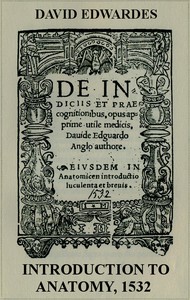
Introduction to Anatomy, 1532 With English translation and an introductory essay on anatomical studies in Tudor England by C.D. O'Malley and K.F. Russell. — Background and Themes
(0 User reviews)
91
Project Gutenberg
2019
Not confirmed
Human anatomy -- Early works to 1800; Anatomy -- Study and teaching -- England -- History -- 16th century
Readers of public-domain and historical texts
Project Gutenberg digital edition
en
Edition facts
Words
18,456
Reading time
81 min
Text sections
3
This digital edition of Introduction to Anatomy, 1532 With English translation and an introductory essay on anatomical studies in Tudor England by C.D. O'Malley and K.F. Russell. — Background and Themes is described by source-level measurements including 18,456 words, 1 hr 21 min estimated reading time, and 3 detected text sections.
The text analysis averages about 24.6 words per sentence, while the detected sections provide another way to judge how the source is divided.
Project Gutenberg metadata also associates the work with “Human anatomy -- Early works to 1800,” connecting these edition facts with the source record’s subject description.
Source:
Project Gutenberg record #59357
This editorial note examines David Edwardes's 1532 anatomical introduction, focusing on the author's Latin diction, the work's structure as a letter to Henry Surrey, and its place in Tudor medical education, based on the facsimile and translation by O'Malley and Russell.
Editorial Edition Score
4.5/5
★★★★★
★★★★★
Calculated from edition completeness, EPUB availability, text structure and catalogue metadata. Not a user rating.
How this score is calculated
- Description quality20 pts
- Title & short description10 pts
- Source metadata20 pts
- Text length15 pts
- Chapters / structure15 pts
- EPUB file integrity20 pts
Total of 100 points, scaled to a 2.5-5.0 range. Editions with an empty description or a missing EPUB file are not scored.
Edition quality
Read the Text
18, while still another student of medicine was Edward Wotton, Reader in Greek and later physician to Henry VIII, for whom Edwardes had briefly substituted.
Still another incentive toward medical study may have been a requirement in chapter 25 of the original statutes. In accordance with this all fellows of the college who held the degree of Master of Arts were required to assume holy orders, unless deputed to the study of medicine. It has been suggested that recipients of this exception were originally expected to attend to the medical needs of the other inmates of the college,[27] and it seems likely that Edwardes was one of these _medicinae deputati_.
Our next record indicates that he had removed to the University of Cambridge where in 1528-9, and upon payment of 3_s._ 4_d._[28] and after lecturing publicly upon Galen’s _De Differentiis Febrium_, he was incepted in medicine with recognition of ‘seven years study of medicine’, presumably at Oxford.[29]
In his only known book, to be considered later, Edwardes informs us that his first practice of medicine had been ‘at Bristol, having left my teachers only shortly before and begun to swim without any support’,[30] although it is not clear whether this represented a brief interlude between Oxford and Cambridge or after he had received his degree of Doctor of Medicine. Whatever the case may have been, the few remaining autobiographical references are to his practice in and around Cambridge. As a member of the Faculty of Medicine, it is possible that Edwardes was criticized for devoting an excessive amount of time to his private practice, since in 1530-1 permission was granted him to be excused from a statutory requirement of attendance at ‘all congregations, masses and exequies’.[31] Nevertheless he participated in the examinations of at least two students, one in 1537-8[32] and the other in 1540-1.[33]
Edwardes’s little book, to which reference was made above, was published in London in 1532 [O.S.] by Robert Redman. It is composed of two treatises of which the first, entitled _On Symptoms and Prognostications_ (_De Indiciis et Praecognitionibus_), deals with uroscopy and medical prognostication, and since it represents merely the continuation of a medieval tradition it is of little importance except, as has been said, for its few autobiographical details. In his practice of medicine Edwardes appears to have represented, as we might expect, a combination of the old and the new. While giving support to uroscopy and displaying some sympathy toward folk medicine, he also gave allegiance to Hippocrates and Galen, and like his continental colleagues of this period he was not averse to the introduction of a word or even several lines of Greek into his text, so indicating his enthusiasm for and his ties with the classical revival. Furthermore, he was certainly one of the first English physicians to appreciate Linacre and terms him ‘the most learned physician of his age’.[34]
The second treatise, _A Brief but Excellent Introduction to Anatomy_ (_In Anatomicen Introductio Luculenta et Brevis_), is, as has been mentioned, the first work published in England which was devoted solely to anatomy, and therefore despite its brevity it deserves some consideration in the general history of medicine and even greater consideration in that of English medicine. Turning our attention now to this treatise on anatomy it should be first noted that although printed in the same volume with the work on medical symptoms and sharing a common title-page with that work, the treatise on anatomy has a separate dedication to Henry Howard (1517?-1547), Earl of Surrey. It had been at the request of Henry VIII that this young nobleman took up residence at Windsor and lived there from 1530 to 1532 as the companion of Henry’s son, the Duke of Richmond. Since Edwardes had dedicated the first treatise to the Duke of Richmond on 21 December 1532, it is not difficult to comprehend his choice of the duke’s companion for the second dedication which bears the date 1 January 1532, or, according to the Gregorian calendar, 1533. There is nothing remarkable about this latter dedication, which contains the usual flattery, except for the final passage. There the author remarked upon the ignorance of anatomy among physicians, sometimes with lethal results. He recognized that the subject of anatomy was a difficult one, hence his treatise has been written with brevity and clarity. Later, as he promised, if opportunity were to be granted to him he would write a more elaborate work.
David Edwardes's Introduction to Anatomy (1532) opens as a Latin epistle addressed to Henry Surrey, a nobleman whose grandfather is praised for virtue and military success. This dedicatory frame, preserved in the facsimile, signals that the work is not a dry textbook but a humanist offering, blending deference with pedagogical intent. Edwardes, styling himself medicus, writes in a Ciceronian period, his sentences winding through praise of Surrey's lineage before turning to anatomical matter. The translators, O'Malley and Russell, note that such rhetorical choices reflect the author's aim to elevate anatomy within a courtly, learned context. The original octavo format, with its compact Latin, suggests a portable vade mecum for students or practitioners, a genre then emerging in England.
Diction and the Humanist Voice
Edwardes's Latin is not the technical jargon of a medieval scholastic but the polished prose of a humanist. In the dedication, he employs balanced clauses and classical vocabulary—virtus, prudentia, res publica—to align his subject with civic and moral worth. The phrase non possum satis admirari genus istud tuum (I cannot sufficiently admire your lineage) exemplifies his rhetorical strategy: flattery as a gateway to instruction. This diction contrasts sharply with the simpler vernacular of contemporary barber-surgeon texts, such as Thomas Vicary's. Edwardes's choice of Latin, however, limited his audience to the learned, a deliberate move to position anatomy among the liberal arts. The translators preserve this voice in their facing-page English, rendering the periods into readable but formal prose, allowing modern readers to sense the original's gravity.
Structure as a Pedagogical Letter
The work's structure—a single continuous letter rather than divided chapters—mirrors the humanist epistolary tradition. Edwardes moves from salutation to anatomical description without section breaks, creating a flowing discourse. This format implies a direct, almost tutorial relationship between author and reader, as if Edwardes were speaking to Surrey (and by extension, the student). The introductory essay by O'Malley and Russell contextualizes this choice: in Tudor England, anatomy was rarely taught through dissection, and texts often served as substitutes for demonstration. Edwardes's letter form may have been an attempt to simulate the oral lecture, with its personal address and logical progression. The facsimile shows that the original printing used marginal notes to guide the reader, a typographical aid that compensates for the lack of formal divisions.
Setting and the State of Tudor Anatomy
The excerpts from the introduction reveal a medical landscape where Oxford and Cambridge still taught from medieval sources, with no provision for human dissection. Edwardes's work appears against this backdrop of conservatism, as noted by the editors: the College of Physicians disciplined a Joannes Geynes in 1559 for criticizing Galen. Edwardes himself does not directly challenge Galen, but his very act of writing an original introduction suggests a desire to modernize. The setting of his text—printed in 1532, just as Henry VIII was breaking with Rome—places it within a broader intellectual shift. The editors point out that imported continental books were common, but vernacular texts like Vicary's remained popular. Edwardes's Latin Introductio thus occupies a middle ground: humanist in form, yet conservative in content, reflecting the tensions of its era.
Recurring Details: The Body as Text
Throughout the excerpts, Edwardes returns to the idea of the body as something to be read. In the dedication, he praises Surrey's grandfather for insignem illam virtutem (that remarkable virtue), linking moral character to physical lineage. This metaphorical thread—the body as a site of virtue and knowledge—recurs in anatomical descriptions, where Edwardes likely treats organs as signs of function. The editors note that Banister's later anatomical drawings, mentioned in the introduction, were based on continental plates, but Edwardes's text predates such visual aids. Instead, his verbal descriptions must stand alone, relying on the reader's ability to visualize from words. The facsimile's typography, with its italic and roman typefaces, further emphasizes the text's role as a visual artifact, a book to be studied as one studies the body.
Readers approaching this edition should attend to the interplay between the facsimile and the translation. The original Latin page, with its abbreviations and marginalia, offers a glimpse into the material culture of Tudor learning. The translators' essay provides essential context, but the core experience lies in comparing Edwardes's humanist rhetoric with the anatomical content. This is not a comprehensive guide to the body but a document of how one early modern author chose to present that body in words. Let the text's formal elegance guide your reading, and note where the language strains to make the invisible visible.
Holding this Tudor anatomy booklet, I recalled my first trembling look at William Harvey and the Discovery of the Circulation of the Blood — Story, Setting & Ideas—that same sense of a hand reaching across centuries. Edwardes’ Latin feels stiff, yet urgent. Harvey’s diagrams slow, methodical. Both whisper how fragile knowledge once was, and how quietly it persists. William Harvey and the Discovery of the Circulation of the Blood — Story, Setting & Ideas
There are no reviews for this eBook.
There are no comments for this eBook.
Reader reflection
Take a moment to reflect on this book
Create a short personal record of your experience with this book.
Your progress
0
/
10
2
How much did you enjoy the reading experience?
3
Would you recommend this book to another reader?
4
How easy was the book to follow?
5
Do you expect to return to this book?
6
Did you relate to its people, ideas, or situations?
7
Could you apply anything you learned?
8
What did you appreciate most?
9
What changed or sharpened your thinking?
10