1

Outline of a natural system of medical science — Reading Companion
(0 User reviews)
1516
Project Gutenberg
2026
Not confirmed
Medicine; Physiology; Pathology; Anatomy
Readers of public-domain and historical texts
Project Gutenberg digital edition
en
Edition facts
Words
19,660
Reading time
86 min
Text sections
7
This digital edition of Outline of a natural system of medical science — Reading Companion is described by source-level measurements including 19,660 words, 1 hr 26 min estimated reading time, and 7 detected text sections.
The text analysis averages about 33.0 words per sentence, while the detected sections provide another way to judge how the source is divided.
Project Gutenberg metadata also associates the work with “Medicine,” connecting these edition facts with the source record’s subject description.
Source:
Project Gutenberg record #78678
Alexander Walker's 1808 outline proposes a unified natural system linking anatomy, physiology, pathology, and materia medica, arguing that disease is any change in healthy state and function, and classifying diseases and remedies by mechanical, vital, and intellectual functions.
Editorial Edition Score
4.6/5
★★★★★
★★★★★
Calculated from edition completeness, EPUB availability, text structure and catalogue metadata. Not a user rating.
How this score is calculated
- Description quality20 pts
- Title & short description10 pts
- Source metadata20 pts
- Text length15 pts
- Chapters / structure15 pts
- EPUB file integrity20 pts
Total of 100 points, scaled to a 2.5-5.0 range. Editions with an empty description or a missing EPUB file are not scored.
Edition quality
Read the Text
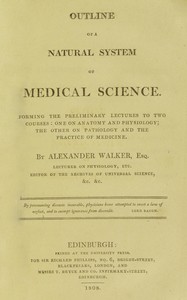
OUTLINE OF A NATURAL SYSTEM OF MEDICAL SCIENCE.
OUTLINE OF A NATURAL SYSTEM OF MEDICAL SCIENCE.
FORMING THE PRELIMINARY LECTURES TO TWO COURSES: ONE ON ANATOMY AND PHYSIOLOGY; THE OTHER ON PATHOLOGY AND THE PRACTICE OF MEDICINE.
BY ALEXANDER WALKER, ESQ. LECTURER ON PHYSIOLOGY, ETC. EDITOR OF THE ARCHIVES OF UNIVERSAL SCIENCE, &c. &c.
_By pronouncing diseases incurable, physicians have attempted to enact a law of neglect, and to exempt ignorance from discredit_.
EDINBURGH: PRINTED AT THE UNIVERSITY PRESS. FOR SIR RICHARD PHILLIPS, NO. 6, BRIDGE-STREET, BLACKFRIARS, LONDON, AND MESSRS T. BRYCE AND CO. INFIRMARY-STREET, EDINBURGH. 1808.
ALEXANDER MONRO, ESQ. SENIOR,
_M. D. Professor of Medicine, Anatomy and Surgery, in the University of Edinburgh, &c._
This Outline of a Natural System of Medical Science is most respectfully dedicated by one who is grateful for the benefits he has conferred upon Anatomy and Physiology, and who is desirous of following his footsteps in the cultivation of these Sciences.
_2, North College Street, 27th October 1808._
_In this small Work, the Author has delivered a very brief Outline of a Natural Systematic Arrangement and Theory of Anatomy, Physiology, Pathology and of the Materia Medica, as strictly dependent on each other._
_Of this system the tendency is, not to controvert one established fact of Medical Science, but by pointing out their relations, to simplify, to consolidate and if possible to increase the amount of our knowledge in all the departments of Medicine._
_As a work of this kind is a fair object of criticism; to the philosophic and liberal reviewer I have only to say, that I shall most willingly submit to his decision. Error is almost inseparable from propositions of any extent or magnitude, and I have doubtless committed many. But to the reviewers for the Edinburgh Medical and Surgical Journal, and those of a London Review under their influence, as they constitute a party somewhat in opposition to my views, I have to observe, that, should they act unjustly, as I know them not individually, I must hold their editor, whom I do know, responsible for their conduct, and I consequently shall do so._
PRELIMINARY LECTURE TO THE COURSE OF ANATOMY AND PHYSIOLOGY; EXHIBITING THE OUTLINE OF A NATURAL SYSTEM OF THESE SCIENCES.
The functions of man are the most interesting objects of Science. Physics and Morals are equally involved by them. It is in them that the physical sciences terminate, and that the moral sciences have their origin.
Of what avail are the former, but to develope the influence of external bodies upon the functions of man? What are the latter, but the results of the reaction of that influence upon men in society?
To explain them is the business of physiology; and if it have hitherto failed in doing so—if it have even neglected the noblest of all the functions—I should say the noblest branch of philosophy—the intellectual functions of man, and have abandoned them to persons totally incapable of developing them, because totally ignorant of the structure on which they depend, and who have left them in a state of greater obscurity than that in which they found them, that is the fault of physiologists, and not of their science.
In these lectures, I shall at least be influenced by the deepest sense of such errors.
But it is not merely the philosophy of the human mind, or rather of the intellectual functions of man, that have thus been abandoned to barbarism. The science itself has never been systematized; and all its individual parts have been so neglected, that the other sciences and the arts dependent upon it, have been left in similar obscurity.
I shall endeavour to shew that it is by the aid of physiology alone that, in explaining the functions of the eye, for instance, we can render perfect the theories of colour and of vision; that, in explaining the functions of the ear, we can construct rational ones of phonics and of hearing; that in explaining the functions of the organ of voice, we can illustrate the formation of letters, and the origin of languages; that, in explaining the functions of the muscles, we can establish those first principles of taste in the fine arts, the very existence of which have so often been questioned, and so deliver a theory of movement and of attitude, applicable to sculpture, the higher species of painting, gesture in oratory, &c. In fine, it is by physiological means only, that we can construct a natural theory of medicine, and render precise and easy, the most delicate and the most difficult of the operations of surgery.
To effect these purposes, nothing is more necessary than arrangement, because it at once involves facts and their theory, or the reasonings founded upon them.
Alexander Walker opens his Outline of a natural system of medical science with a bold epigraph from Lord Bacon, accusing physicians of using the claim of incurability to excuse ignorance. The work, printed in Edinburgh in 1808, is dedicated to Alexander Monro, a prominent professor of anatomy at the University of Edinburgh. Walker presents his system as a brief sketch, not a full treatise, intended to simplify and consolidate medical knowledge without controverting established facts. He warns that error is inevitable in such a broad undertaking and directly addresses potential critics, particularly those from the Edinburgh Medical and Surgical Journal, whom he accuses of being in opposition to his views. This combative yet earnest tone sets the stage for a work that aims to reorganize medical science from its foundations.
A System Built on Relations
Walker’s central claim is that anatomy, physiology, pathology, and materia medica are strictly dependent on each other and can be arranged in a natural system where each part correctly corresponds and flows from the others. He states that anatomy is the basis of physiology, physiology the basis of medicine, and that the classification of one applies to the rest. This interconnectedness is not merely theoretical: Walker insists that the system involves mineral, vegetable, and animal nature at once. He draws a parallel between the functions of different life forms—mechanical structure in minerals, mechanical and vital functions in vegetables, and mechanical, vital, and intellectual functions in animals—and uses this tripartite division to classify both diseases and remedies. The system is presented as a way to shed light on what he calls the dark paths of medical science, though he acknowledges that his outline is necessarily brief and stripped of illustration.
Disease as Change of State and Function
Walker defines disease as any change of the healthy state and healthy function of parts. He emphasizes that action depends on state, and life itself on organization; thus, to change action one must affect structure. Using fracture as an example, he explains that the primary disease is the broken bone, but that ruptured blood vessels and injured nerves constitute new diseases affecting different functions. This principle allows him to argue that disease can be traced through mechanical, vital, and intellectual levels. He also speculates that some actions of vessels—absorbing, circulating, secreting—may be independent of nerves, citing the form and arrangement of capillary tubes in vegetables. Even if this speculation proves false, he maintains it cannot materially affect his system, because the action of a part is strictly its own, and injury renders it incapable of performing that action.
The Role of the Materia Medica
Walker extends his natural arrangement to the materia medica, classifying articles of medicine according to whether they operate on mechanical, vital, or intellectual organs, and then according to whether they increase, render irregular, or diminish action. This mirrors his classification of diseases and reinforces the unity of his system. He argues that the same tripartite division that applies to anatomy and physiology also governs pathology and therapeutics. The implication is that a physician who understands the fundamental categories of structure and function can apply that knowledge consistently across all branches of medicine. Walker does not provide detailed examples in this outline, but the framework is clear: each disease and each remedy has a natural place within the hierarchy of mechanical, vital, and intellectual functions, and the system promises to simplify the study and practice of medicine by revealing these underlying relations.
A Sketch with Ambitions
Walker repeatedly emphasizes that his work is merely a sketch, a preliminary outline delivered as lectures for courses on anatomy and physiology and on pathology and the practice of medicine. He quotes Lord Bacon again, asserting that the harmony of a science, with each part supporting the other, is the true confutation of objections. This rhetorical move positions his system as self-validating: if the parts fit together coherently, that coherence itself is evidence of correctness. Yet Walker also admits that error is almost inseparable from propositions of any extent or magnitude, and he submits to the judgment of philosophic and liberal reviewers. The tension between confident system-building and cautious acknowledgment of fallibility runs through the text. Readers approaching this work should expect a programmatic statement rather than a fully elaborated theory, and should note that Walker’s claims about the independence of vascular action from nerves and his classification of diseases are presented as hypotheses open to challenge.
Walker’s Outline is best read as a manifesto for a unified medical science, not as a finished system. The excerpts reveal a writer who is both ambitious and defensive, eager to reorganize his field but aware of the risks. For a first reading, pay attention to how Walker uses the tripartite division of mechanical, vital, and intellectual functions to connect anatomy, physiology, pathology, and therapeutics. Note also his reliance on analogy across kingdoms of nature and his willingness to speculate. The work rewards careful attention to its structure, which is itself an argument for the natural system it proposes.
There’s something humbling about old medical books, the way they treat the body as a whole, even when they’re only about one organ. Reading Alexander Walker’s outline felt like someone gently restoring order to chaos. That same quiet reverence came back with Cases of Organic Diseases of the Heart — A Closer Reading, where each case breathes like a small, unfinished prayer for understanding.
There are no reviews for this eBook.
There are no comments for this eBook.
Reader reflection
Record your reading impressions
A brief reflection can help important ideas stay with you longer.
Your progress
0
/
10
2
Was reading this book enjoyable?
3
Is this a title you would suggest to others?
4
How demanding did the text feel?
5
How would you describe its reading pace?
6
Did this book create an emotional response?
7
How understandable was the text?
8
Which part made the strongest impression?
9
What changed or sharpened your thinking?
10