1

The commonwealth of cells — A Closer Reading
(0 User reviews)
648
Project Gutenberg
2024
Not confirmed
Human physiology
Readers of public-domain and historical texts
Project Gutenberg digital edition
en
Edition facts
Words
37,977
Reading time
166 min
Text sections
13
For The commonwealth of cells — A Closer Reading, the stored edition analysis reports 37,977 words, 2 hr 46 min estimated reading time, and 13 detected text sections.
The text analysis averages about 25.9 words per sentence, while the detected sections provide another way to judge how the source is divided.
Project Gutenberg metadata also associates the work with “Human physiology,” connecting these edition facts with the source record’s subject description.
Source:
Project Gutenberg record #74813
An editorial note on Spurrell's 1901 essays, focusing on his conversational voice, structural use of analogy, and shifts between broad principles and specific bodily mechanisms.
Editorial Edition Score
4.8/5
★★★★★
★★★★★
Calculated from edition completeness, EPUB availability, text structure and catalogue metadata. Not a user rating.
How this score is calculated
- Description quality20 pts
- Title & short description10 pts
- Source metadata20 pts
- Text length15 pts
- Chapters / structure15 pts
- EPUB file integrity20 pts
Total of 100 points, scaled to a 2.5-5.0 range. Editions with an empty description or a missing EPUB file are not scored.
Edition quality
Read the Text
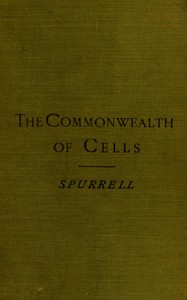
THE COMMONWEALTH OF CELLS
Some Popular Essays on Human Physiology
BY H. G. F. SPURRELL, B.A. OXON.
LONDON BAILLIÈRE, TINDALL AND COX 8, HENRIETTA STREET, STRAND 1901
[_All rights reserved_]
MY ESTEEMED FRIEND AND TUTOR,
GUSTAV MANN, M.D., ETC.
Ever since the very beginning of my student days, when my contemporaries took to plying me with embarrassing demands for information upon all matters medical, I have been constantly impressed by the interest which the unscientific public take in the workings of their bodies and the material basis of their minds. It is this general display of interest among my friends that has emboldened me to add yet another book to the many already dealing with the subject. In using the word ‘unscientific’ I imply, of course, no reproach. I mean simply to denote those people who have specialized in some branch of knowledge other than those collectively known as Natural Science.
I usually find, when discussing physiology with such people, that they take more interest in general principles than in details, which they frequently find repellent, and that they frame their questions in an appallingly comprehensive manner.
My object throughout this little work has therefore been to present the fundamental principles of physiology in a brief, consecutive and readable form, for those who do not care to study the text-books. There is no lack of excellent books already, books illustrated by careful drawings quite gruesome in their accuracy, but they are almost all intended for “students,” and the casual reader, finding the organs divided up for exhaustive treatment, fails to form a conception of the body as an organic whole, and misses the very principles he is in search of, in the heap of details under which they are buried.
It may cause some surprise that, though in my efforts to be up-to-date I have in places outstripped the text-books, I quote no authorities. But a moment’s consideration will show that it would defeat the very object of a sketch like this to burden the text with an account of how my views were formed, while, on the other hand, the pioneers of science will forgive me. Their papers will be quoted in more durable works, and their names honoured long after this little book has been forgotten.
OXFORD, _March, 1901_.
THE CHEMISTRY OF THE BODY 8
THE MECHANICS AND PHYSICS OF THE BODY 31
THE NERVOUS SYSTEM 58
The unscientific public is extremely prone, and not altogether without reason, to take medicine as a starting-point, and arrange all biological science around it. As it is, moreover, apt to gauge the interest and utility of every branch of this science from a practical point of view, and bestows most attention upon that which it imagines is of the greatest service to the doctor, I think a series of popular essays on physiology could not commence with more advantage, at any rate to physiology, than by briefly discussing, not with what it deals, for that is pretty generally known, but what is its relation to medicine. Further, as the doctor is more easily discussed than medicine, the physiologist will be more manageable for our immediate purpose than physiology in the abstract, so we will devote the first few pages to the question of how his labours benefit the patient.
Everyone knows the doctor, and everyone knows that physiology deals with the ‘functions of different organs of the body’; but the public rarely meet the physiologist, except in the fanciful caricatures of his enemies, which though frequently personal are rarely accurate. These rancorous libels, if anyone heeded them, would tend to raise doubts as to whether the physiologist was a good companion for the doctor, and if it were not as well for them to see as little of each other as possible.
Spurrell opens his preface by recounting how friends' 'embarrassing demands for information upon all matters medical' drove him to write a book for the unscientific reader. This personal, almost apologetic tone sets the stage for a work that deliberately avoids the 'gruesome accuracy' of textbook illustrations. Instead, he promises a 'brief, consecutive and readable' account of physiological principles. The resulting essays move fluidly between broad analogies—the body as a commonwealth of cells—and concrete descriptions of reflex actions, such as blinking twice a minute or the involuntary adjustments of pupil size. Spurrell's voice is that of a tutor speaking to a curious layperson, not a specialist addressing peers.
A Conversational Guide to the Body
Spurrell's prose is deliberately informal. He addresses the reader directly, uses everyday examples (a fly in the eye, a man whose hand is struck off by a sword), and occasionally inserts wry observations—for instance, noting that an absent-minded man who 'will run into people, charge lamp-posts, trip over steps, and tread upon dogs' proves walking is reflex, not voluntary. This tone is consistent across the essays, from the introduction's frank admission that the public 'take medicine as a starting-point' to the detailed description of fainting as 'one of Nature's most perfect and merciful contrivances.' The language is precise but never pedantic, aiming to demystify rather than overwhelm.
Structure by Analogy, Not by Organ
Rather than dividing the body into systems (circulatory, digestive, etc.), Spurrell organizes his essays around broad concepts: 'Living Matter,' 'The Chemistry of the Body,' 'The Mechanics and Physics of the Body,' and 'The Nervous System.' This allows him to treat the body as an integrated whole. For example, in discussing reflex action, he moves seamlessly from the cough and sneeze to the eye's protective reflexes, then to swallowing, standing, walking, blood-pressure regulation, and fainting—all within a single narrative arc. The effect is cumulative: each example reinforces the principle that the body operates automatically, without taxing the intellect. The reader is led to see patterns rather than memorize parts.
Shifts in Pace: From Principle to Detail
Spurrell varies his pace noticeably. He often begins a section with a broad, almost philosophical statement—'Reflex actions are, however, by no means only protective'—then narrows to a specific mechanism, such as the 'explosive blast of air from the lungs' in a sneeze. This rhythm keeps the exposition lively. In the excerpt on fainting, he starts with a dramatic scenario (a severe wound), explains the physiological cascade (dilatation of abdominal vessels, fall in blood-pressure, slowed heart), and ends with the incidental consequence (insufficient blood to the brain). The shift from narrative to mechanism and back again mirrors his stated goal: to present principles without burying them in details.
Readers should approach these essays as a series of connected talks rather than a reference manual. Spurrell's analogies—the commonwealth, the reflex as automatic servant—are meant to be suggestive, not exhaustive. When he says he has 'outstripped the text-books' in places, he signals that some claims may be provisional. The value lies in watching a skilled expositor translate 1901 physiology into plain language, revealing both the science and the sensibility of its era.
There’s something about Spurrell’s old essays, the way he’ll drift from a wide principle to a single, quiet mechanism, that feels like sitting with a friend who explains things slowly. I kept thinking of that gentle, unhurried tone while rereading Arteriosclerosis and Hypertension, with Chapters on Blood Pressure 3rd Edition. — Text and Context. It’s the same patient voice, just older, and somehow more intimate for it.
There are no reviews for this eBook.
There are no comments for this eBook.
Reader reflection
Record your reading impressions
A brief reflection can help important ideas stay with you longer.
Your progress
0
/
10
2
How much did you enjoy the reading experience?
3
Would you encourage someone else to read it?
4
Did the language feel accessible?
5
How valuable was this book for your own interests?
6
Could you follow the author’s main argument?
7
What was the strongest part of the book?
8
Did any part of the book stay with you emotionally?
9
What changed or sharpened your thinking?
10