1

Observations on M. Laennec's method of forming a diagnosis of the diseases of the chest by means of the stethoscope, and of percussion; and upon some points of the French — Reading Notes
(0 User reviews)
920
Project Gutenberg
2024
Not confirmed
Laennec, R. T. H. (René Théophile Hyacinthe), 1781-1826; Chest -- Diseases -- Diagnosis
Readers of public-domain and historical texts
Project Gutenberg digital edition
en
Edition facts
Words
21,891
Reading time
96 min
Text sections
8
The catalog record for Observations on M. Laennec's method of forming a diagnosis of the diseases of the chest by means of the stethoscope, and of percussion; and upon some points of the French — Reading Notes provides practical reading context through 21,891 words, 1 hr 36 min estimated reading time, and 8 detected text sections.
The text analysis averages about 27.7 words per sentence, while the detected sections provide another way to judge how the source is divided.
Project Gutenberg metadata also associates the work with “Laennec, R. T. H. (René Théophile Hyacinthe), 1781-1826,” connecting these edition facts with the source record’s subject description.
Source:
Project Gutenberg record #74999
Charles Scudamore's 1826 treatise evaluates Laennec's stethoscope and percussion for chest diagnosis, while critiquing French medical doctrines on fever, gout, and rheumatism, advocating English purgative and mercurial treatments.
Editorial Edition Score
4.7/5
★★★★★
★★★★★
Calculated from edition completeness, EPUB availability, text structure and catalogue metadata. Not a user rating.
How this score is calculated
- Description quality20 pts
- Title & short description10 pts
- Source metadata20 pts
- Text length15 pts
- Chapters / structure15 pts
- EPUB file integrity20 pts
Total of 100 points, scaled to a 2.5-5.0 range. Editions with an empty description or a missing EPUB file are not scored.
Edition quality
Read the Text
Italic text is denoted by _underscores_.
Some minor changes to the text are noted at the end of the book.
The superscript re is denoted by 1^{re}.
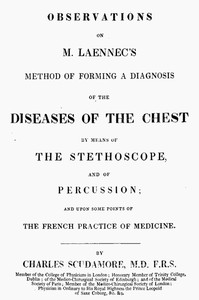
METHOD OF FORMING A DIAGNOSIS
DISEASES OF THE CHEST
AND UPON SOME POINTS OF
THE FRENCH PRACTICE OF MEDICINE.
CHARLES SCUDAMORE, M.D. F.R.S.
Member of the College of Physicians in London; Honorary Member of Trinity College, Dublin; of the Medico-Chirurgical Society of Edinburgh; and of the Medical Society of Paris; Member of the Medico-Chirurgical Society of London; Physician in Ordinary to His Royal Highness the Prince Leopold of Saxe Coburg, &c. &c.
London: PRINTED FOR THE AUTHOR, By Joseph Mallett, 59, Wardour Street, Soho;
AND PUBLISHED BY LONGMAN, REES, ORME, BROWN, AND GREEN, PATERNOSTER ROW.
TO Sir HENRY HALFORD, Bart. K.H. F.R.S. PRESIDENT OF THE COLLEGE OF PHYSICIANS, PHYSICIAN TO THE KING, &c. &c. &c.
In requesting the honour of dedicating to you the following pages, I am actuated by the feelings of respect and personal regard, which I entertain equally for your public and for your private character.
It is also with more than ordinary interest that I address my observations to you, as the President of the College; an office which, it may with truth be said, you fill with no less dignity to yourself, than with benefit to the whole profession.
In becoming an advocate for the employment of the stethoscope, I disclaim adopting principles in the practice of physic, which might with any justice be called mechanical.
It cannot however be denied, that with all the improvements which the art of medicine has received, it still must, on many occasions, depend greatly on conjecture.
Some of the diseases of the chest are attended with such obscurity, that the detection of their precise nature bids defiance to the most acute penetration. What prudent physician, then, will disdain to avail himself of the means which this simple but philosophical instrument affords, of obtaining a more faithful diagnosis?
It is not intended that its use should supersede those established principles of our art, which early and regular education, as well as experience, have pointed out to us; but that it should serve as an auxiliary in the investigation of obscure disease.
For my own part, I have no apprehension that the judicious employment of the stethoscope can, in any degree, tend to make us negligent in observing the symptoms of diseases, or indifferent to the study of the usual means of diagnosis.
In the hope, that the general opinions which I have offered in this volume, may receive the high sanction of your approval,
I have the honour to remain, DEAR SIR, Your most obliged, faithful, And obedient Servant,
Wimpole Street, April 14th, 1826.
Having expressed my opinion generally on the merits of the stethoscope, in the course of the following Essay, I have little to say in the form of a preface.
Although the credit of the invention is due to the ingenuity of M. Laennec alone, and the volume which he has presented to us abounds with valuable pathology, it is of no small importance that the sentiments and the experience of others should also be collected and recorded.
Before any new method in the practice of medicine can be firmly established, or even deserve to be regarded in the light of fixed authority, it is incumbent upon us to examine all the collateral evidence which can be produced in its favour; and he who, with this view, contributes to the general stock of information, may claim the merit of usefulness, although he be not entitled to the more brilliant distinction awarded to genius.
It appears to me, that whoever adopts the use of the stethoscope, must study it for himself, and consider, that all which is offered to his attention by the industry and observations of others, is calculated to serve his purpose only as an introductory lesson.
The skilful employment of this instrument must be the result of practice. Every case which occurs, presents new and distinct matter for investigation. It is peculiarly necessary to be accurate in marking with nicety the nature of the impressions which are made upon the ear, and to reflect upon the phenomena with all the skill and care of the physiologist, the anatomist, and the physician. Nothing must be left to the imagination; for, if this creative faculty be exercised, the judgment may be misled, rather than informed and assisted.
I have purposely confined myself to a limited sketch of the general subjects which I have embraced; so that if the following pages should not appear to possess the merit of great novelty, they will, I hope, at least escape the imputation of being tedious and devoid of interest.
Charles Scudamore, a London physician attending Prince Leopold, published this 1826 work to assess René Laennec's stethoscopic method and percussion for diagnosing chest diseases. The book is neither a translation nor a simple endorsement; Scudamore positions himself as an advocate for the stethoscope while distancing his practice from what he calls “mechanical” principles. He acknowledges that chest diseases often defy “the most acute penetration,” and presents the instrument as a means to obtain “a more faithful” understanding. The text also extends into broader French medical controversies, particularly the doctrines of Broussais regarding gastroenteritis.
Stethoscope as a Diagnostic Aid, Not a Mechanical System
Scudamore opens by declaring he advocates for the stethoscope but disclaims “adopting principles in the practice of physic, which might with any justice be called mechanical.” This careful framing suggests that in 1826, some British physicians viewed the stethoscope as reducing medicine to mere mechanics. Scudamore counters that chest diseases are so obscure that even “the most acute penetration” fails, and the stethoscope offers a “simple but philosophical” way to gain more reliable evidence. He does not describe how the instrument works or cite specific cases from Laennec; instead, he argues from the premise of diagnostic uncertainty. The excerpts show no detailed auscultatory findings, only a general endorsement of the method as an adjunct to clinical judgment.
Contrasting French and English Therapeutics
A substantial portion of the excerpts contrasts French and English treatment of fevers, gout, and rheumatism. Scudamore objects to the French prohibition of purgatives when the tongue appears coated, arguing that “the preference is greatly due to our English practice of giving occasional doses of calomel.” He warns that fear of inducing gastroenteritis—a concept central to Broussais's system—could lead to “the serious error of omission.” In gout, he rejects the view that it is a form of gastroenteritis with joint irritation, and opposes the French reliance on leeches, instead advocating “alteratives and purgatives.” He distinguishes gout from rheumatism by noting that gout spares the “husbandman who unites temperance with his labours,” while rheumatism affects all. These passages reveal a direct engagement with specific French authorities, not merely a general survey.
Selective Agreement and Practical Caution
Scudamore does not wholly reject French ideas. He admits “the partial, but not the total, fitness of the doctrines in question.” In treating inflammation of the intestines, he agrees that “it must be our first care to remove the inflammatory action by general and local bleedings,” and to avoid purgatives if they cause vomiting. He also concedes that in some gouty paroxysms, “the mucous digestive membrane is affected with inflammatory irritation.” This balanced stance suggests a clinician weighing evidence from both sides. The excerpts do not reveal whether Scudamore ever used the stethoscope himself; his observations remain theoretical. Readers should note that the text is a monograph of opinion, not a case series or experimental report.
Scudamore’s work is best read as a period document illustrating how British physicians selectively adopted and adapted French clinical innovations. The catalog subjects—Laennec and chest diseases—accurately reflect the book’s stated topic, but the excerpts show that therapeutics, not auscultation, dominate the argument. Readers interested in the stethoscope’s early reception will find more technical detail in Laennec’s own treatise. Scudamore’s value lies in his candid articulation of national medical differences and his insistence on clinical judgment over doctrinal rigidity.
Years among these shelves taught me that Dr. Scudamore’s cough-and-gravel bedside vigil, his careful percussion, shares a quiet kinship with The art of natural sleep — Story, Setting & Ideas. Both seek the body’s own rhythm beneath agitation, trusting a gentler calibration than the shouting methods of their day. That humble concord has kept me company many an evening.
There are no reviews for this eBook.
There are no comments for this eBook.
Reader reflection
Before you leave, reflect on the book
Use these questions to collect your thoughts before moving on.
Your progress
0
/
10
2
Was reading this book enjoyable?
3
Would you encourage someone else to read it?
4
How demanding did the text feel?
5
How personally connected did you feel to the book?
6
How would you rate its originality?
7
How useful were the ideas in this book?
8
Did any part of the book stay with you emotionally?
9
In one sentence, what did you learn?
10