1

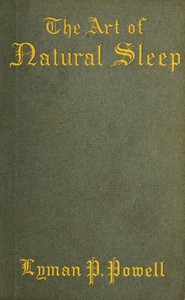
The art of natural sleep — Story, Setting & Ideas
(0 User reviews)
695
Project Gutenberg
2020
Not confirmed
Insomnia; Sleep; Emmanuel movement
Readers of public-domain and historical texts
Project Gutenberg digital edition
en
Edition facts
Words
12,393
Reading time
54 min
Text sections
23
This digital edition of The art of natural sleep — Story, Setting & Ideas is described by source-level measurements including 12,393 words, 54 min estimated reading time, and 23 detected text sections.
The text analysis averages about 22.4 words per sentence, while the detected sections provide another way to judge how the source is divided.
Project Gutenberg metadata also associates the work with “Insomnia,” connecting these edition facts with the source record’s subject description.
Source:
Project Gutenberg record #62492
Lyman P. Powell's 1908 manual combines personal experience with Emmanuel Movement techniques, using auto-suggestion and spiritual counsel to treat insomnia, illustrated by case histories from Northampton clinics.
Editorial Edition Score
4.7/5
★★★★★
★★★★★
Calculated from edition completeness, EPUB availability, text structure and catalogue metadata. Not a user rating.
How this score is calculated
- Description quality20 pts
- Title & short description10 pts
- Source metadata20 pts
- Text length15 pts
- Chapters / structure15 pts
- EPUB file integrity20 pts
Total of 100 points, scaled to a 2.5-5.0 range. Editions with an empty description or a missing EPUB file are not scored.
Edition quality
Read the Text
Sleep has its own world, A boundary between the things misnamed Death and Existence; sleep has its own world.
Consciousness may be suspended. But the cortical centres are frequently as active when we are asleep as when awake. The attention can be maintained with such unbroken steadiness as to awake some persons with the exactness of an alarm clock on the very minute, even though for purposes of deception the hands of the clock may have been set back without their knowledge. The motor centres can be counted on so confidently that they will drive the somnambulist with the accuracy of a trained chauffeur to his appointed destination. Sleep is, therefore, nothing more than a temporary suspension of a portion of the brain’s activity.
[2] Manaceïne, 62, 69, 70.
[3] Dr. J. Madison Taylor in the _Popular Science Monthly_, September, 1905.
[4] Thomson’s _Brain and Personality_, 314.
THE NECESSITY OF SLEEP
But that suspension is an absolute necessity to health of mind and body. Men have been known to go for forty days without nourishment and retain unimpaired all the mental faculties. No man goes for even three days and nights without sleep except he pay a penalty in mental equipoise, and death itself is apt to bring his misery to an end, it is claimed, in five sleepless nights and days. Professors Patrick and Gilbert of the University of Iowa found, some years ago, that in certain cases there were after two nights of complete wakefulness hallucinations, loss of attention, inability to remember, and unmistakable evidences both of mental disorganisation and physical depression.[5] In Kipling’s story, tragically true to life, Hummil died after eighty-four hours of unrelieved insomnia, and the author’s closing words would seem to indicate that madness overtook him at the last: “In the staring eyes was written terror beyond expression of any pain.”
The occasional genius like Napoleon may perhaps get on habitually with four hours of sleep each night, and the mother watching by the sick-bed of her child may go for weeks in an emergency with but an hour or two of sleep at intervals, infrequent and irregular. But the sensible division made by Alfred the Great into eight hours for sleep, eight hours for work, eight hours for play, will be as far as possible observed by the right-minded and far-seeing everywhere.
[5] _Psychological Review_, September, 1896.
INSOMNIA AND ITS CAUSES
Insomnia reduced to simplest terms is nothing but the inability to sleep. While the causes of insomnia may sometimes be exceedingly complex, ordinarily they are evident both to us and those we love the best. Anything, as we all learn by experience, which accelerates the activity of the mind and increases the congestion of the brain is likely to induce insomnia. Worry, fear, grief, prolonged mental effort, any sort of emotional excitement, social dissipation, the intemperate use of coffee, tea, or alcohol are among the most familiar causes of insomnia. Disturbances of digestion, neuralgic pains, arterial disease, eye-strain, and dental lesions are the hidden causes, oftener than we imagine, of protracted wakefulness.
Many of the more obstinate cases of insomnia are due, we know at last through Dr. Upson’s remarkable book,[6] to some dental lesion unsuspected because, as is not uncommon, it is unaccompanied by the ache habitually associated with all the ills to which the teeth are heirs. In my Emmanuel clinic I have had one case of insomnia which, in spite of all an efficient doctor could do for the body and the Emmanuel worker for the mind, persisted until I at last discovered that the sufferer was in immediate need of a dentist, whose threshold, through a morbid fear, he had not crossed in many years.
[6] _Insomnia and Nerve Strain_, 12.
For insomnia there is no specific known to medicine. While the good family doctor may correct digestive disturbances, banish for the time neuralgic pains, modify arterial disease, relieve with the oculist’s assistance eye-strain, and through the dentist remove the cause of dental lesions, sometimes insomnia persists long after the physical cause has disappeared. I have had in my clinic one case of chronic sleeplessness caused by a headache which appeared incurable though the cause of the headache and insomnia alike had vanished years before.
Drugs which induce sleep induce it merely for the time. Doctor Caillé in his large experience has found morphia invaluable for the inhibiting of pain or of severe dyspnœa, chloral and the bromides useful in cases of visceral neuralgia, codein and urethan in arteriosclerosis, and in pulmonary tuberculosis, where beer and porter failed to bring the longed-for sleep, dionin, trional, and hyoscin. But in ordinary cases of insomnia, where the cause is evidently more psychical than physical, he is inclined to turn rather to suggestion in one form or another.[7]
Lyman P. Powell, an Episcopal rector in Northampton, Massachusetts, wrote this 1908 guide to insomnia treatment out of his own experience: the first half of the pamphlet that preceded the book was composed during a sleepless night. Powell frames sleeplessness as a condition responsive to what he calls “auto-suggestion,” a method he links to the Emmanuel Movement, a then-influential blend of psychotherapy and religious counsel. The book’s subtitle promises “definite directions for the wholesome cure of sleeplessness,” and its pages deliver a structured regimen of mental discipline, physical relaxation, and spiritual affirmation. Powell’s voice is that of a pastor-clinician, direct and prescriptive, yet he grounds his advice in reported outcomes from the Emmanuel Clinics in Boston and Northampton, where he claims more than three hundred sufferers testified to benefit.
From Pamphlet to Clinic Manual
Powell traces the book’s genesis in his preface: a pamphlet written in two halves—the first during a sleepless night, the second two years later after he had “found relief by auto-suggestion from the lifelong bondage of insomnia.” First published as a weekly column in The Hampshire Gazette, it was reprinted by demand and later used at the Emmanuel Clinic. The expansion into a book, Powell notes, came at the suggestion of Rev. Elwood Worcester, two magazine editors, and two publishing houses. This origin story matters because it shapes the book’s tone: it is not a detached medical treatise but a personal testimony turned into a clinical tool. Powell explicitly distinguishes his work from theoretical volumes on sleep physiology, citing Marie de Manaceïne’s standard work and Dr. Upson’s Insomnia and Nerve Strain, positioning his own as a practical, spiritually inflected alternative.
The Language of Suggestion and Serenity
Powell’s prose in the treatment passages is notably rhythmic and incantatory, designed to be spoken or internalized. He instructs the patient to “claim your new privilege in Jesus’ name” and to “keep by day as well as night the serenity you here have found.” The repeated use of imperatives—“act,” “keep,” “take,” “brood”—creates a cadence of reassurance. He borrows from St. Paul’s Epistle to the Romans (“neither death, nor life… shall be able to separate you”) to anchor the suggestion in scriptural authority. This blending of psychological auto-suggestion with religious language is the book’s distinctive stylistic feature. Powell also uses metaphor sparingly but effectively: the patient must “work them into the warp and woof of your inmost soul,” suggesting a craft-like integration of new mental habits.
Case Histories as Evidence
Powell offers a series of brief case reports to demonstrate the method’s efficacy. The cases are varied: a man “on the verge of suicide,” a trained nurse whose “sleep cog” had slipped, a college instructor sleepless before the academic year, a wife and mother who after six weeks of drugged sleep “went home from her first treatment with a shining face.” The language is anecdotal and deliberately vivid—the “shining face” and the “heart-breaking disappointment” that “swept down without a word of warning” are meant to evoke sympathy and credibility. Powell does not provide clinical detail or long-term follow-up; instead, he relies on the dramatic before-and-after contrast. He also acknowledges that one treatment does not always suffice, noting that “a dozen treatments are required” in some cases, and stresses the patient’s “close co-operation” as essential.
The Patient’s Role: Auto-Suggestion and Unconcern
Powell devotes a section to the patient’s responsibilities, which he calls “auto-suggestions.” The patient must “cease to worry about sleep,” “never mention his symptoms to anyone except the Emmanuel worker,” and “cultivate a heavenly unconcern about himself.” The repeated mantra is “It does not matter anyway.” Powell’s instructions are precise: lie still in the normal sleep position for eight hours, relax every muscle, breathe “lightly, regularly, rhythmically” in a well-ventilated room, and avoid morning light. The tone is that of a coach drilling a routine. Notably, Powell reframes lying awake as acceptable: “Bed is for rest as well as sleep.” This cognitive reframing—reducing the anxiety about sleeplessness itself—is the core of his method, and he presents it in plain, repetitive language meant to be memorized and recited.
Powell’s book is best read as a period document of the Emmanuel Movement’s therapeutic optimism, where religious authority and early psychotherapeutic techniques converged. Readers interested in the history of insomnia treatment, the intersection of religion and medicine in early twentieth-century America, or the rhetorical strategies of self-help literature will find it a compact primary source. The case reports, though lacking scientific rigor, offer a window into how sufferers and healers narrated recovery. Powell’s insistence on the patient’s active mental discipline—his “auto-suggestions”—prefigures later cognitive-behavioral approaches to insomnia, making this slender volume more than a historical curiosity.
That rainy afternoon, the 1908 manual’s case histories felt almost intimate—strangers learning to quiet their minds. Powell’s talk of auto-suggestion lingered oddly, a gentle probing beneath the skin’s surface. Flipping pages, I landed on a stray footnote about bodies claimed for science, and soon the rain itself seemed to dissolve into another book: Body-snatching — Key Ideas to Explore, its cool covers keeping secrets I hadn’t expected.
There are no reviews for this eBook.
There are no comments for this eBook.
Reader reflection
Take a moment to reflect on this book
Create a short personal record of your experience with this book.
Your progress
0
/
10
2
How much did you enjoy the reading experience?
3
Would you recommend this book to another reader?
4
How demanding did the text feel?
5
Would you like to discuss this book with someone?
6
What did you think about the pace?
7
Which element worked best for you?
8
Did any part of the book stay with you emotionally?
9
Which lesson or insight stayed with you?
10