1

Overweight and Underweight — Context and Discussion
(0 User reviews)
404
Project Gutenberg
2021
Not confirmed
Diet; Weight loss; Weight gain
Readers of public-domain and historical texts
Project Gutenberg digital edition
en
Edition facts
Words
9,095
Reading time
40 min
Text sections
2
This digital edition of Overweight and Underweight — Context and Discussion is described by source-level measurements including 9,095 words, 40 min estimated reading time, and 2 detected text sections.
The text analysis averages about 22.9 words per sentence, while the detected sections provide another way to judge how the source is divided.
Project Gutenberg metadata also associates the work with “Diet,” connecting these edition facts with the source record’s subject description.
Source:
Project Gutenberg record #66226
This 1953 guide from Metropolitan Life Insurance Company uses insurance data to define desirable weight by height and frame, then outlines calorie-based methods for weight loss and gain, emphasizing medical oversight and habit change.
Editorial Edition Score
4.5/5
★★★★★
★★★★★
Calculated from edition completeness, EPUB availability, text structure and catalogue metadata. Not a user rating.
How this score is calculated
- Description quality20 pts
- Title & short description10 pts
- Source metadata20 pts
- Text length15 pts
- Chapters / structure15 pts
- EPUB file integrity20 pts
Total of 100 points, scaled to a 2.5-5.0 range. Editions with an empty description or a missing EPUB file are not scored.
Edition quality
Read the Text
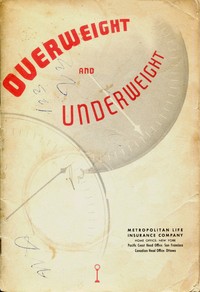
OVERWEIGHT AND UNDERWEIGHT
METROPOLITAN LIFE INSURANCE COMPANY HOME OFFICE: NEW YORK Pacific Coast Head Office: San Francisco Canadian Head Office: Ottawa
PAGE What Is Desirable Weight? 3 Overweight and Its Dangers 5 What Makes a Person Fat? 5 Why Do People Overeat? 6 How to Lose Weight 7 The Body’s Need for Food 8 The Body’s Need for Exercise 11 What About Short Cuts? 12 How Many Calories? 13 On Keeping a Record 19 Special Problems 19 Underweight and Its Dangers 22 What Causes Underweight? 22 How to Gain Weight 23 Adding Extra Calories 24 Saving Energy 24 Calorie Tables 25
Edition of January 1953 COPYRIGHT 1950, METROPOLITAN LIFE INSURANCE COMPANY.
P.F.M.—PRINTED IN U.S.A.—(u) 380 L. W. (Edition Jan. 1953)
_What Is Desirable Weight?_
Desirable weight is a very individual thing. It may be described as the weight at which a person both _looks_ and _feels_ his best. Height, bone structure, and muscular development must all be taken into account.
Because no two people are alike, weight tables cannot show with complete accuracy exactly what every individual should weigh. The tables shown here are given as a guide rather than as a rigid standard to which everyone should conform. They show desirable weights for men and women at age 25 and over. After a person is full grown and has reached his best weight, he should not gain or lose much for the rest of his life. It used to be considered inevitable and normal for people to get heavier toward middle age. We know now that it is not a normal part of getting older, not healthy, and not necessary.
Life is much easier in many ways for people who are not too fat or too thin. They usually feel and look better. They are apt to live longer. They are less likely to suffer from backaches, foot troubles, constant fatigue, and a host of daily discomforts. They have more fun buying clothes. Normal weight is worth any effort it takes to reach and keep—worth it in terms of everyday comfort and of a healthier, longer life.
DESIRABLE WEIGHTS FOR MEN AND WOMEN OF AGES 25 AND OVER[1] Weight in Pounds According to Frame (as Ordinarily Dressed) _men_ HEIGHT SMALL FRAME MEDIUM FRAME LARGE FRAME (with shoes on) Feet Inches
5 2 116-125 124-133 131-142 5 3 119-128 127-136 133-144 5 4 122-132 130-140 137-149 5 5 126-136 134-144 141-153 5 6 129-139 137-147 145-157 5 7 133-143 141-151 149-162 5 8 136-147 145-156 153-166 5 9 140-151 149-160 157-170 5 10 144-155 153-164 161-175 5 11 148-159 157-168 165-180 6 0 152-164 161-173 169-185 6 1 157-169 166-178 174-190 6 2 163-175 171-184 179-196 6 3 168-180 176-189 184-202
_women_ HEIGHT SMALL FRAME MEDIUM FRAME LARGE FRAME (with shoes on) Feet Inches
4 11 104-111 110-118 117-127 5 0 105-113 112-120 119-129 5 1 107-115 114-122 121-131 5 2 110-118 117-125 124-135 5 3 113-121 120-128 127-138 5 4 116-125 124-132 131-142 5 5 119-128 127-135 133-145 5 6 123-132 130-140 138-150 5 7 126-136 134-144 142-154 5 8 129-139 137-147 145-158 5 9 133-143 141-151 149-162 5 10 136-147 145-155 152-166 5 11 139-150 148-158 155-169
OVERWEIGHT AND ITS DANGERS
Anyone who is 15 or more pounds heavier than his desirable weight is considered overweight. For those still in their 20’s or younger a _little_ extra weight does no harm. For people over 30 it is not good.
Overweight is a danger signal, particularly for those over 40. Studies of life insurance figures show that overweight people develop diabetes, heart disease, high blood pressure, and other life-shortening conditions earlier, and are apt to die younger, than people whose weight is normal. They are poor surgical risks and have less resistance to infection. Stout women are more likely to develop complications in pregnancy.
_What Makes a Person Fat?_
Most people are fat simply because they eat too much. This does not necessarily mean that they stuff themselves with large quantities of food. It does mean that they take in more calories[2] than their bodies can use. This is often surprisingly easy to do, particularly for a person who has poor eating habits.
Some people blame their overweight on metabolism (the rate at which their bodies use energy) and on the glands which regulate metabolism. In a very few cases, poorly functioning glands may _contribute_ to overweight. Even then, the overweight patient who is under a physician’s treatment for glandular disorders is able to lose weight when his food intake is regulated.
What many people do not realize, however, is that the body’s energy requirements usually change after age 30 or 40. As a person gets older, metabolism slows down, and fewer calories are needed to maintain weight. The trouble is that eating habits usually stay exactly the same, while physical activity often decreases.
Heredity is often claimed as a cause of overweight. Careful studies do not bear this out. Heredity does determine the type of body build a person has, but when people from overweight families change their eating habits it has been proved that they, too, can lose weight.
The opening pages of Overweight and Underweight immediately establish a pragmatic, data-driven tone. The booklet defines desirable weight as “the weight at which a person both looks and feels his best,” then promptly supplies detailed height-and-frame tables for men and women aged 25 and over. The text explicitly cautions that these tables are “a guide rather than a rigid standard,” acknowledging individual variation. This early emphasis on flexibility—paired with the insurer’s authority—frames the entire work as a practical tool, not a prescriptive mandate.
From Tables to Tactics: The Calorie Framework
The middle sections pivot from measurement to method. A chapter titled “How to Lose Weight” introduces a calorie-budget system: “To lose weight, you must take in fewer calories than you use up.” The booklet provides sample meal plans and a calorie table listing common foods, from “apple, medium” (100 calories) to “walnuts, ½ cup” (390). Notably, it also addresses psychological drivers, observing that “emotions may also play a part” in overeating—a surprisingly modern nod to behavioral factors. The tone remains instructional, with numbered steps and bullet-pointed tips, reinforcing the idea that weight management is a matter of arithmetic and willpower.
Underweight: Mirroring the Overweight Approach
The underweight section mirrors the structure of the overweight chapters, creating a symmetrical reading experience. It defines underweight as “20 percent or more below his best weight” and lists causes: “eating too little, from poor eating habits, from over-activity or too little rest, and from worry or prolonged tension.” The advice reverses the calorie equation: “Underweight people must take in more calories than they use.” The booklet even uses parallel phrasing, noting that “will power can be as great a factor in gaining weight successfully as it is in losing.” This structural echo reinforces the booklet’s core message that both conditions stem from the same basic principles of energy balance.
The Body’s Need for Food and Exercise
Two short chapters—“The Body’s Need for Food” and “The Body’s Need for Exercise”—anchor the booklet’s physiological rationale. The food chapter outlines essential nutrients (proteins, carbohydrates, fats, vitamins, minerals) and warns against “fad diets” that omit any group. The exercise chapter recommends moderate activity, stating that “exercise helps to keep the body in good condition” and burns calories. These sections are notably brief (about one page each), suggesting the booklet assumes readers already accept basic health tenets. Their placement before the calorie tables implies that readers should understand the why before the how.
Special Problems and Keeping a Record
The final substantive sections address practical hurdles. “Special Problems” covers topics like “eating away from home” and “the problem of holidays,” offering strategies such as “planning ahead” and “choosing low-calorie foods.” “On Keeping a Record” advises readers to log daily food intake and weight changes, emphasizing that “a record will show you where you are succeeding and where you are failing.” These chapters reveal the booklet’s target audience: individuals who need concrete, actionable tools rather than abstract theory. The emphasis on self-monitoring aligns with the insurer’s interest in long-term health outcomes, subtly reinforcing the message that weight control is a personal responsibility.
Readers should approach this booklet as a period-specific artifact of mid-century health advice. Its reliance on calorie counting and physician consultation remains relevant, but its framing of weight as a matter of personal willpower reflects the era’s assumptions. The symmetrical structure—overweight and underweight treated as mirror problems—offers a clear, if simplistic, framework. For modern readers, the value lies not in the specific meal plans but in the booklet’s disciplined, evidence-based approach to a topic often clouded by fads.
Reading Overweight and Underweight left me thinking about how we measure ourselves against numbers, and how quiet those charts feel decades later. That same lingering unease brought Body-snatching — Key Ideas to Explore to mind, though it circles darker ground. Both share a strange intimacy with flesh—what we claim, what we lose, what we weigh when no one records it.
There are no reviews for this eBook.
There are no comments for this eBook.
Reader reflection
Take a moment to reflect on this book
Create a short personal record of your experience with this book.
Your progress
0
/
10
2
Did this book hold your interest?
3
How likely are you to recommend this book?
4
How demanding did the text feel?
5
Did the story or argument move comfortably?
6
Was the book what you thought it would be?
7
How personally connected did you feel to the book?
8
How useful were the ideas in this book?
9
Which lesson or insight stayed with you?
10