1

Text book of veterinary medicine, Volume 1 (of 5) — Themes and Context
(0 User reviews)
635
Project Gutenberg
2023
Not confirmed
Veterinary medicine
Readers of public-domain and historical texts
Project Gutenberg digital edition
en
Edition facts
Words
151,423
Reading time
659 min
Text sections
121
For Text book of veterinary medicine, Volume 1 (of 5) — Themes and Context, the stored edition analysis reports 151,423 words, 10 hr 59 min estimated reading time, and 121 detected text sections.
The text analysis averages about 20.7 words per sentence, while the detected sections provide another way to judge how the source is divided.
Project Gutenberg metadata also associates the work with “Veterinary medicine,” connecting these edition facts with the source record’s subject description.
Source:
Project Gutenberg record #71015
James Law's 1896 veterinary textbook, Volume 1, addresses American livestock medicine with a focus on bacteriology, diagnosis, and treatment. Excerpts show detailed clinical descriptions of respiratory diseases, including hæmoptysis and pulmonary apoplexy, with precise symptom differentiation and therapeutic protocols.
Editorial Edition Score
4.9/5
★★★★★
★★★★★
Calculated from edition completeness, EPUB availability, text structure and catalogue metadata. Not a user rating.
How this score is calculated
- Description quality20 pts
- Title & short description10 pts
- Source metadata20 pts
- Text length15 pts
- Chapters / structure15 pts
- EPUB file integrity20 pts
Total of 100 points, scaled to a 2.5-5.0 range. Editions with an empty description or a missing EPUB file are not scored.
Edition quality
Read the Text
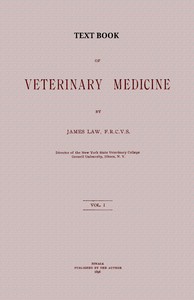
TEXT BOOK OF VETERINARY MEDICINE
JAMES LAW, F.R.C.V.S.
Director of the New York State Veterinary College Cornell University, Ithaca, N. Y.
ITHACA PUBLISHED BY THE AUTHOR 1896
Copyright by JAMES LAW 1896
PRESS OF ANDRUS & CHURCH ITHACA, N. Y.
During a long experience in teaching veterinary medicine and surgery in Cornell University, the author felt the urgent need of a compend on the subject, written from the American standpoint and having special reference to the American live stock industry. This led to the production of the Farmer’s Veterinary Adviser, which has been well received, and has, up to the present, passed through ten editions in the United States, besides the unauthorized editions published in Canada and Great Britain.
In entering upon a larger field as Director of the New York State Veterinary College, and professor of medicine and sanitary science, he aims at producing a work which will meet the needs of the American student and practitioner. The special phases of animal pathology in America, the diseases peculiar to our soil, and the parasites that prevail here, but are unknown in Europe, demand consideration from the American point of view. The special features of our breeding, grazing and feeding industries, and of the dairy, over our great extent of territory, and the varying influence of soil, water, climate, altitude and traffic, the scope and limitations of our interstate traffic, and our special relation to the old world in the matter of meat products, combine with other conditions in demanding a somewhat different treatment of the subject from that which we find in European publications. Then, too, the recent extraordinary advances in the field of bacteriology and sanitary science, which have virtually revolutionized modern medicine, and are an earnest of still greater advances in the near future, demand a work which shall, as far as possible, set forth the present advanced status, and thus lay a solid foundation to intelligently follow, if not to lead, in the imminent advance. As a contribution to this, the present volume, the first of a series, is offered to students, practitioners and scientists by their friend,
New York State Veterinary College, Cornell University. October, 1896.
James Law's Text Book of Veterinary Medicine, Volume 1 (1896) opens with a preface that grounds the work in a specific American context: the author, director of the New York State Veterinary College, writes for American students and practitioners, addressing diseases and parasites peculiar to the United States. The text immediately establishes a clinical, observational voice, as seen in the detailed description of hæmoptysis, where Law distinguishes pulmonary bleeding from nasal or gastric hemorrhage by noting that blood from the lungs is "bright red, clear, frothy, or mixed with mucus." This precision extends to treatment, with specific dosages like "one drachm of acetate of lead" given thrice daily.
Clinical Precision in Symptom Differentiation
Law's diagnostic method relies on careful comparison of symptoms across conditions. In the excerpt on hæmoptysis, he contrasts the "cough of hæmoptysis" with "the sneezing of epistaxis and the retching of hæmatemsis." This tripartite distinction—cough, sneeze, retch—shows a systematic approach to differentiating respiratory, nasal, and gastric bleeding. He also notes that blood from the stomach is "clotted and blackened, with an acid odor from the presence of the gastric juice," while nasal hemorrhage is "not frothy." Such precise sensory details (color, frothiness, odor) are typical of Law's reliance on observable signs rather than speculative causes. The text further links prognosis to prior health: "the previous ill-health of the patient, the presence of tubercle as ascertained by auscultation and percussion" reduces chances of recovery. This integration of physical examination (auscultation, percussion) with history-taking reflects a clinical methodology that is both practical and evidence-based.
Therapeutic Specificity and Drug Regimens
Treatment protocols in the excerpts are remarkably concrete. For hæmoptysis, Law recommends absolute rest, elevated head position, and cold applications. In "threatening or obstinate cases," he prescribes "one drachm of acetate of lead" thrice daily, combined with "a drachm of opium" to suppress cough. Other agents—ergot, tannin, matico, oil of turpentine—are listed as having been "employed with advantage." The inclusion of a saline laxative ("one pound sulphate of soda") for costiveness shows attention to concurrent symptoms. For pulmonary apoplexy, Law suggests "iodide of potassium, bitters and stimulating diuretics" to aid liquefaction and absorption over months. These regimens are not generic; they are tied to specific pathological states (e.g., embolism, rupture) and include dosages, durations ("fifteen or twenty days after an attack"), and routes (oral, topical cold). The voice is that of an experienced clinician offering tried remedies, not theoretical possibilities.
Narrative Voice and Structural Pacing
Law's prose shifts between dense pathological explanation and brisk therapeutic instruction. In the section on pulmonary apoplexy, he defines infarction as resulting from "embolism of a branch of the pulmonary artery" due to clots from a diseased heart or systemic veins. The explanation is concise: "A virtual stasis occurs beyond the embolism, and the blood filtering in through the anastomosing capillaries fills and blackens the affected lobule." This is followed by a terse list of color changes ("black currant jelly" to "yellow color" or "necrotic mass enclosed in a cyst"). The pace then accelerates into treatment: "Iodide of potassium, bitters and stimulating diuretics may be given." This rhythm—pathophysiology, then immediate therapy—characterizes the work. The preface's longer, more personal sentences ("During a long experience in teaching...") contrast with the clipped, imperative style of therapeutic sections ("Keep the head in an elevated position"). Such variation in sentence length and tone reflects Law's dual role as educator and practitioner.
Readers approaching this volume should attend to Law's systematic use of contrastive symptoms and his integration of American agricultural conditions—soil, climate, interstate traffic—into disease causation. The excerpts reveal a text that is both a reference manual and a clinical guide, where each condition is anchored by observable signs and followed by actionable treatments. The work's value lies in its specificity: dosages, durations, and differential diagnoses are given without ambiguity, making it a practical tool for the veterinary student or practitioner of the era.
Leafing through James Law’s old veterinary pages, I paused at his careful distinction between hæmoptysis and pulmonary apoplexy—so patient, so exact. It reminded me, oddly, of another quiet volume I once kept by the window, one that also paused to sort the mind’s bleed from its bruise. That book was Think: A Book for To-day — Context and Discussion. Both felt like someone speaking slowly, hoping clarity could be a kind of kindness.
There are no reviews for this eBook.
There are no comments for this eBook.
Reader reflection
Take a moment to reflect on this book
Create a short personal record of your experience with this book.
Your progress
0
/
10
2
How did the book work for you overall?
3
Would you recommend this book to another reader?
4
How much effort did this book require?
5
How distinctive were its ideas or approach?
6
How clear did the writing feel?
7
What did you appreciate most?
8
Did it raise ideas you would like to talk about?
9
What did this book teach you most?
10