1

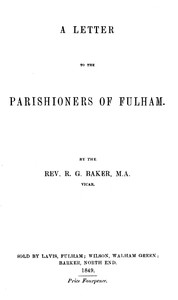
A Letter to the Parishioners of Fulham — Reading Notes
(0 User reviews)
382
Project Gutenberg
2021
Not confirmed
Poor -- England -- London; Working class -- England -- London; Working class -- Dwellings; Housing -- England -- London; Cholera -- Prevention; Fulham (London, England)
Readers of public-domain and historical texts
Project Gutenberg digital edition
en
Edition facts
Words
7,909
Reading time
35 min
Text sections
1
For A Letter to the Parishioners of Fulham — Reading Notes, the stored edition analysis reports 7,909 words, 35 min estimated reading time, and 1 detected text section.
The text analysis averages about 28.4 words per sentence, while the detected sections provide another way to judge how the source is divided.
Project Gutenberg metadata also associates the work with “Poor -- England -- London,” connecting these edition facts with the source record’s subject description.
Source:
Project Gutenberg record #67031
A parish vicar's 1849 letter to Fulham residents analyzes cholera mortality statistics, links poverty and housing to disease, and proposes improved dwellings for the working class.
Editorial Edition Score
4.3/5
★★★★★
★★★★★
Calculated from edition completeness, EPUB availability, text structure and catalogue metadata. Not a user rating.
How this score is calculated
- Description quality20 pts
- Title & short description10 pts
- Source metadata20 pts
- Text length15 pts
- Chapters / structure15 pts
- EPUB file integrity20 pts
Total of 100 points, scaled to a 2.5-5.0 range. Editions with an empty description or a missing EPUB file are not scored.
Edition quality
Read the Text
There were several persons, indeed, present on the 17th inst., who were prepared and even desirous to hear another proposition brought forward, connected with the domiciliary condition of the poor, and tending to correct an evil in their present dwellings, confessedly far more difficult to reach than either their defective sewerage, or their scanty provision of water. And it is one which not only affects most seriously their sanitary state, but impairs all the decency of their daily habits of life, and nearly defeats whatever means can be attempted for the improvement of their spiritual and moral character. I allude to the crowded manner in which they live together; the landlord of the house too often entirely regardless of any rule for restricting the number of its inmates; and his tenants sometimes deriving a large profit, beyond the amount of their own rent, from the numerous under-tenants whom they admit, without scruple or restraint, to share in the occupation of them. Thus it happens not unfrequently, that into a cottage with two small bed-rooms, built and adapted only for a single family, two or even three other families, besides individual lodgers, are admitted. And from that hour must the inmates of it be compelled to abandon all the happy arrangements of household cleanliness, decency, and order. Mr. Rouse, in his faithful and elaborate MS. Report on the sanitary condition of a large part of this parish, states, that he has known in the summer twenty-six persons living in such an house: and from fifteen to twenty is the frequent number of their inmates. But while it ought to be stated that the worst cases of this kind occur among the Irish labourers, they prevail to a greater or a less extent in all the following districts, viz.: Parson’s Green Lane, Peterborough Row, Sand End, Garden Row, Carpenter’s Row, Dawe’s Lane, Wheat-Sheaf Alley, Gain’s Buildings, Bedford Place, Stanley Place, the cottages near Normand House, Orchard Place, Buckler’s Alley, the Old Greyhound Cottages, Marsh Croft, Sun Street, Star Lane, and Willow Place.
And it is a melancholy fact, that while in some other parts of Fulham a considerable number of small houses have been built within the last few years, of a more substantial and commodious style, in order to meet the increasing wants of this portion of the inhabitants, better drained, better ventilated, and in some more healthy localities, they are gradually lapsing into the same state. A very few of them once becoming occupied in this comfortless manner lower the credit of those contiguous to them. One tenant sets a bad example to the rest: and thus in the very districts where some hope had been encouraged for a time of better things, the same baneful system of crowding the houses with lodgers is spreading.
The history of these masses of ill-regulated dwellings is, alas! uniform and instructive. Some speculating builder or other, oftentimes unknown in the neighbourhood, and having no sympathy with the miseries which he inflicts upon it, becomes possessed of a narrow slip of land, the mere frontage of a road or a footpath, and erects upon it a collection of low, slightly built cottages, with windows wholly unsuited to them, with no drainage but that of cesspools, confined in their dimensions, rarely emptied, and saturating with their noxious contents not only the adjacent soil, but even the walls of the houses close to which they are often placed; with no pumps for drinking-water but such as soon become tainted by the contiguity of these very cesspools; and with no provision of other water, but that which an occasional cart, drawn by a miserable donkey, brings dear-bought to the door. High rents, far beyond the means of the tenants, but sternly collected as each week comes round, can only be met by the vicious practice of subletting each room or fraction of a room which can by any sacrifice be dispensed with. Even the essential whitewashing of the walls within is sometimes imposed as a burden upon the occupier, who of course does it in the most careless way, instead of its being undertaken by the landlord. And whenever the work of dilapidation begins in one of these tenements, each successive tenant, flying from his hard bargain, leaves it of course more dismantled than he found it; until they become utterly unfit for the occupation of human beings, whether under the summer sun, striking upon their slight and exposed roofs, or the winter wind, penetrating the settlements of their walls and the cracks of their windows.
The Reverend R. G. Baker opens his 1849 letter to the parishioners of Fulham with a stark numerical account: in nine weeks, 127 deaths occurred, 56 from cholera, and 58 of those deaths were among people aged five to fifty-five—ages typically considered less vulnerable. He notes that the victims, with only three exceptions, were labourers or their families, living in overcrowded, poorly ventilated dwellings. This statistical framing immediately establishes the letter as a data-driven argument, not merely a pastoral consolation.
Mortality Figures and Their Implications
Baker presents the cholera mortality in precise tables, showing 11 deaths in children aged 5–10, 9 in each subsequent decade up to 50, and only 5 between 50 and 55. He emphasizes that 58 deaths occurred in the prime of life, outside the high-risk periods of infancy and old age. The rapidity of the illness is stressed: 35 cases ended within 24 hours, 18 within 12. These details serve to underscore the suddenness and indiscriminate nature of the outbreak, while also pointing to environmental causes rather than inherent susceptibility.
The Geography of Poverty and Disease
Baker draws a direct line between the victims' social class and their residence. The poorest parishioners lived in the cheapest, most crowded parts of Fulham, where dwellings were overcrowded and lacked ventilation. He contrasts these conditions with the healthier homes of the better-off, implicitly arguing that cholera was not a divine punishment but a preventable consequence of housing policy. The letter repeatedly returns to the physical state of these homes, using phrases like 'overcrowded with inmates' and 'want of ventilation' to build a case for reform.
Proposed Remedies and Practical Obstacles
Baker advocates for improved dwellings for the 'hard-working and intelligent, and still independent poor.' He cites the Metropolitan Association for Improving the Dwellings of the Industrious Classes, describing its model houses in Pancras Road and Spicer Street. He acknowledges the difficulty of acquiring land in Fulham due to complex tenures, but points to recent successful projects—a Roman Catholic church, schools, a workhouse, alms-houses—as evidence that obstacles can be overcome. His tone is pragmatic, urging the vestry to secure a suitable plot before the year's end.
A Clergyman's Rhetorical Strategy
Baker's letter is structured as a pastoral address, beginning with 'My dear Parishioners' and closing with 'Your sincere friend and well-wisher.' Yet its content is relentlessly factual, mixing moral concern with statistical tables and references to sanitary reports. He avoids theological speculation about cholera as divine judgment, instead focusing on earthly causes and remedies. The letter includes a memorial from landowners and occupiers supporting sewerage improvements, indicating that Baker sought to mobilize civic action through a blend of clerical authority and empirical evidence.
Baker's letter is best read as a primary document of mid-19th-century public health advocacy, where a clergyman uses his pulpit to promote sanitary reform. Readers should attend to how he weaves together mortality data, housing conditions, and calls for practical action, all within the formal constraints of a pastoral letter. The appended memorial and references to model dwellings offer a concrete sense of the reform networks active in 1849 London.
There’s something unbearably poignant about that 1849 vicar’s careful tables of cholera deaths, each number a Fulham doorstep. Reading it, I kept thinking how nursing would later become its own quiet ledger of witness. An old handbook like The Tuberculosis Nurse: Her Function and Her Qualifications A Handbook for Practical Workers in the Tuberculosis Campaign — A Reader’s Guide feels like a sequel to that same care, written by hands that counted breaths instead of deaths.
There are no reviews for this eBook.
There are no comments for this eBook.
Reader reflection
Record your reading impressions
A brief reflection can help important ideas stay with you longer.
Your progress
0
/
10
2
Did this book hold your interest?
3
Is this a title you would suggest to others?
4
How demanding did the text feel?
5
Which part made the strongest impression?
6
Did it raise ideas you would like to talk about?
7
Would you read this book again?
8
How would you rate its originality?
9
What is the main idea you are taking away?
10