1

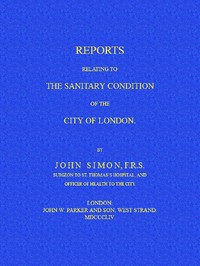
Reports Relating to the Sanitary Condition of the City of London — Themes and Context
(0 User reviews)
2467
Project Gutenberg
2017
Not confirmed
Sanitation -- England -- London; Cemeteries -- England -- London; Mortality -- Statistics
Readers of public-domain and historical texts
Project Gutenberg digital edition
en
Edition facts
Words
101,571
Reading time
442 min
Text sections
16
Reports Relating to the Sanitary Condition of the City of London — Themes and Context can be approached with a clearer sense of reading commitment from its source measurements: 101,571 words, 7 hr 22 min estimated reading time, and 16 detected text sections.
The text analysis averages about 29.6 words per sentence, while the detected sections provide another way to judge how the source is divided.
Project Gutenberg metadata also associates the work with “Sanitation -- England -- London,” connecting these edition facts with the source record’s subject description.
Source:
Project Gutenberg record #54622
John Simon's reports to the City of London Commissioners of Sewers, reprinted with footnotes, document mid-19th-century urban sanitation challenges, focusing on structural defects, water supply, and burial grounds, with a proposal for municipal property acquisition.
Editorial Edition Score
4.8/5
★★★★★
★★★★★
Calculated from edition completeness, EPUB availability, text structure and catalogue metadata. Not a user rating.
How this score is calculated
- Description quality20 pts
- Title & short description10 pts
- Source metadata20 pts
- Text length15 pts
- Chapters / structure15 pts
- EPUB file integrity20 pts
Total of 100 points, scaled to a 2.5-5.0 range. Editions with an empty description or a missing EPUB file are not scored.
Edition quality
Read the Text
gs of our existing sanitary condition, perhaps I may venture to speak of the almost obvious remedy. ‘Almost obvious’ I say; for surely no one will doubt that this great subject should be dealt with by comprehensive and scientific legislation; and I hardly see how otherwise, than that it should be submitted in its entirety to some single department of the executive, as a sole charge; that there should be some tangible head, responsible--not only for the _enforcement_ of existing laws, such as they are or may become, but likewise for their _progress_ from time to time to the level of contemporary science, for their _completion_ where fragmentary, for their _harmonisation_ where discordant.
If--as is rumoured, the approaching re-constitution of the General Board of Health is (after the pattern of the Poor-law Board) to give it a Parliamentary President, that member of the Government ought to be open to challenge in respect of every matter relating to health. What, for this purpose, might be the best subordinate arrangements of such a Board, it would take a volume to discuss. But at least as regards its constituted head, sitting in Parliament, his department should be, in the widest sense, to _care for the physical necessities of human life_. Whether skilled coadjutors be appointed for him or not; engineers--lawyers--chemists--pathologists; whether he be, as it were, the foreman of this special jury, or, according to the more usual precedent of our public affairs, collect advice on his own responsibility, and speak without quotation of other authority than himself, his voice, unless the thing is to be a sham, must represent all these knowledges.
The people, through its representatives, must be able to arraign him wherever human life is insufficiently cared for.
He must be able to justify or to exterminate adulterations of food; to shew that alum ought to be in our loaves, or to banish it for ever; to shew that copper is wholesome for dessert, or to give us our olives and greengages without it; to shew that red-lead is an estimable condiment, or to divert it from our pepper-pots and curries.
Similarly with drugs and poisons--the alternatives of life and death--a minister of Public Health would, I presume, be responsible for whatever evils arise in their unlicensed and unregulated sale. He would hardly dare to acquiesce in our present defencelessness against fraud and ignorance; in doses being sold--critical doses, for the strength of which we, who prescribe them, cannot answer within a margin of _cent. per cent._; or in pennyworths of poison being handed across the counter as nonchalantly as cakes of soap.[7] Surely, before he had been six months in office, he would have procured some enactment to remedy this long neglect of the legislature, by providing that the druggist’s trade be exercised only after some test of fitness, and in subjection to certain regulations.
[7] Without referring to what may be considered rare--the sale of poison for the purposes of intended homicide, I may remind the reader of the very dreadful facts collected by the Commissioners on Trades and Manufactures, as to the immense sales of opium in our principal manufacturing towns, for the purpose of quieting--and with the effect of killing, children, while their poor mothers are absent from home in their several occupations.
Within his province, likewise, it would fall to be cognisant of all that relates to the constitution of the Medical Profession. The difficulties which have baffled successive Home-Secretaries might soon find their solution in the less divided attention which he could bring to their study. Amid conflicting opinions and an apparent scramble for power, he would soon distinguish where might be the strife of jealousy and covetousness, where a truthful zeal for the honour and efficiency of medicine. I think he could not be long in curing our more scandalous anomalies. Probably--unless human bowels require other doctoring in London than in Manchester, he would manage that a doctor there should be a doctor also here; that no licence for the partial practice of medicine should be recognised--no licence admitting a man to do in Edinburgh what it would be a misdemeanour for him to do in Greenwich. And obviously, in order to this--since a professional diploma is the only criterion by which the public can measure the competence of those who seek their patronage, he would see that, as far as may be, the various licensing bodies exact from their candidates equal and sufficient qualifications; that the diploma entitling a man to call himself Surgeon or Physician, Accoucheur or Apothecary, mean the same thing--imply the same education, whether it be got in Scotland, Ireland, or England; and that any falsification of such diploma, or any unauthorised assumption of the title which implies its possession, be promptly punishable at law.[8]
John Simon's Reports Relating to the Sanitary Condition of the City of London opens with a dedication to his father, Louis Michael Simon, framing the work as a record of 'anxious labour' and 'endeavours to do my duty.' The volume collects annual reports addressed to the Commissioners of Sewers, originally printed for internal use, now reprinted with minimal textual alterations and distinguishing footnotes marked 'J. S., 1854.' Simon, serving as Officer of Health to the City and a surgeon at St. Thomas's Hospital, structures his reports around specific physical defects in housing, water supply, and burial practices, moving from detailed observations of courts and alleys to broader policy recommendations.
Movement from Observation to Remedy
Simon's reports follow a consistent pattern: he first describes a sanitary problem with precise, localized detail, then proposes a remedy. For instance, he identifies 'constructional errors' in courts and alleys—overcrowding, poor ventilation, and lack of light—and notes that these are often incurable due to 'the number of landlords, and on their mutual independence.' His solution is not piecemeal but structural: he suggests the Corporation assume proprietorship of such tenements, buying them compulsorily and converting them into model lodgings. This movement from specific observation to systemic intervention recurs throughout the volume, linking each report's evidence to a coherent administrative vision.
Recurring Images of Confinement and Light
Simon repeatedly uses imagery of confinement and deprivation of light to describe unhealthy dwellings. He criticizes the window-tax, which tempts 'a struggling population' to reduce 'their inlets of ventilation and light' for small savings. In courts and alleys, he finds 'dark intricacies' where overcrowding and blocked air create disease. The physical structure of buildings becomes a metaphor for social neglect: houses are 'wretched tenements' under 'petty owners' who fail to maintain them. This recurring focus on light and air as measurable necessities grounds his arguments in tangible, observable conditions rather than abstract theory.
Structure of the Reports and Their Appendices
The volume is organized chronologically, with five annual reports followed by an appendix of tables and two special reports on burial grounds. The preface explains that Simon has added footnotes to clarify or qualify earlier passages, creating a layered text where the 1854 author comments on his earlier self. The appendix includes 'Tables Illustrating the Sanitary Condition of the City of London,' providing statistical backing. This structure—report, table, special report—allows Simon to move between narrative description and quantitative evidence, reinforcing his credibility as both a medical officer and a public administrator.
Proposal for Municipal Landlordship
In his first annual report, Simon outlines a radical proposal: the Corporation should use 'compulsory purchases of house-property, on the ground of its unfitness for human habitation' to reclaim slums. He argues that private enterprise cannot solve the problem because properties are fragmented among many owners. By becoming a single landlord, the Corporation could improve both health and property value, then sell the renovated houses to fund further reclamation. This idea, presented as a 'general mention' rather than a detailed plan, reflects Simon's pragmatic approach—grounded in observed failures of the market—and his faith in municipal action as a remedy for urban decay.
Simon's reports offer a window into the administrative and medical thinking of mid-Victorian London, where the officer of health acted as both investigator and advocate. Readers should note the interplay between the original reports and the 1854 footnotes, which reveal how Simon's views evolved. The volume is best approached as a document of public health history, not a narrative, with its value lying in the concrete details of housing, water, and burial practices that Simon meticulously recorded.
Reading John Simon’s reports, I was struck by how often he circled back to the earth—its dampness, its overcrowded burial grounds. It made me think of how we still wrestle with that same quiet anxiety about what happens below. That thread led me, gently, to Cremation of the Dead: Its History and Bearings Upon Public Health — A Reader’s Guide. Both feel like old, worried friends whispering about the same stubborn problem.
There are no reviews for this eBook.
There are no comments for this eBook.
Reader reflection
Before you leave, reflect on the book
Use these questions to collect your thoughts before moving on.
Your progress
0
/
10
2
Did this book hold your interest?
3
Would you encourage someone else to read it?
4
How demanding did the text feel?
5
How strong was your personal connection to the text?
6
How valuable was this book for your own interests?
7
What did you appreciate most?
8
Did the story or argument move comfortably?
9
What did this book teach you most?
10