1

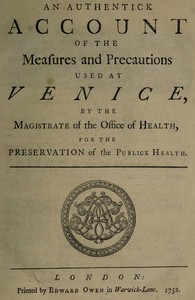
An Authentick Account of the Measures and Precautions Used at Venice By the Magistrate of the Office of Health, for the Preservation of Publick Health — Inside the Classic
(0 User reviews)
255
Project Gutenberg
2021
Not confirmed
Plague -- Italy -- Venice; Public health laws -- Italy -- Venice; Public health administration -- Italy -- Venice
Readers of public-domain and historical texts
Project Gutenberg digital edition
en
Edition facts
Words
11,426
Reading time
50 min
Text sections
2
For An Authentick Account of the Measures and Precautions Used at Venice By the Magistrate of the Office of Health, for the Preservation of Publick Health — Inside the Classic, the stored edition analysis reports 11,426 words, 50 min estimated reading time, and 2 detected text sections.
The text analysis averages about 40.2 words per sentence, while the detected sections provide another way to judge how the source is divided.
Project Gutenberg metadata also associates the work with “Plague -- Italy -- Venice,” connecting these edition facts with the source record’s subject description.
Source:
Project Gutenberg record #65479
An 18th-century Venetian health office manual detailing quarantine procedures, ship inspections, and cargo purification, based on the author's firsthand account of plague prevention measures.
Editorial Edition Score
4.5/5
★★★★★
★★★★★
Calculated from edition completeness, EPUB availability, text structure and catalogue metadata. Not a user rating.
How this score is calculated
- Description quality20 pts
- Title & short description10 pts
- Source metadata20 pts
- Text length15 pts
- Chapters / structure15 pts
- EPUB file integrity20 pts
Total of 100 points, scaled to a 2.5-5.0 range. Editions with an empty description or a missing EPUB file are not scored.
Edition quality
Read the Text
AN AUTHENTICK ACCOUNT OF THE Measures and Precautions USED AT _VENICE_, BY THE MAGISTRATE of the Office of HEALTH, FOR THE PRESERVATION of the PUBLICK HEALTH.
_LONDON_: Printed by EDWARD OWEN in _Warwick-Lane_. 1752.
AN AUTHENTICK ACCOUNT OF
The MEASURES and PRECAUTIONS used at _VENICE_, by the MAGISTRATE of the Office of HEALTH, for the PRESERVATION of the PUBLICK HEALTH.
It is now the Third Century since the following Regulation took its Rise.
The Office of Health is furnished with such ample Power and Authority, as makes it at once useful and respectable; it is administered by the Subjects of the Republick most eminent for their Prudence, Dignity and Talents; it is furnished with Abundance of Officers, a few of whom are employed in the Distribution of Orders, and the rest in their Execution. In describing occasionally these different Branches, much Light will be let in upon the Subject.
Experience has shewn, that in the _Ottoman_ Dominions the Plague is never utterly extinct: Hence it is an immutable Law with the Magistrate of the Office of Health, to consider the whole Extent of the _Ottoman_ Dominions, and every State dependent on it, as always to be suspected to be in an infected Condition, to such a Degree, as not to receive, in any Part of the Dominions of the Republick, either confining to or commercing with them, any Persons, Merchandizes, Animals, or any other Thing coming from thence, without the necessary Inspection of the Office of Health, and the previous Purifications.
To explain myself, I will suppose that a suspected Ship, coming from some Scale of the _Levant_, presents itself at the Mouth of these Ports, and, by describing the Conduct that is observed towards it, I shall shew the Rules that are practised with regard to every Vessel, coming from any Part of the World, that is either infected, or suspected to be so.
No Vessel can enter these Ports, unless it touches at _Istria_, and takes a Pilot on Board, or unless, on approaching to the Ports, it wait for the Towers of the Admiral to tow it up. These Officers do not immediately depend upon the Magistrate, but are obliged, however, not to neglect any of his Rules, nor to mix with any Vessel, even free or cleared, unless by the Magistrate’s Leave; to make use of tarred Cables, or Cables of [Transcriber’s Note: an intentional blank space was left here in the original] in the towing Vessels in, in order to avoid all Communication, and to direct the Captain of every suspected Vessel to hoist up on the Mizen Mast a particular Signal; so that, by Means of the Spies, who are continually on the High Tower of St. _Mark_ to discover any Vessels that approach, such Vessel is immediately known to be a Vessel subject to perform Quarantine.
As soon as the Vessel is discovered, the Magistrate has Notice, and all the Officers belonging to him; the Chief of whom instantly dispatches the _Guardian_ (whose Turn it is) to meet it and go on Board, and guard it during the Term of Quarantine.
The Magistrate has Sixty of these Guardians in his Service, whose Duty it is, by Turns, either to go a-board any Ship, or to the _Lazarettos_, to superintend the Purification of Merchandizes, or the proper Quarantine of Persons. Their Duty, in general, is to see that all the Rules are observed concerning the Precautions and Purifications: Their Office is dangerous and delicate to the last Degree; they have a particular daily Appointment, which they have also from those concerned in the Ship or Cargo, besides their daily Provisions; and they answer with their Life any Contravention to the Rules that they should suffer to take Place, or dare to have any Hand in.
The anonymous author of this 1752 account immediately establishes the Venetian Office of Health as a body of "ample Power and Authority," administered by subjects "most eminent for their Prudence, Dignity and Talents." The text proceeds by describing a hypothetical ship from the Levant to illustrate the rules applied to all vessels from infected or suspected places. This methodical approach—using a single case to explain the entire system—shapes the reader's understanding from the outset.
The author emphasizes that the plague is considered "never utterly extinct" in Ottoman dominions, leading to an immutable law treating those regions as perpetually suspect. This premise underlies every subsequent regulation, from the requirement for pilots and tarred cables to the hoisting of a specific signal on the mizen mast. The opening thus frames the entire work as a practical exposition of a rigorous, experience-based system.
The Role of Signals and Surveillance
The account details a layered surveillance system. Spies stationed on the High Tower of St. Mark constantly watch for approaching vessels. When a ship is spotted, the Magistrate is immediately notified, and a chain of officers is activated. The ship must hoist a particular signal on the mizen mast to indicate it is subject to quarantine. This signal allows the authorities to distinguish suspected vessels from free ones before any contact occurs.
The author notes that pilots and towing vessels use tarred cables to avoid communication with the crew. Even free vessels cannot mix with suspected ones without the Magistrate's leave. The emphasis on visual markers and physical separation underscores the Venetian approach: preventing contagion through strict procedural barriers rather than relying on medical treatment.
Unloading and the Status of the Bastazi
Once a ship is anchored, the unloading process begins at a designated shore. The workers called Bastazi handle the goods, and from that moment they are considered "unclean" and forbidden from any communication. A clerk or supercargo accompanies the merchandise to the Lazaretto to ensure proper delivery and obtain receipts. The author stresses that this system ensures accountability: every item is noted, and the Bastazi must return everything they received.
The text reveals a careful distinction between persons and goods. While passengers may begin quarantine sooner, their belongings—especially merchandise—must undergo the full forty-day purification. The author explains that "the Evil manifests itself more easily in Persons than Things," yet because passengers carry personal effects, the suspicions become equal, and the required purification must be equal too. This logic drives the detailed procedures for opening chests, exposing apparel to air, and making a formal roll of all items.
The Quarantine Timeline and Its Triggers
The quarantine period for merchandise from the Levant is regularly forty entire days. However, the author notes that this period can be extended if any Bastazi falls sick or dies, or if any sign of infection appears on the ship. The quarantine of the ship and crew begins only after unloading is complete, while passengers may start earlier by moving to the Lazarettos with their wearing apparel. This staggered timeline reflects the Office of Health's priority: ensuring that every item liable to expurgation passes through the established trials.
The author emphasizes that the end of unloading and the completion of transportation to the Lazaretto are distinct terms that must be diligently considered. It is not enough that goods have gone through purification; it must be manifested that they have. This insistence on documentation and verification runs throughout the account, showing a bureaucracy designed to leave no room for error or evasion.
The Lazaretto Procedures and Record-Keeping
Upon arrival at the Lazaretto, a Guardian opens all chests, strong boxes, and envelopes, taking a note called "making the Roll." He then orders all wearing apparel to be exposed to the air. The Prior is always present, and the Guardian registers both the persons entering quarantine and their things, along with the names of the Guardians in charge. A report is sent to the Magistrate specifying the day of debarkation, the moment when chests were opened, and the roll of items requiring expurgation.
If any merchandise is discovered among passengers' belongings, the passengers' quarantine cannot commence until those goods are transported elsewhere for proper precautions. The author's detailed description of these steps—from the roll to the report—reveals a system where every action is recorded and communicated upward. The account thus serves not only as a description but as a manual for officials, emphasizing punctuality and adherence to rules.
This account offers a rare, granular view of 18th-century public health administration in Venice. Readers should note that the author writes as an insider, explaining procedures without questioning their efficacy. The text is best approached as a primary source on quarantine logistics rather than a medical treatise. Pay attention to the recurring emphasis on documentation and the physical separation of persons and goods—these details reveal the underlying assumptions about contagion and control that shaped Venetian policy.
Reading this old Venetian manual, I kept thinking how meticulous those officials were, checking every bale and hull for contagion. It feels strange that a century later, the American Public Health Association was already wrestling with poisoned soil and water. Same careful worry, different enemy—one invisible, the other creeping through the ground. There’s a quiet ache in seeing how each generation thinks its vigilance will be the last one needed. Soil and Water Pollution : Presented to the American Public Health Association at New Orleans, Dec. 1880 — Text and Context sits on my shelf like a letter from that long summer of concern.
There are no reviews for this eBook.
There are no comments for this eBook.
Reader reflection
Take a moment to reflect on this book
Create a short personal record of your experience with this book.
Your progress
0
/
10
2
Was reading this book enjoyable?
3
Would you recommend this book to another reader?
4
How easy was the book to follow?
5
Did the book give you something worth debating?
6
Could you follow the author’s main argument?
7
How strong was your personal connection to the text?
8
Would you read this book again?
9
What did this book teach you most?
10