1

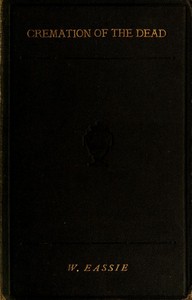
Cremation of the Dead: Its History and Bearings Upon Public Health — A Reader’s Guide
(0 User reviews)
245
Project Gutenberg
2015
Not confirmed
Funeral rites and ceremonies; Cremation -- History
Readers of public-domain and historical texts
Project Gutenberg digital edition
en
Edition facts
Words
35,455
Reading time
155 min
Text sections
6
For Cremation of the Dead: Its History and Bearings Upon Public Health — A Reader’s Guide, the stored edition analysis reports 35,455 words, 2 hr 35 min estimated reading time, and 6 detected text sections.
The text analysis averages about 21.3 words per sentence, while the detected sections provide another way to judge how the source is divided.
Project Gutenberg metadata also associates the work with “Funeral rites and ceremonies,” connecting these edition facts with the source record’s subject description.
Source:
Project Gutenberg record #48492
William Eassie's 1875 work examines cremation's history and public health benefits, contrasting ancient practices with Victorian burial laws, citing European and American movements, and detailing sanitary arguments against earth burial.
Editorial Edition Score
4.7/5
★★★★★
★★★★★
Calculated from edition completeness, EPUB availability, text structure and catalogue metadata. Not a user rating.
How this score is calculated
- Description quality20 pts
- Title & short description10 pts
- Source metadata20 pts
- Text length15 pts
- Chapters / structure15 pts
- EPUB file integrity20 pts
Total of 100 points, scaled to a 2.5-5.0 range. Editions with an empty description or a missing EPUB file are not scored.
Edition quality
Read the Text
The probable sanitary origin of Cremation--Not necessarily opposed to Religion--General reasons--Wisdom of adopting it in cases of epidemics--Sundry objections treated--The decorousness of the practice--Cremation desirable in the battlefield--In cases of murrain--In the destruction of condemned food, &c. 1-23
METHODS OF TREATING THE DEAD.
Exposure, or the absence of all burial--Consignment to the deep--Petrifaction--Envelopment in some solid material--Burial in the earth--Embalming preparations--Desiccation of the body--Cremation a widely-spread practice--Examples of quasi-cremation 24-40
State of things thirty years ago--The new cemeteries--Space allowed for, and the depths of interments--Vault burial--A well-chosen cemetery--An improperly-chosen one--The closing and regulation of old burial-grounds, &c.--Materials for coffins 41-52
DANGERS OF OUR SYSTEM OF BURIAL.
Churchyards and the evils resulting from some of them--How the living are affected by them--Disorders caused by putrid emanations--Dangers of inhaling the atmosphere of some burial-grounds--Vaults--Poisoning of wells and water-courses--Laxity of many interments 53-67
PRESENT STATE OF THE QUESTION.
Promoters of the practice of Cremation and prospects of its adoption in Italy--In Switzerland--In France--In Belgium--In Austria--In Germany--In America--In England--Sir Henry Thompson's work--The Cremation Society of London, its objects, &c. 68-88
CREMATION, ANCIENT AND MODERN.
Ancient modes of cremation as illustrated by recent burnings in Italy, India, Siam, and North America--Modern experiments in Italy, Germany, and England--The Siemens' apparatus, its construction, perfect working, and economy--Proposed procedure--Disposal of the ashes--Description of cinerary vessels, old and new--Conclusion--Bibliography of the subject 89-130
(_All at end of book._)
I. VIEW OF A SIEMENS' APPARATUS (GERMAN PATTERN).
II. SIEMENS' APPARATUS (ENGLISH PATTERN).
III. SKETCH OF MORTUARY CHAPEL.
V. SKETCH OF FAMILY COLUMBARIUM, OR NICHE IN PRIVATE CHAPEL.
VI. URNS IN THE CRYPT AND CHURCH.
CREMATION OF THE DEAD.
Cremation of the dead is neither new in theory nor in practice. In the England of modern times, however, the question has only recently assumed recognised importance. And the more one considers cremation, the more one finds himself wondering how it has come to pass that we practise burial, with its many faults, and do not burn our dead. Thousands amongst us are now beginning to feel thankful that the dead are soon to 'rule our spirits from their urns' in a realistic and not alone in a poetical sense. They think there is something majestic and even pleasurable in the idea that it will ere long be possible, on all civilised shores, to leave their mother earth, not with a partial, but with a fully consummated sacrifice upon her altar, bidding her adieu none the worse, but rather the better, for their sojourn with her. They groan and labour under the burden of enforced burial, and 'hail with satisfaction and joy the prospect that a chariot of fire may receive them instead of the cold and darksome grave.'
The scheme has met with some enemies, and injudicious promoters of the system have not proved the least of them. The idea that it was sought to make it compulsory, was an unfortunate utterance. The notion of producing illuminating gas for general purposes from the combustion of the bodies was another mischievous idea.[1] Equally so was the proposal for the erection of a tall shaft in the cemetery grounds, where the gases could be seen consuming--something after the fashion, I suppose, of the twelfth century's _lanternes des morts_. The publication of crude and undigested fancies does more harm than good to the subject they are meant to benefit.
[1] The original proposer of this scheme was M. Rudler, who proposed it to Dr. Caffe, of Paris, in 1857.
It has been urged that the practice of burning the dead had its origin in a heathen religion, but it is not wise to accept the imputation. Let us take Greece for an example. All historians inform us that the people of ancient Greece practised inhumation. But when they did practise cremation, they nowhere associated the burning of the dead with the worship of the gods. And we are at liberty to argue from this fact that neither did the aboriginal peoples from whom they derived it, regard it as an act with which religion had aught to do, the story of Odin notwithstanding. And the reason why the Greeks did not practise it earlier, was doubtless simply because the bulk of the colonists came from countries where another system prevailed. Cecrops and Danaus, who were instrumental in colonising Athens and Argos, were Egyptians, and Cadmus, the founder of Thebes in Bœotia, was a Phœnician.[2] Neither of these nations burnt their dead, but practised another system of burial.
William Eassie, a civil engineer and secretary of the Cremation Society of London, opens his 1875 treatise with a clear sanitary argument: cremation, far from being a modern innovation, was a widespread ancient practice abandoned to the detriment of public health. The book's dedication to Sir Henry Thompson signals its practical bent, and the preface reveals its origin in a paper requested by the President of the Metropolitan Branch of the British Medical Association. Eassie's evidence-driven approach draws on historical examples, contemporary European legislation, and the work of German and American advocates to build a case rooted in hygiene rather than sentiment.
Sanitary Origins and Religious Neutrality
Eassie grounds his argument in what he calls the 'probable sanitary origin of Cremation,' insisting it is 'not necessarily opposed to Religion.' He lists general reasons for adopting the practice, emphasizing its wisdom during epidemics and on battlefields. The introduction treats 'sundry objections'—including decorum—by asserting that cremation is more dignified than decay in earth. This framing positions the book as a public health manual rather than a philosophical manifesto, drawing authority from Eassie's engineering background and his role in the Cremation Society.
Global Precedents and Contemporary Movements
Chapter V surveys the 'present state of the question' across Europe and America. Eassie notes progress in Italy, Switzerland, France, Belgium, Austria, Germany, and America, citing specific societies and publications: Drs. Trusen, Küchenmeister, and Reclam in Germany; Professor Frazer in America; and Sir Henry Thompson in England. He records that the New York Incremation Society 'accepts the obligation of burning the bodies of its members' and that a German Society formed in New York. A striking anecdote describes a Persian gentleman in an Eastern State who 'was personally assaulted by an ignorant mob' for attempting to cremate his wife. These details ground the international movement in concrete events and personalities.
The English Campaign and Practical Apparatus
Eassie traces English advocacy from Sir Thomas Browne through later works by Dr. J. Jamieson and a 'Member of the Royal College of Surgeons' in 1857. He credits Sir Henry Thompson's two-part article in the Contemporary Review (1874) with marking 'a new era,' noting that 'nearly every European nation has now translated it for itself.' The Cremation Society of London, founded January 13, 1874, issued a declaration that revealed 'how very prevalent and how widely spread was the antipathy to the present mode of burial.' Eassie emphasizes the need for a suitable apparatus, endorsing Thompson's chosen design after 'several crucial tests.' This section blends historical narrative with technical advocacy, reflecting Eassie's dual role as secretary and engineer.
Eassie's book is best read as a period document in the public health reform movement, not a complete history. Readers should note that the excerpts cover only the preface, table of contents, and parts of Chapter V; the full work includes chapters on burial laws, dangers of interment, and methods of treating the dead. The author's engineering perspective and his reliance on contemporary medical and legal sources make this a valuable primary source for Victorian attitudes toward death, sanitation, and reform.
Reading about Eassie’s sanitary arguments, I remembered standing in an old churchyard as a child, watching rain pool against the headstones. The ground felt too full. That unease returned years later, unexpectedly, while leafing through Soil and Water Pollution : Presented to the American Public Health Association at New Orleans, Dec. 1880 — Text and Context, where the same worry spoke in plainer, older language. Two books, one quiet dread.
There are no reviews for this eBook.
There are no comments for this eBook.
Reader reflection
How did this book work for you?
Your answers remain private and are stored only in this browser.
Your progress
0
/
10
2
Was reading this book enjoyable?
3
How likely are you to recommend this book?
4
How much effort did this book require?
5
How would you rate its originality?
6
Could you follow the author’s main argument?
7
Did the book give you something worth debating?
8
Did the book meet your expectations?
9
In one sentence, what did you learn?
10