1

Water pollution—Wells — Text and Context
(0 User reviews)
2469
Project Gutenberg
2020
Not confirmed
Wells; Water -- Pollution; Drinking water
Readers of public-domain and historical texts
Project Gutenberg digital edition
en
Edition facts
Words
7,722
Reading time
34 min
Text sections
1
The catalog record for Water pollution—Wells — Text and Context provides practical reading context through 7,722 words, 34 min estimated reading time, and 1 detected text section.
The text analysis averages about 22.6 words per sentence, while the detected sections provide another way to judge how the source is divided.
Project Gutenberg metadata also associates the work with “Wells,” connecting these edition facts with the source record’s subject description.
Source:
Project Gutenberg record #62174
Irving A. Watson's 1883 medical society report uses vivid rhetorical contrasts—poetry versus chemistry, tradition versus science—to argue for sanitation. Detailed case studies trace illnesses to polluted wells, blending clinical observation with advocacy for pure water.
Editorial Edition Score
4.3/5
★★★★★
★★★★★
Calculated from edition completeness, EPUB availability, text structure and catalogue metadata. Not a user rating.
How this score is calculated
- Description quality20 pts
- Title & short description10 pts
- Source metadata20 pts
- Text length15 pts
- Chapters / structure15 pts
- EPUB file integrity20 pts
Total of 100 points, scaled to a 2.5-5.0 range. Editions with an empty description or a missing EPUB file are not scored.
Edition quality
Read the Text
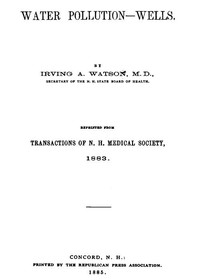
WATER POLLUTION—WELLS.
WATER POLLUTION—WELLS.
BY IRVING A. WATSON, M. D., SECRETARY OF THE N. H. STATE BOARD OF HEALTH.
REPRINTED FROM TRANSACTIONS OF N. H. MEDICAL SOCIETY, 1883.
CONCORD, N. H.: PRINTED BY THE REPUBLICAN PRESS ASSOCIATION. 1885.
WATER POLLUTION—WELLS.
Poets have sung of the “babbling brooks” and the “mountain springs” with their “silver cascades.” Painters have sketched
“the placid stream, Reflecting back the mirrored beam,”
in many a sequestered nook, where the beauty of the scene gave to the soul its grandest appreciation of nature’s handiwork; but the poet’s song and the painter’s canvas are too often the false airs and the tinsel drapery of Momus—fun and folly. But poets and painters live in a realm uncongenial to the startling facts of modern chemistry. Virgil would undoubtedly have been as ready to have believed that H₂O represented a glass of milk, as that it was the equivalent of pure water; while, if Raphael had been told that the pool of Bethesda was abundant with “albuminoid ammonia,” he might innocently have believed it to be “something good to eat.”
Tradition and popular education have taken wings in a tangent direction from many of the fundamental principles of a natural existence, and, while freighting the popular mind with its bulky chaff, sparsely grained, they seldom recognize the revelations of science. The plot of some well drawn novel, or the fascinating performances of its hero, rest unforgotten in the embrace of memory,—are sought after, cherished, and remembered in all and by all ages. Science as yet is but little courted, much less wedded to the popular taste, and the stubbornness of facts is in direct ratio to the inflexibility of the public mind. Science, however, is not always of one hue. It is full of attractions and alluring fascinations. It needs only to be clothed in well cut and fashionable garments, and properly and politely introduced, to receive universal recognition and popular applause. This is especially true of the science of sanitation, because it is more closely allied to the vital interests of every community and every family than all others, and, through the simplicity of its primary principles, can be realized and understood by all.
Pure water is essential to the health and comfort of every community: there is no argument to the contrary. How such a _desideratum_ can be acquired and maintained is a problem which requires the closest application of science, as well as mechanical and engineering skill. The question, whenever and wherever applied, becomes an isolated reality, and the solution, instead of being based upon established formulas or analogy, is almost wholly dependent upon the individual facts and conditions connected therewith.
The aspect of the question a century hence will be very different from what it is to-day, even as in its present bearings it differs from the time when the woodman’s axe was the only sound of industry that echoed through the sleeping valleys and over the watchful hills of New Hampshire. In that day the hardy pioneer quenched his thirst by the side of any stream or spring with water as pure as earth could give. He thought not to glance up the stream to see if it was spanned by a family vault, or flanked by a barn-yard. Likewise, if he partook from the bubbling spring or the primitive well, he never imagined a crystal of urea came up in the tiny fountains of sand at its bottom, or that the sparkle of the water was the carbonic acid of a sink drain; for around him were no such dangers. But civilization (in many respects a misnomer) came on, and brought with her more evils than one,—seduced the virginity of nature, and begot a host of illegitimate products and conditions. Into her very veins—the streams and rivers—have been injected the effete products of waste and decay; and to-day her very gifts, poisoned by men, bring pain, poverty, tears, and death into many households.
We have all, no doubt, traced some cases of the zymotic order to polluted water, with evidence that left no doubt as to the correctness of our conclusions. As to how far such influences extend in the causation of disease is undetermined, but I believe it extends far beyond the category of acute zymotic diseases.
Irving A. Watson opens his 1883 report to the New Hampshire Medical Society by juxtaposing poetic and painterly ideals of water—'babbling brooks' and 'silver cascades'—against the 'startling facts of modern chemistry.' He wryly imagines Virgil mistaking H₂O for milk and Raphael believing 'albuminoid ammonia' was something edible. This rhetorical strategy immediately frames the work as a polemic: science, he argues, must be 'clothed in well cut and fashionable garments' to win public favor. The report is less a dry treatise than a persuasive performance, blending literary allusion with epidemiological evidence.
Rhetoric of Persuasion
Watson’s prose is deliberately theatrical. He dismisses tradition and popular education as 'bulky chaff, sparsely grained' and insists that 'the stubbornness of facts is in direct ratio to the inflexibility of the public mind.' His metaphors are mixed but forceful: science is a courted bride, facts are stubborn, and sanitation is a vital interest. The opening pages function as a jeremiad against ignorance, using classical and biblical references (Virgil, Raphael, the pool of Bethesda) to elevate a practical subject. This is not a neutral technical manual; Watson is a reformer trying to convert his audience.
Clinical Case as Evidence
The report’s core consists of detailed case histories. One account describes a 47-year-old man with 'sore throat and hoarseness, laryngo-pharyngitis,' an erythematous eruption, and eventually 'very tenacious' sputum 'composed almost entirely of pus.' Watson notes the patient insisted his well water was 'splendid water.' Later, the man’s son developed dysentery with petechial eruption, followed by two other sons and the mother. Watson does not claim proof, but the temporal and spatial clustering implies contamination. The clinical language—'auscultation revealed very heavy, moist rales'—is precise, yet the narrative arc is almost tragic.
The Rye Beach Well Incident
A second case involves a wealthy Philadelphian who built a summer residence on a rocky elevation. He constructed a cesspool forty feet from the house and a well sixty feet away, both dug into the ledge. Within two weeks, the well was polluted. The family continued using the water until it became 'repulsive to the senses of taste and smell.' The result, Watson states bluntly, 'was the death.' He does not elaborate on the number or identity of the deceased, but the brevity underscores the danger. The site was 'from a sanitary point of view, no better could possibly be selected,' yet engineering failure—placing cesspool and well on the same fissured rock—proved fatal.
Diction of Dirt and Danger
Watson’s vocabulary oscillates between the poetic and the clinical. He speaks of 'the beauty of the scene' and 'nature’s handiwork' but also of 'albuminoid ammonia,' 'sputa,' and 'petechial eruption.' This juxtaposition mirrors his argument: the public must learn to see water not as picturesque but as a potential vector of disease. His choice of the word 'pollution' is itself significant—it carries moral as well as physical weight. The report is a document of its time, when germ theory was still contested, and Watson relies on observational correlation rather than laboratory proof. His diction reveals a man trying to make science vivid and urgent.
Watson’s report is best read as a hybrid: part medical lecture, part public health manifesto, part cautionary tale. The case studies are not anonymized or aggregated; they retain the texture of individual suffering. Readers should attend to the way Watson builds his argument through anecdote and analogy rather than statistical tables. The work is a window into late-nineteenth-century sanitary reform, where persuasion was as important as data.
I recall how Watson’s Water Pollution—Wells pleaded for clean water with the quiet urgency of a physician who had watched families sicken by their own dooryards. Years later, turning through Sanitation in Panama — Inside the Classic, I felt that same patient voice—less a shout than a steady hand guiding a city toward safer ground. Both books whisper of unseen dangers and the slow, grateful relief of pure sources.
There are no reviews for this eBook.
There are no comments for this eBook.
Reader reflection
Record your reading impressions
A brief reflection can help important ideas stay with you longer.
Your progress
0
/
10
2
How much did you enjoy the reading experience?
3
Would you encourage someone else to read it?
4
How easy was the book to follow?
5
Did this book create an emotional response?
6
Could you see yourself revisiting this book?
7
Did you gain anything practical from the text?
8
Was the book what you thought it would be?
9
What is the main idea you are taking away?
10