1

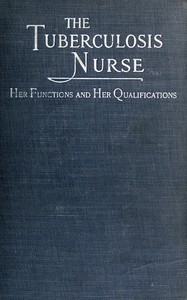
The Tuberculosis Nurse: Her Function and Her Qualifications A Handbook for Practical Workers in the Tuberculosis Campaign — A Reader’s Guide
(0 User reviews)
78
Project Gutenberg
2022
Not confirmed
Tuberculosis -- Nursing; Tuberculosis -- Nursing -- United States -- History
Readers of public-domain and historical texts
Project Gutenberg digital edition
en
Edition facts
Words
67,264
Reading time
293 min
Text sections
25
The Tuberculosis Nurse: Her Function and Her Qualifications A Handbook for Practical Workers in the Tuberculosis Campaign — A Reader’s Guide can be approached with a clearer sense of reading commitment from its source measurements: 67,264 words, 4 hr 53 min estimated reading time, and 25 detected text sections.
The text analysis averages about 23.2 words per sentence, while the detected sections provide another way to judge how the source is divided.
Project Gutenberg metadata also associates the work with “Tuberculosis -- Nursing,” connecting these edition facts with the source record’s subject description.
Source:
Project Gutenberg record #67640
A 1915 handbook by Ellen N. La Motte, a Johns Hopkins-trained nurse, detailing the practical role of tuberculosis nurses in early 20th-century public health campaigns. Focuses on home-based care, patient education, and dietary management for the urban poor, with an introduction by Dr. Louis Hamann.
Editorial Edition Score
4.9/5
★★★★★
★★★★★
Calculated from edition completeness, EPUB availability, text structure and catalogue metadata. Not a user rating.
How this score is calculated
- Description quality20 pts
- Title & short description10 pts
- Source metadata20 pts
- Text length15 pts
- Chapters / structure15 pts
- EPUB file integrity20 pts
Total of 100 points, scaled to a 2.5-5.0 range. Editions with an empty description or a missing EPUB file are not scored.
Edition quality
Read the Text
The Tuberculosis Nurse Her Function and Her Qualifications A Handbook for Practical Workers in the Tuberculosis Campaign
Ellen N. La Motte, R.N.
Graduate of Johns Hopkins Hospital; Former Nurse-in-Chief of the Tuberculosis Division, Health Department of Baltimore
Physician in Charge, Phipps Tuberculosis Dispensary, Johns Hopkins University
G. P. Putnam’s Sons New York and London =The Knickerbocker Press=
COPYRIGHT, 1915 BY ELLEN N. LA MOTTE
=The Knickerbocker Press, New York=
To tuberculosis, more than to any other infectious disease, the parable of the seed and the soil is strictly applicable. Without the tubercle bacillus there can be no tuberculosis, but for tuberculosis to develop, many factors of great complexity and as yet but little understood must facilitate the implantation of the bacillus and augment its growth. It is true that though we may emphasize the rôle of the bacillus, still we cannot completely ignore those personal factors that contribute to make the infection fruitful, and likewise though we focus our attention upon individual resistance, still we cannot keep out of sight the invader that is being resisted. The two viewpoints meet and run together, but are sufficiently separate to lead to different methods in our efforts to eradicate tuberculosis.
On the one hand are those who direct their efforts toward the annihilation of the tubercle bacillus. We are sufficiently instructed about the life history and habits of this organism to lay our plans upon a firm, scientific basis—a basis so firm and at first sight so simple and so plausible that over-enthusiasm led to predictions that have been sadly disappointed. The principles are sound indeed, but in practice their application has met with insuperable difficulties. These obstructions have sharpened our wits to find new avenues that now promise a more ready approach to the goal. To put the matter briefly, the tuberculosis campaign of the past fifteen years has taught us two important lessons: first, that the tuberculous cannot be isolated in their homes; second, that they cannot be cured in or out of sanatoria. I am shocked myself to read these bald statements, particularly the second, and still I am convinced that they are true. Some patients can be isolated in their homes, and many patients recover from tuberculosis and remain well. Tuberculosis is very amenable to treatment and under proper conditions the results of treatment are very gratifying. The difficulty is that the proper conditions are in most instances wanting, and when they are absent sanatorium recovery is almost invariably followed, after a brief period, by relapse. The records of cases with tubercle bacilli in the sputum establish this fact. Concerning the value of statistics of cases without tubercle bacilli in the sputum I entertain the gravest doubt. While I am heartily in favour of treating such patients, the personal equation enters too largely into the diagnosis to give the results convincing value as evidence of the lasting benefits of treatment. Experience has taught me that the educational value of sanatoria has been grossly exaggerated, and that this value is of small account in a broad plan of prevention. Our present knowledge, fortified by the costly experience of the past fifteen years, forces us to believe that the most direct and effective way of dealing with the tubercle bacillus is to isolate as many advanced consumptives as is possible. The hospital, perhaps supplemented by colonies, is the rational method of procedure. Other factors are of importance; all other factors are, but this is the fundamental and essential factor in the campaign.
Ellen N. La Motte's 1915 handbook opens with a stark admission from Dr. Louis Hamann's introduction: 'the tuberculous cannot be isolated in their homes; second, that they cannot be cured in or out of sanatoria.' This blunt assessment sets the tone for a manual that addresses the practical, often frustrating work of tuberculosis nursing among the urban poor. La Motte, a Johns Hopkins Hospital graduate and former nurse-in-chief of Baltimore's Tuberculosis Division, writes not from a sanitarium but from the tenement and the dispensary. Her focus is on the nurse as a teacher, a dietitian, and a persistent visitor in homes where poverty, ignorance, and overcrowding complicate every medical directive.
The Nurse as Dietitian and Household Instructor
La Motte devotes considerable attention to the nurse's role in reshaping family diets, distinguishing between food that 'merely fills the stomach' and food that 'nourishes and upbuilds.' She lists cabbage, turnips, doughnuts, and pies as cheap, indigestible staples among the poor, while advocating for meat, eggs, milk, rice, beans, hominy, and oatmeal—some of which, she notes, are no more expensive. The nurse must engage in 'exclusive as inclusive propaganda,' teaching families to avoid penny candies, enormous pickles, and strong tea and coffee. La Motte warns against excessive milk and eggs, which can cause indigestion—'one of the gravest and most distressing complications of tuberculosis.' She advises rest in a reclining position before and after meals, and offers alternatives like peptonized milk, junket, and flavored egg albumen for advanced patients.
Cooking and the Limits of Medical Authority
La Motte emphasizes that improper cooking can ruin wholesome food: a hard-boiled or fried egg is less digestible than a soft-boiled one; overcooked meat loses its value. She assumes her nurse-readers have training in dietetics, but acknowledges that in many homes 'dense ignorance of these important matters prevails.' The nurse must supervise not just what is eaten but how it is prepared. Yet La Motte also recognizes the doctor's authority: 'If a doctor is in attendance, he will of course arrange such diet as he thinks best, but if the nurse is left to herself, she will not overstep the boundaries.' This careful negotiation between professional expertise and hierarchical limits defines the nurse's daily work.
The Campaign's Uncomfortable Lessons
Hamann's introduction frames the entire handbook: the tuberculosis campaign's first fifteen years taught that isolation at home is impossible and that 'many patients recover from tuberculosis and remain well' despite the failure of sanatoria. La Motte's practical advice—on diet, cooking, rest, and patient education—operates within this sobering reality. She does not promise cures but offers incremental improvements: a glass of milk between meals, a soft-boiled egg, a patient lying flat after eating. The nurse is not a miracle worker but a persistent, knowledgeable presence in homes where the battle against tuberculosis is fought meal by meal, habit by habit.
Readers should approach this handbook as a primary document of early public health nursing, not as a clinical guide for modern practice. La Motte's voice is direct, unsentimental, and grounded in the material realities of poverty. Her emphasis on diet, digestion, and household education reveals the nurse's role as a mediator between medical science and the daily lives of patients. The book's value lies in its specific, practical observations and its unflinching acknowledgment of the limits of institutional care in 1915.
I remember my grandmother’s old nursing manuals, the faint smell of paper and starch, and how they made her work feel like quiet ritual. This 1915 handbook carries that same hush—less about cure, more about the steady, unsung watch over a sick room. Reading it, I thought of Sanitation in Panama — Inside the Classic, another era’s battle against invisible enemies, where diligence itself was the medicine.
There are no reviews for this eBook.
There are no comments for this eBook.
Reader reflection
Take a moment to reflect on this book
Create a short personal record of your experience with this book.
Your progress
0
/
10
2
How much did you enjoy the reading experience?
3
Would you recommend this book to another reader?
4
Did the language feel accessible?
5
Would this book work well in a reading group?
6
Which aspect of the book did you value most?
7
What did you think about the pace?
8
How distinctive were its ideas or approach?
9
What did this book teach you most?
10